Remixiferous

blogjune

… splendiferous remix …

Library Hack

Entries for the LibraryHack competition to remix data from Australian libraries have now closed. You can see them all on the Libraryhack Entries page . Prizes are announced 24 June.

I have two favourites so far.

1) The glorious image viewer is a physical installation that consists of three cylinders that rotate, displaying projected images from the library’s collection. This little movie tells you more about it: 3D Interactive projection image viewer .

2) Convictbook that displays using a Facebook-like interface information and photos of over 100 000 convicts from the State Library of Queensland’s Convict Transfer Register. The link above is to the entry page at LibraryHack, but you can see Convictbook  live here: Convictbook

Post number 4 for #blogjune 2011

YouTube Creative Commons Licensing

blogjune

As of today, YouTube will give users the ability to indicate during upload that they have licensed their movies under an Attribution 3.0 United States (CC BY 3.0) license.  Before now, the only way you could indicate that you were releasing under a Creative Commons license was to add an note to the credits.

There will be just one type of license that you can choose, although there are many other types of Creative Commons License available. This CC Licence means that you are allowing others to reuse your content as long as they give you credit in the way that is specified on the YouTube site. So people will be able to use your content for commercial gains and  to remix it however they want.

Further, the YouTube Editor has been altered to allow you to edit more than just your own videos.  You can now search for any items that have a Creative Commons license and reuse and remix them.

With only two licenses to choose from at upload, I wonder how this affects people who (like me) prefer to use another type of Creative Commons License? Following the link to the generic YouTube license, it says:

…you retain all of your ownership rights in your Content. However, by submitting Content to YouTube, you hereby grant YouTube a worldwide, non-exclusive, royalty-free, sublicenseable and transferable license to use, reproduce, distribute, prepare derivative works of, display, publish, adapt, make available online or electronically transmit, and perform the Content in connection with the Service and YouTube’s (and its successors’ and affiliates’) business, including without limitation for promoting and redistributing part or all of the Service (and derivative works thereof) in any media formats and through any media channels. You also hereby grant each user of the Service a non-exclusive license to access your Content through the Service, and to use, reproduce, distribute, display, publish, make available online or electronically transmit, and perform such Content as permitted through the functionality of the Service and under these Terms of Service. The above licenses granted by you in video Content you submit to the Service terminate within a commercially reasonable time after you remove or delete your videos from the Service. You understand and agree, however, that YouTube may retain, but not display, distribute, or perform, server copies of your videos that have been removed or deleted. The above licenses granted by you in user comments you submit are perpetual and irrevocable.

So – I am guessing that I can either:

  1. Keep my copyright and grant YouTube a license to reuse
  2. Keep my copyright and grant YouTube a license to reuse PLUS add my own Creative Commons Licence via the credits so people do not have to contact me to get permission for the reuse I specify
  3. License as a Attribution 3.0 United States (CC BY 3.0)

More information is available on the YouTube Creative Commons page.

Post number 3 for #blogjune 2011

Visual Aura or Migraine without the headache…

blogjune

Imagine you are getting ready to shower before work. Looking down you see something very ordinary like this:
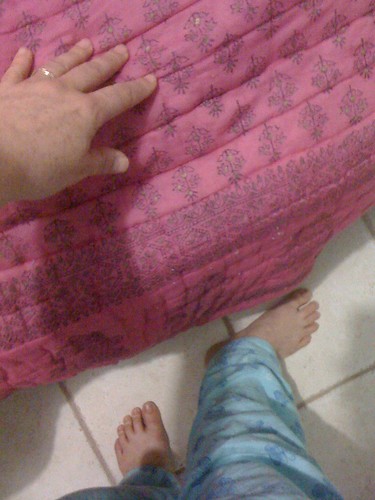
 

Within a minute, however, growing across your field of vision begins a flashing, zigzagging shape .  It covers most of the visual field, and over the next twenty minutes or so, it will drift toward the left side. About 15 minutes in, another one will appear in the centre, pushing the first one further left. It shimmies and moves about slightly.You cannot really look at it directly and it does not really obscure anything.

You feel your body go rather weak and you space out a little – words come, but they are slowly formed and very deliberate. By now you are concentrating on your breathing and trying to breathe evenly and slowly without hyperventilating. It is difficult – there is this freakish flashing thing dominating your vision.
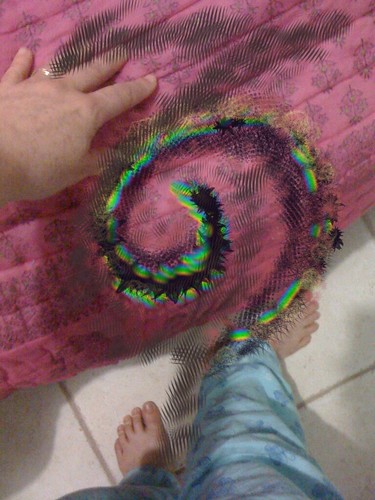
 

Shut one eye and it is still there. Look through that one with the other shut and the flashing thing stays. Even closing your eyes does not block it out. It just superimposes itself in colour against the darkness. It is like someone yelling loudly in your ear nonstop and not being able to turn your head away.

As it gets more intense and goes for longer than it ever has before, you phone the government help line, Healthdirect. With it getting worse, you decide to go to the hospital emergency department 10 minutes away. While dressing for this, you look up and notice that the aura has vanished – like a distant lawnmower cutting out without you noticing exactly when the sound stopped.

Not out of the woods yet though. When you look at the faces of your family, just the faces, they seem wrong. Almost like Picasso’s Weeping Woman. When you look closer and try to quantify or calibrate where the distortion is, each bit looks normal – but taken together the face just looks wrong. That only lasts for about 5 minutes.

That’s what happened to me this morning. The Emergency Department confirmed my G.P’s diagnosis – Migraine Aura or Visual Aura . Often people who get migraines have this kind of visual disturbance. It seems like I get the visual disturbance, feel weak and kind of spaced-out for a day, but do not get the terrible headache.

The first time it happened was after a parent died and the second time was  in the weeks after giving birth, 8 years ago.  It has not happened since. I was so glad to know the probable cause this morning, as the first couple of times was very, very scary. It is still scary , but knowing that I was neither having a stroke, about to have an epileptic fit nor going plain crazy was comforting. The facial metamorphosia was new, but maybe it was there before and I only noticed it this time.

Post number 2 for #blogjune 2011

Blog every day of June 2011. Let’s go

Uncategorized

Again this year I am participating in Blog Everyday Of June . Follow the link over to Libraries Interact to see who else has committed to making one post each day on their blogs this month.

This blog has had only 56 posts since June last year – about twice as many as I did for all of June 2010. Time to get noisy again.

Khazov, A. (2011). June iPhone Calendar 2011 - Rus. Retrieved from http://www.flickr.com/photos/45991448@N06/5759498818/

You can see below in reverse chronological order what I blogged about last June – my cat (by request), the new Grove Library, ebooks, using WordPress, the future of public libraries … sounds like me…

Post number 1 for #blogjune 2011

What libraries need to do to create mashable data – Libraryhack interview with Kathryn Greenhill

Uncategorized

Kate Davis talked to me via Skype last week as part of the the Libraryhack event around mashing up data from Australian State and National libraries.

In this little clip, I answer her questions about:

  1. Why is Open Data important ?
  2. What kinds of data should libraries be making open?
  3. What are the applications of mashups for libraries ?

For the applications of mashups, I talk a bit about getting data into the physical world, rather than just blending two digital sources that remain online. Examples would be pointing an iPad at a monument and seeing all of the library’s local history data about it, or pointing a smartphone at a book in a school library bookshelf and seeing how often it has been studied in classes and how previous students rated the book.

I then go on to talk about what libraries need to ensure to make our data really useful for mashing up. My points were:

  1. Collect enough useful information initially
  2. Store it in a standardised format
  3. Work toward a permanent URL for each data object – an authoritative “anchor point” for further remix
  4. Ensure useful reuse rights
  5. Endeavour to complement and complete the collection of data to make it comprehensive
  6. Provide easy access for those who want to contribute data
  7. Provide an alternative open platform to closed publishing sources
  8. Allow live API access to data if at all possible
  9. Actively insert mass batches of data outside the library website (eg. SLQ photos in Wikipedia) but work out how to ensure funders know this service is happening
  10. Anticipate possible future use cases

And …. here it is , LibraryHack interview with Kathryn Greenhill .

What is a library? What do librarians do?

Uncategorized

… There is NO one-size-fits all answer …

Back at the ALIA Information Online Conference in February, I asked a bunch of librarians around the breakfast table what they thought a library was and what librarians do. They all had different answers. Some involved dead cats. Some librarians also shared what they think new librarians need to know.

I made this little movie partly to share with students in my Introduction to Libraries unit. What comes out to me is how flexible librarians need to be and how enthused most of the librarians are about what they do – even if they all explain it rather differently …

Thank you to: Amy, Ruth, Con, Naomi, Peter, Kate, Andrew, Bonnie, Lucinda, Kim and Sophie.

This was shot using a Zoom Q3. I like the audio it produced, which is why I bought it. Most of the movie is black and white, however, because it could not cope with the dim light in the ballroom… so it was either some with bright orange faces or everyone with black and white…

What is a library? What do librarians do?

All of us, smarter than any of us. So let’s share.

Uncategorized

A couple of days ago, I added to my Twitter profile the phrase “all of us are smarter than any of us”. I seem to say it over and over to students. It is really the backbone idea around many of the things about which I am passionate – Open Source, unconferences, personal learning networks and libraries.

Wikipedia works because enough people care and put in time and effort to make something with authority. Pushing for an “Australian content only” site separate from Wikipedia would just not work. There is not critical mass to maintain it and more people would search Wikipedia first.

What if we had something similar in libraryland? We already do. I suggest that if we get behind the efforts below and read, comment and engage, we will make our own library lives easier. I would love to see Australian library folk adding Australian-based content to these sources.


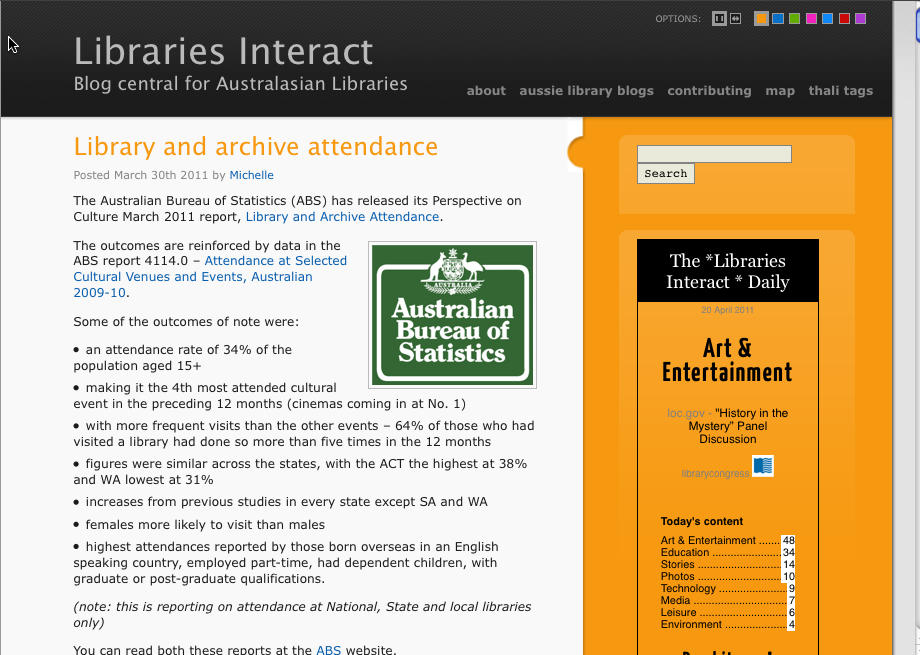
Libraries Interact: blog central for Australasian Libraries . Started in 2006 by a group of Australian library bloggers. Anyone can join up and submit a blog post as long as it is relevant to libraries and Australasia.


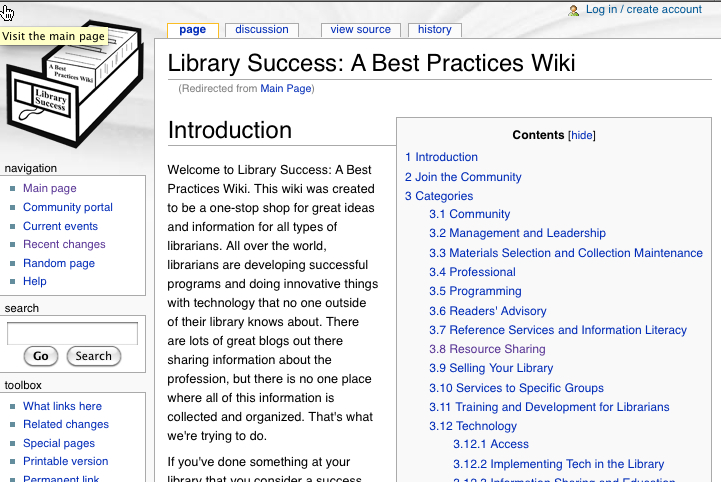
Library Success: a best practices wiki .  Originally created by librarian Meredith Farkas. The Grand Dame of collaborative libraryland sharing that details ways that libraries have done things well. It is looking a bit tired at the moment, but pages like the Mobile Libraries page are still being updated. I wonder whether it would make a good student project for someone to research and update the topics? And for another to run a social media campaign to encourage people to contribute?

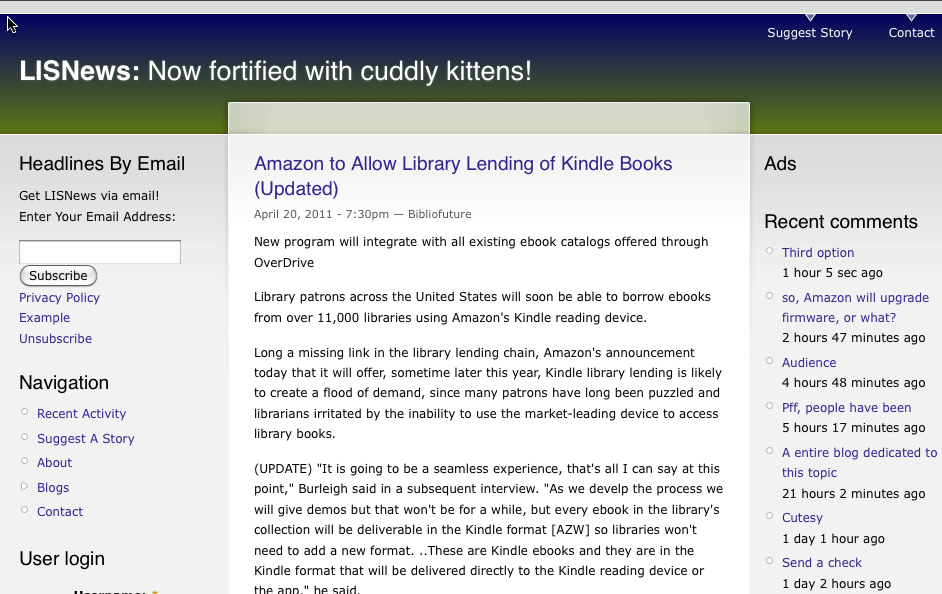
LISNews . Created by librarian Blake Carver in 1999 . Publishes news stories about libraries from around the world. A great way to find out who is doing what, and how what we do is regarded by other people. You can very easily contribute by suggesting a story . (And if you want to kill a couple of seconds in a very amusing way, check in every so often and watch the site tagline change …I believe that no kittens were injured in the production of the latest tagline)

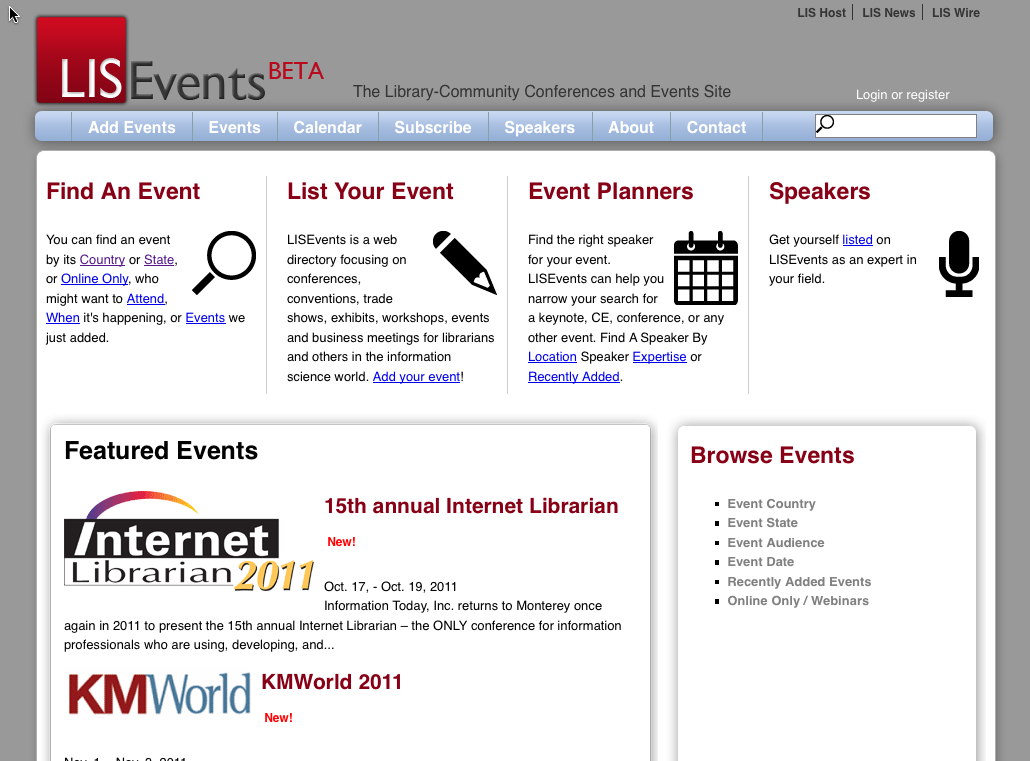
LISEvents This aims to be a “library community conferences and events site”.  It is another Blake Carver brainchild. It was launched earlier in the week and so far there is just one Australian entry. Adding an entry is easy.  Something like this could become a great directory for Australian library events. There is also a “speakers” section where you can find someone who can talk about a particular topic or add your own details


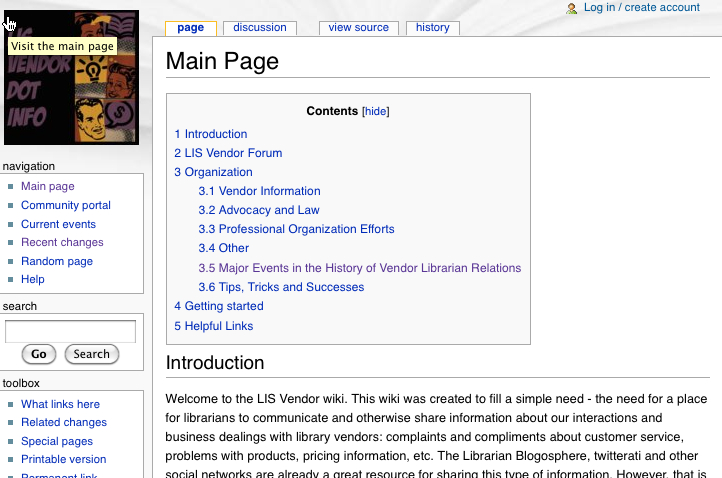
LISVendor Created by law librarian, Sarah Glassmeyer. This wiki is self-described as  “a place for librarians to communicate and otherwise share information about our interactions and business dealings with library vendors: complaints and compliments about customer service, problems with products, pricing information, etc.”.

And … not really open contribution … . You can suggest ideas for blog posts in their Contributor Interest Form.   I think the profession would benefit if we engaged with what is being said here and through comments …

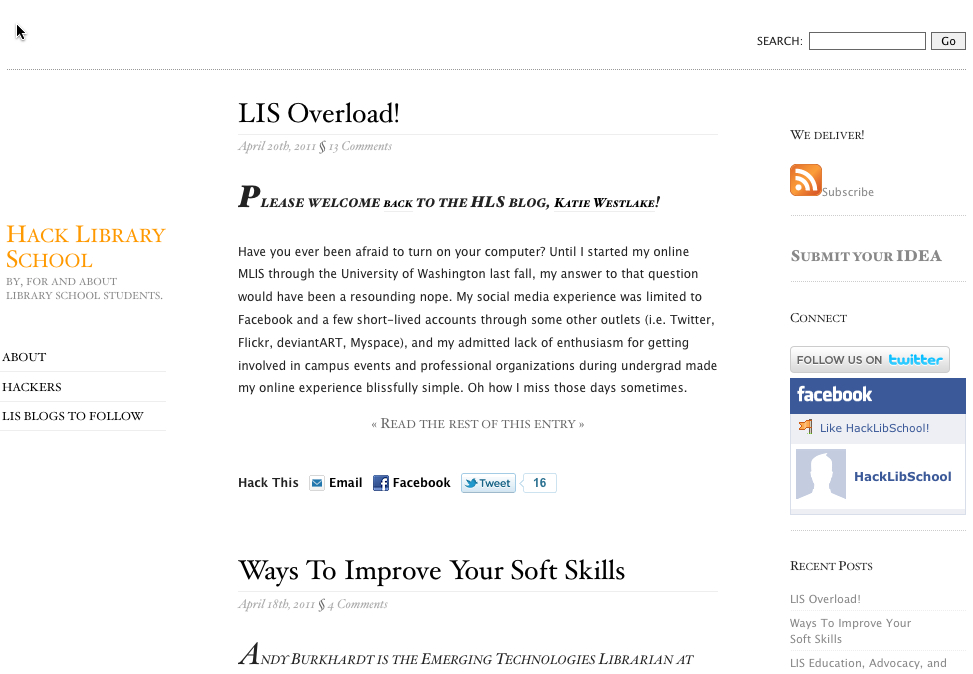
Hack Library School A collaborative blog by library students where they share not only the library school experience, but how that can be made better.


So…. are there other sources that I have missed?

Library Hack event at State Library of Western Australia: CoverItLive

Uncategorized

I am tweeting today from the State Library of Western Australia’s Day of Hack event. The event hashtag is #libhackwa . I am pulling these tweets and those from @libsmatter into a CoverItLive window below.

Here is a description of the event:

The national Libraryhack competition invites people to create mashups and apps using publicly available and reusable data. Re-mix library datasets and create new content, or re-purpose them and build new apps, and be in the running to win a great prize. The datasets for use can be found at: http://libraryhack.org/data/

Come to the State Library for a taster session and start thinking about what you might create to be able to enter the national competition. We’ll have mashing experts and specialists from the Australian Web Industry Association on hand to help you navigate your way through the wealth of info released for mashups.

The National and State Libraries of Australasia’s Reimagining Libraries initiative has a vision to:

In collaboration, the National, State and Territory Libraries of Australia and New Zealand will become leaders in empowering people to create, discover, use and transform our collections, content and global information resources.

There are ten separate projects to achieve this vision. Project number 5, lead by the State Library of Queensland, is described as:

Community created content – identifying and implementing a framework and tool set for everyone to create and transform online content

One element of this project in the Library Hack initiative. Anna Raunik from the State Library presented a paper at the recent ALIA Information Online Conference that explained the ideas and implementation of the project in the LibraryHack project.

Raunik, A. (2011). Reuse, recycle, reinvent.. new ways to use library data. Presented at the Information Online: ALIA 15th Conference and Exhibition, Sydney, Australia: Australian Library and Information Association. Retrieved from http://www.information-online.com.au/sb_clients/iog/bin/iog_programme_2011_A5.cfm?vm_key=64A5AF30-1422-0982-EB1CFB070F532D42

Here’s the CoverItLive window:

CoverItLive Public Libraries Western Australia Conference

Uncategorized

I am live tweeting the Public Libraries of Western Australia here in Fremantle today from my blogging twitter account, @libsmatter . I am chairing the keynote session and then co-facilitating a session with Cindi Trainor and John Blyberg in the afternoon.

I hope that Twitter’s recent dummy spit of not allowing 3rd party clients to use APIs has not affected CoverItLive too. I suspect not, because CiL does other things than just deal with Twitter, so it should be fine. If I find that feeds from Twitter are not being fed in, then I will change to the Cover It Live window in the middle of the event.

The window is pulling in tweets from @libsmatter and anything with the conference hashtag #plwaconf .

Here is the CoverItLive window:


Content machine, jumping fish and conferences coming up…

Uncategorized

CONTENT MACHINE

I am creating content, content, content for my work at the moment, so I am afraid I am not talking as much here. Technology for information management, and the history of libraries and what managers do in a public library are all ajumble in my head this week and being spat out into lecture notes and live lectures and screencasts and workshops.

Petrucenia, A. (2010). . Retrieved from http://www.flickr.com/photos/andriuxuk/4427753474/

Yes – I am enjoying my job. Discussion in the second hour of a workshop yesterday was everything one hopes university can offer to students (and tutors). Times like this make it worthwhile.

JUMPING FISH

And I had an amazing sunset snorkle at Cottesloe Beach that night – with silhouettes of fish jumping over orange tinged water while the moon rose over the shore. I could put my head under the water and swim through metres and metres of tiny fish then look up and see them jumping above the water.

CONFERENCES

PLWA

I am looking forward to co-presenting (and hanging out with) John Blyberg and Cindi Trainor at the Public Libraries Western Australia Biennial conference on April 1 in Fremantle. They are both American Library Journal Movers and Shakers and have damn fine library brains. Registrations close tomorrow. I have attended the last two conferences and  although I was looking forward to seeing some of the speakers that I knew, I found that there were several “dark horse” speakers who I learned a lot from. Maybe I just chose sessions well, but it is one of the *very* few conferences where every session was enlightening and interesting.

We are doing an “interactive session” about the Darien Statements and why it is useful to think about what the core of librarianship is for you. What do we mean by “interactive session”? – we will all find out together on the day…

NEW LIBRARIANS’ SYMPOSIUM

I am taking it as a sign of faith in my ability to make people want to get out of bed that I am keynoting this conference in Perth on the last day. On a Sunday. First thing in the morning. The morning after the conference dinner.  18 September 2011. The excellent Kate Davis and Mal Booth will be speaking in the days before me – and David Lee King in the afternoon. All these things make me really, really, really eager to do a great job.

The title of my talk will be “The Hidden Rulebook: building bridges instead of hitting brick walls”.

NATIONAL LIBRARY CAMP

This event is Monday after New Librarians’ Symposium, 19 September 2011. Many people at NLS will be staying for this. It will be exciting and fun and we will all laugh and learn. I can promise that much. Much more? I do not know. Registrations open soon.

Off to churn, churn, churn …