100 articles that every librarian should read

blogjune

Over at Ruminations, Con is thinking about a link that she retweeted today from  @clairebrooks entitled 100 Articles that Every Journalist Should Read.

Con is riffing on this and wonders whether collaboratively we can get together 100 articles that you would:

recommend to anyone working in a library, who is thinking about the future of libraries and their role in building this future?

I have my own list of articles that I think all librarians should read – well those that are interested in the same things as me, anyhow. Some are there because they offer a perspective from outside the library echo-chamber, some are there because they represent large-scale research that breaks away from the “how we done it good” that characterizes much library literature. Some are toolkits for equity of access.  Most items are on it because they are a good read by themselves – clear, logical and interesting writing that makes me think of more questions, rather than feel like I have just read all the answers.

Strahl, P. (2011). Thumbs-up Conny. Retrieved from http://www.flickr.com/photos/strahl/5723899741/

I see very little literature on my list about management or philosophies of librarianship. There is little about taxonomy, cataloguing, corporate librarianship and knowledge management. I guess they are outside my interests.

My list has an Australian slant, and leans toward:

  • equity of access to information and library resources
  • the impact on libraries of shared data on the internet
  • how library users find research information
  • format changes – the rise of online video, ebooks, transliteracy and DRM
  • how librarians and libraries are preparing for the future

I have created a Zotero group for sharing articles that people recommend, 100 articles every librarian should read . The library of references is here, 100 articles that every librarian should read library .It is public, so anyone can look at it. Some of my links go through my university library’s link resolver, but it is easy to work out what they should be.  If  you have (or make!) a Zotero account, then you can add your own candidates. We can then pare them down to just 100. If you are blogging this or want to contribute to the list in another way, please pop over to Con’s post Day 14 #blogjune Library Futures Reading List and leave a comment there.

So – I have around 40 items on my list. I am sure that only about a quarter of them would make it to a definitive list of “must reads” for EVERY librarian. What would you keep? What is missing?

MY LIST OF MUST-READS FOR LIBRARIANS

I have asterisked *** those that I think you should read RIGHT NOW. 

  • Berners-Lee, T., Hendler, J., & Lassila, O. (2001). The semantic Web: a new form of Web content that is meaningful to computers will unleash a revolution of new possibilities. Scientific American, 284(5), 34.
  • Gow, V., Brown, L., Johnston, C., Neale, A., Paynter, G., & Rigby, F. (2009). Making New Zealand Content Easier to Find, Share and Use. Museums and the Web 2009. Presented at the Museums and the Web 2009, Toronto: Archives & Museum Informatics,. Retrieved from http://www.archimuse.com/mw2009/papers/gow/gow.html
  • Holland, M. (1997). Diffusion of innovation theories and their relevance to understanding the role of librarians when introducing users to networked information. The Electronic Library, 15(5), 389-394. doi:10.1108/eb045587
  • King, D. L. (2009). What is a Digital Branch, Anyway? Building the Digital Branch: Guidelines for Transforming Your Library Website, Library Technology Reports, 45(6), 5-9.
  • Levine, R., Locke, C., Searles, D., Weinberger, D., & McKee, J. (1999). The Cluetrain Manifesto. Retrieved April 29, 2011, from http://www.cluetrain.com/
  • Morville, P. (2005). Information Interaction. Ambient Findability (pp. 43-63). O’Reilly Media, Inc.
  • Oldenburg, R. (1999). The Great Good Place: Cafes, Coffee Shops, Bookstores, Bars, Hair Salons, and Other Hangouts at the Heart of a Community (3rd ed.). Da Capo Press.


Post number 15 for #blogjune 2011. Half way there!!!!
Tools for teaching coding to kids

blogjune

Every month or so, a few questions niggle me:

  • Should I learn more about how to code (write and modify computer programs) ?
  • Should I be teaching my kids more about coding ?
  • Should I add a little more coding to the course I am teaching?

The answers are, I think:

  • Definitely
  • Yes
  • Probably

On the weekend, an article appeared on the “Click” section of the BBCTV site suggesting that the British education system is not creating the programmers needed by the  large video game production sector. The analogy was that by teaching kids how to use (but not to create) programs, the education system is doing the equivalent to teaching them how to read without knowing how to write. This was seen as a problem for any “business that has computer technology at its core”.

Hudson, A. (2011, June 4). Are children becoming ‘digitally illiterate’? BBC. Retrieved from http://news.bbc.co.uk/2/mobile/programmes/click_online/9503255.stm


I would love to see sessions in libraries aimed at teaching kids how to code – especially girls. One can dream.


So – if you want to teach your kids to code, what are some options?


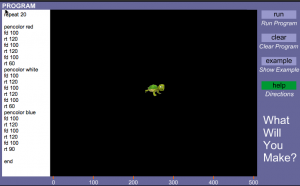
1.  Logo – This is both a philosophy of teaching coding plus the language to do it.  It was developed by Samuel Papert and Wally Feurzig in the late 1960s. At its simplest, it involves writing commands to move a cursor (often in the shape of a turtle) around the screen. It comes pre-installed on the One Laptop Per Child laptops. More information on the Logo Foundation Site . For a really simple example, check out this little game at the Math Playground that allows you to see how various commands move the Turtle around the screen.


2. Scratch – Developed at MIT and aimed at 6 – 16 year olds. One can drag and drop elements on to a panel to quickly combine them. Many of the variables can be altered in each box. More information at the Scratch site. Check out the “Featured projects” page to see what students have made.


3. Kodu . This is available at not cost from from Microsoft and can be used on an Xbox 360 or downloaded to a PC. It lets kids create complete gaming worlds, with many of the hard bits pre-made. My little guys have tried this out – creating a game where one had to catch apples from a tree. I seem to remember the apples then following you and exploding – but I could be making that bit up… You can see more at the Kodu site .


4. Raspberry Pi . Coming at the end of 2011, this is a complete computing system on a USB stick. It is aimed at providing a setup that any kid can use to learn basic programming. It should cost around 15 British Pounds. More information at the Raspberry Pi Foundation.


Post number 14 for #blogjune 2011

Oh – the indignity!

blogjune


Nougat chewed one of her stitches out, so she is in the collar-of-shame around the clock.  She still gets to snuggle in our bed.

One of the skin lumps turned out to be a squamous cell carcinoma, but the vet thinks they managed to remove it all.

Nougat still has her head tipped to the right and is falling over but is becoming more vocal each day – back to her old chatty self.


Post number 13 for #blogjune 2011

Balancing: Kids in the Kitchen

blogjune

“I’m so postmodern I make my muffins out of milkshakes” … so sings Mr8 tonight…

We are teaching our boys to cook. Every Sunday is “Kids in the Kitchen” when they cook dinner. The week before, they plan the meal and work out what ingredients they will need and arrange their shopping list for our weekly grocery shop.  They go to the Farmers’ Markets on Sunday mornings and buy any fresh ingredients they will need. One parent is on cooking duty for the weekend, so works with the kids to plan what they need to do and help them cook it. Bit by bit the kids are making more decisions and doing more meal preparation each time.

Somehow it has evolved into one kid doing the main meal and the other doing dessert.

Mr8 wanted me to blog the recipe for our Milkshake Muffins. We make a fantastic lunchtime banana smoothie that includes dates, sunflower seeds, walnuts, yoghurt and Milo. Two days ago we speculated whether we could use it as the basis of muffins, so tonight was experiment night.

The world’s best muffin recipe book is Esther Brody’s 500 Best Muffin Recipes , so we adapted her Banana Bran Muffins on p.28. Actually only 5 ingredients are the same… All measurements are metric.

Postmodern Milkshake Muffins

Makes 30 – 36 muffins

  • 1/2 cup granulated sugar
  • 1/2 cup brown sugar
  • 1 cup olive oil
  • 3 eggs
  • 2 TBSP Milo
  • 1 1/2 cup mashed banana
  • 1 1/2 cup milk
  • 1/2 cup plain yoghurt
  • 1 1/2 cup instant oats
  • 1/2 cup dates unchopped
  • 1/2 cup dates chopped
  • 1/2 cup walnuts unchopped
  • 1/2 cup walnuts chopped
  • 1/2 cup sunflower seeds
  • 2 cups white plain flour
  • 1 cup wholemeal plain flour
  • 3 tsp baking powder
  • 3 tsp baking soda
  • 1 tsp salt
  1. Grease three muffin trays
  2. Preheat oven to 190 degrees C (350 degrees F)
  3. Combine granulated sugar, brown sugar and oil in a bowl.
  4. Beat in eggs, one at a time.
  5. Use a foodprocessor to combine the 1/2 cup unchopped dates, 1/2 cup unchopped walnuts, banana, milk, yoghurt, sunflower seeds and Milo.
  6. Add the milkshake mixture to the egg/sugar mixture.
  7. Add the oats
  8. In another bowl combine the flour, baking powder, baking soda and salt. Add to the banana mixture; stir until ingredients are just mixed. Do not overmix. Fold in chopped dates and walnuts.
  9. Spoon batter into prepared muffin tin, filling to the top.
  10. Bake in preheated oven for 15 to 20 minutes.

The “Postmodern” in the title comes courtesy of Amanda Palmer and Neil Gaiman programming Rage on ABCTV today and playing the Bedroom Philosopher’s I’m So Postmodern this morning. It is a little odd to hear our two boys running about the house singing “I’m So Postmodern …”:

Post number 12 for #blogjune 2011

Gamestorming, and increasing the quality of the question …

blogjune

If you have a spare moment, check out the work of Dave Gray.

Did you know 4.0

Dave harnesses his talent for visual thinking to creatively approach familiar problems and concepts in new ways. He founded a company called XPLANE. If the name sounds familiar, they are behind this movie about statistics around media convergence – you know, the one that tells you that there are 2 million TV sets in bathrooms in the USA:

Did You Know 4.0. (2009). Retrieved from http://www.youtube.com/watch?v=6ILQrUrEWe8

Gamestorming

You may have heard people raving about his latest book, Gamestorming: a playbook for innovators, rulebreakers and changemakers , co-written with Sunni Brown and James Macanufo. It details a number of thinking games to use with large groups of people to clarify ideas and find solutions. For anyone who has worked with improv theatre or even had any kind of hippy-ish grassroots organisation involvement, many of the techniques will be very familiar. The “button” exercise, for example is just an updating of the “talking stick” idea. There is a lot of sticking postit notes on butchers paper on walls like people sometimes do when deciding topics at the start of an unconference. The analysis of the types of thinking at the start is interesting. Do you want to narrow down ideas (convergent thinking) or generate lots more (divergent thinking)? Do you want to find consensus? Do you want to find relationships between ideas? Group like ideas and concepts to create nodes in a system? There is even a four page guide to drawing people at the start, as many of the exercises involve drawings to get people thinking or in response to ideas – and if you are communicating with people, then you will be drawing people..

It looks to be aimed at rather staid and traditional organisations, with a “look, you can fire up your workers just like those wacky kids at Google!” sort of delivery, but with serious business language and examples. It has hit its target market well and, from the regular search I have set up on the word #gamestorming on Twitter,  groups of people seem to be enjoying using the techniques in it.

The book is definitely worth reading and I would LOVE to get use some of the techniques with a group of librarians who want to stem the ebook menace / have free information literacy for all / easily expose as much as their local content as possible / collectively create a super professional development series / make our funding bodies increase our budgets by 10% / work out how to work best with museums and galleries and broadcasters / take over the world – or whatever else a whole bunch of smart and motivated librarians are capable of doing when they unleash their energy and superpowers in a channeled way…

Q-Tools

If Gamestorming sounds a little too involved, if you at all work in any kind of library, you should check out Dave’s post,Q-tools: An approach for discovery and knowledge work. It looks at different ways of classifying and refining questions. It is almost upside-down from the traditional approach of libraries, where we created taxonomies and classification schema for our “just in case” collections that were aimed at organising our potential answers.

The post looks at ways to create more effective questions in a world of indexed full-text and keyword-searchable “just in time” information online. This is like a taxonomy to use to classify and analyse the question you use to filter the information. The analysis is by methodology, how you want the answer sorted and refined technically – rather than the traditional “reference interview” types of questions that focus more on refining the subject and purpose of an information enquiry aimed at a single solution.

Here are his different types of questions. It is worth looking at the longer explanations and diagrams in the post.

  1. A prism is a question that divides information into smaller groups.
  2. A razor is a question that divides information into two categories, based on relevance.
  3. A generator is a question that has a potentially unlimited number of answers.
  4. A peeler is a single question that, when repeated, drives attention to deeper and deeper levels, like the peeling of an onion.
  5. A flanker is a question that seeks patterns or ideas that are similar. The purpose of a flanker is to think laterally and find an analogous situation that may help you think about things differently.
  6. A splicer is a question that combines information, or sets, into groups. The purpose of a splicer is to find larger categories and simplify collections of information.
  7. A pointer is a question that has a well-defined or broadly agreed-upon answer, or set of answers. The purpose of a pointer is to gather specific information, for example: “What is your name?”

Post number 11 for #blogjune 2011

A #blogjune posting request – please blow your trumpet ! Bah-Bow

blogjune

Please tell me – What are you doing well professionally or in your library ?

This post was started on Thursday and finished on Friday, so I will count it as a post for both days 🙂

This one was inspired by Teresa Bennet’s  post about Sparkling with Confidence and by Jeff Cruz’ post today on the ALIA Sydney blog , Open Access vs. Cultural Protocols: Indigenous Knowledge Management …. so inspiring in fact that instead of going straight to sleep after turning in for the night, I have fired up my laptop while snuggling under the covers.

Brown, G. (2011). Trumpets. Retrieved from http://www.flickr.com/photos/gsbrown99/5777438271/

Teresa went to an event last week where Rachel Green was a guest speaker. One of her takeaways was that by sharing our strengths we can contribute, so doing this is not negative or boasting…and then today…

Jeff discussed the protocols around access to indigenous knowledge and looked at how curation agencies can sensitively respect this with their digitized information – arguing that indiscriminate Open Access to information applied without cultural sensitivity is not useful. I don’t think anyone would disagree. I also do not think that Open Access ever meant Open Slather …

It is a very useful discussion – made even more useful for something that is happening in my workplace by the mention of the Mukurtu project . This is a method for providing tiered access to indigenous information according to who is enquiring and whether they have a cultural right to access the information. It provides both a metadata schema to store information about the cultural status of  a digital object, as well as rights of access. It will be downloadable for people who want to tinker with it in Spring 2011 , but I can see from the site that it looks like basically a Drupal installation with a particular set of plugins and pre-configuration… which makes it both very flexible and very easy to adapt and use…

As I sent a link to this to someone else who may be interested, it occurred to me that I only found out about this due to the #blogjune project. The post only existed due to #blogjune. What we have is not only a bunch of librarians blogging about their cats and food and things that scare them, but an outburst of professional conversation as well … Already there have been some excellent professional posts on the Sydney ALIA blog – props to Katrina and co. for arranging this – but also:

I know that everyone does not have a cool prezi up their sleeves … but I would like to know, would love to hear more library bloggers sharing their strengths – boasting even, I don’t mind. I will bet that something that you do well professionally that you think is rather ordinary actually would be mindblowing to other library folk.

I am constantly impressed when I go to conferences at the everyday projects that libraries are doing, but often we do not get to hear about. One of the most memorable was from a couple of librarians at Batchelor College in Darwin talking about how they “non project managed” the transformation of a cluttered space into a flexible and culturally sensitive learning space. I am not necessarily thinking of clever Library Week events – it could be something very simple.

BAH-BOW!

I’ll start. I should leave this tomorrow, but it is a really simple thing. When I was at the Grove, we had self-checkout PCs that used to make an high pitched alert sound when a user did something wrong like try to issue an item already on loan to someone else. People constantly ignored it and staff were not wonderful at hearing the sound either. At a staff meeting after brainstorming, we decided to try the “wrong answer” noise from the old game show, Family Feud. Luckily the Bah-Bow! sound could be downloaded from the Internet Archive , so we did so, made that the new alert sound for the self check units and suddenly users were paying attention when the selfcheck needed their attention…

… so #blogjune bloggers, what is a strength that you have professionally or do well in your library?

Post number 9 and 10 for #blogjune 2011


An update on my cat

blogjune

I couldn’t post about having a sick cat without posting an update when I knew more.

Over the weekend Nougat perked up a bit and was less lethargic, which means that she was even wobblier as she tried to do more. She was eating like a horse – which she usually does to create extra body-heat to compensate for having so little fur.

Nougat had an anaesthetic and a full body x-ray yesterday. There was nothing nasty found in her spine or hips. Her right inner-ear however is full of yukky stuff that showed up on the x-ray as a white swollen mass behind her eardrum. This is sort of good news, as when there is not an obvious problem in one side like an ear infection, this kind of balance loss is usually caused by something central – often a brain tumour.

The treatment is either very strong drugs or getting the eardrum punctured by a specialist who then taks a biopsy and cleans out the yuck. She has been sick on and off with this for eight months – so sick that we did not think she would get through it twice –  so we are going to give her time to recover and then probably go for the operation.

She had a couple of old-cat skin lesions removed at the same time as the x-ray, so has 16 stitches at the moment – eight under her right foreleg and eight just above her tail on her back. We have three different medications to give her – one liquid that must be taken with food once a day, a pill twice a day and another liquid that we gave her for the first time when she returned from the vet. We have another ten days of this one, which has the side-effect of making her foam at the mouth and call up her Cat Mafia friends to take out a contract on her owners…. We also have to wash out her ear with a special ear wash for the next 10 days.

Thanks to modern veterinary science, as well as a showbag of medications, we also took home a CD with Nougat’s x-rays on it… not sure how I feel about that…in fact I feel almost like I am invading her privacy by putting the image above here…

We just need to get her through the next few days without splitting her stitches or splattering herself on the tiles. She has already tried to jump up on to a desk, missed her footing and landed flat on her back right where her stitches are. Luckily someone will be with her for the rest of the week. I do not think she will enjoy the collar of shame that the vet gave us for her to wear when noone else is around.

Post number 8 for #blogjune 2011

Balancing, and not being Pollyanna

blogjune

I saw a tweet yesterday asking how people with kids manage to get anything done.

The answer in my case – “with compromise on how I do almost everything and feeling very tired much of the time”.

This is one of the reasons I do not blog every day. Some days – most days – that is about as much as I can come up with in the insightful and/or interesting department.

There is no rule that says that this blogging space needs to be positive and interesting…except…except.. that is how I mainly want it to be.

I spend a lot of time researching most posts, providing links to follow for further information. About twice a month over the last five years I have looked back to my blog to confirm a factette or find the name of some useful tool that I wanted to use. The CoverItLive sessions that I put here have been very useful to me to follow up something that I did not have time to think about at the time of the event. I want this space to be useful in that way.

I want this space to be somewhere that I feel OK revisiting and as a record of my thoughts, much more than a record of how I am feeling or what I am doing generally. I definitely don’t want a whole bunch of posts with a light touch and positive spin that do not really reflect where my mind is at the moment – just for the sake of writing every day.

… And there is the challenge with this #blogjune exercise. I cannot daily write the types of posts that I usually like to write. It takes more time than I have. I feel like I am diluting my usual blogging style and my blog. If I am spending my time feeling tired and like I am pulled in one thousand directions, I don’t really want to write about it here. I already KNOW that this is how it feels for me much of the time. I am sure that most other people do too. Some days though – most days – that’s all I’ve got.

Post number 7 in #blogjune

How to pass units that I teach – and thinking about fairness and kindness

blogjune

After two semesters of being a unit coordinator at university, I am sharing secret insider knowledge about how to pass the units I teach.

  1. Read the unit outline
  2. Clarify what you do not understand
  3. Do what the unit outline says, when it says to do it

And here is the secret how to do very well in the units I teach:

  1. Read the unit outline
  2. Clarify what you do not understand – and support classmates
  3. Do what the unit outline says to a high standard, when it says to do it

I am seeing three kinds of students:

  1. Clever, organised students. They do very well.
  2. Not so clever, organised students. They pass.
  3. Clever, disorganised students. Some pass, barely. Most do not.

Students in the last category are hard to watch as they make their way through semester. I am learning to be much, much clearer with expectations – even to the extent of pedantic silliness, spelling out requirements in a way that must make students in the first two categories want to say “duh! – please don’t patronise us”.

It is so hard to balance fairness to all students. There are students who without making any fuss spend their time ensuring that they are within word limits, learn how to reference correctly, write in a scholarly manner, answer what a question asks in the way it asks for, ask if they need an extension before an assignment is due, demonstrate that they have read the required readings and offer support to their fellow students. I want to honour their efforts and take their efforts as seriously as they do. I also want to be kind to everyone.

Some of the hardest students to watch are those who are disorganised because they have too much else going on in their lives. I know that divorces, health issues, having to work to eat and supporting family members in crisis can affect studies. I also know that there are students who withdraw or do not take up studies when these things are going on in their lives because they accept that they could not study well.

I think it takes more than two semesters to get the right balance of fairness and kindness. I wonder, also, if it is possible at all…

But, the three steps to pass at the start of this post? I know that they do work…

Post number 6 for #blogjune 2011

Unexpectedly about my cat

blogjune

Our 15 year old Cornish Rex, Nougat, has been very under the weather for a few days. She keeps losing her balance, mainly in her back legs. This is an update for folks on Twitter who have been so supportive and asking about her.

She does not quite remember that she has the problem, so we are constantly with her in case she tries to jump up to the places that she can usually reach easily. Or goes headfirst into her food bowl. Stewart even saw her fall straight to the ground twice as she sat dozing in the sun.

She has had ear infections for the last 8 months, but also increasing problems coordinating her back legs. She goes in for a general anesthetic in two days to take x-rays and generally poke about to see whether it is an ear problem or something more sinister like a brain tumour.

In the meantime, we are cuddling her all that we can, and annoying the heck out of her by following her about as she tries to walk. We think it is better that she keeps moving, even if we have to catch her, than if we carry her everywhere. She had a shot of antibiotic and another of prednisolone last night at the vet. We are giving her further antibiotics as pills and a syrup of prednisolone each day – not fun when she is wobbly and trying to escape. We have to hold her very tight.

You can see pictures of her as a kitten playing in Christmas decorations plus the story so far in  A post about my cat , which I did by request last #blogjune.

Hopefully within a few weeks she will be back to leaping unexpectedly for my icecream. Hopefully.

Post number 5 for #blogjune 2011