Horizon Report 2011

Uncategorized

The New Media Consortium/ Educause have released their annual Horizon Report that identifies and describes emerging technologies likely to have a large impact over the coming five years  on and use in teaching, learning, and creative inquiry.

Johnson, L., Smith, R., Willis, H., Levine, A., & Haywood, K. (2011). The 2011 Horizon Report. Austin, Texas: New Media Consortium. Retrieved from http://net.educause.edu/ir/library/pdf/HR2011.pdf

This years’ trends are:

Time-to-adoption One Year or Less:

  • • Electronic Books
  • • Mobiles

Time-to-adoption Two to Three Years:

  • • Augmented Reality
  • • Game-based Learning

Time-to-adoption Four to Five Years:

  • • Gesture-based computing
  • • Learning Analytics

The “key trends” and “critical challenges” at the start are often more interesting.

Key Trends:

  • • The abundance of resources and relationships made easily accessible via the Internet is increasingly challenging us to revisit our roles as educators in sense-making, coaching, and credentialing.
  • • People expect to be able to work, learn, and study whenever and wherever they want.
  • • The world of work is increasingly collaborative, giving rise to reflection about the way student projects are structured.
  • • The technologies we use are increasingly cloud-based, and our notions of IT support are decentralized.

Critical Challenges:

  • • Digital media literacy continues its rise in importance as a key skill in every discipline and profession.
  • • Appropriate metrics of evaluation lag behind the emergence of new scholarly forms of authoring, publishing, and researching.
  • • Economic pressures and new models of education are presenting unprecedented competition to traditional models of the university.
  • • Keeping pace with the rapid proliferation of information, software tools, and devices is challenging for students and teachers alike.

Who would feel OK asking libraries for money?

Uncategorized

… authors I hope…but we need to make it so…

File this one under “trends to watch out for” – or probably “trends that will steamroller us if we have not understood their effects by now”. We should be watching musicians for clues about how the change from physical to online,electronic, pirateable content affects an industry. What they are doing now may happen for authors within two years.
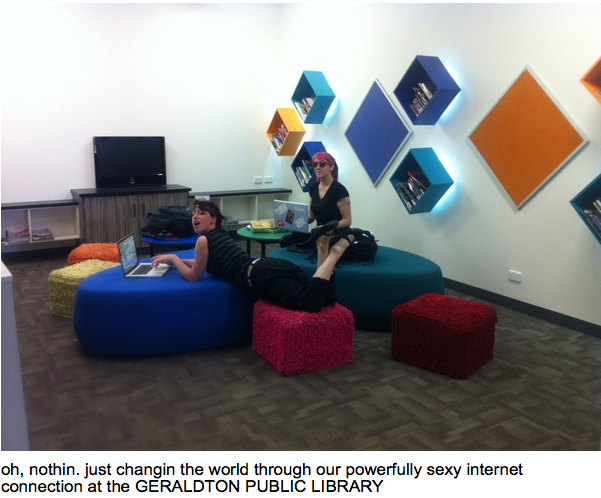
Amanda Palmer with Kim Boekbinder at the Geraldton Public Library today

In my post in an unfinished (I know!)  series, 11 answers for libraries in 2011: PART ONE I suggested that libraries should consider working together  “to create a single publishing platform and rights-management tool to allow easy creation and access to local content”. I think that we should add  to my fantasy platform an “easy direct payment system to authors”. This could mean providing an easy way for authors to receive payment in return for content from their readers, or a way for libraries to jointly subsidize production of works.

Libraries are used to paying for content. If the average academic library user understood the subscription costs to academic databases or scholarly articles, their heads would spin – we are talking sometimes tens of thousands for a single specialist database. We budget to pay for content. We want to give money to someone for content.

If in some cases we were to cut out publishers as middle men, as suggested by Michael Mace in his keynote at the ALIA Information Online Conference last week,  it would mean dealing directly with authors. If so, we need to make it an OK thing for authors to ask libraries for money. I wonder if the “halo effect” of libraries being such a great, beneficial institution actually stops authors from considering direct payment from libraries a possibility. Maybe we need to be more vocal about our budgets and willingness to pay.

After attending four performances by punk-cabaret idol, Amanda Palmer, in the last couple of weeks, I can see that libraries could position themselves in two new ways in a future where technology allows authors to better control their content distribution. One way would be as hosts for “ninja distribution” – free, limited access events. The other would be to directly subsidize content to ensure authors could eat while they create. More on this after looking at how Amanda Palmer is challenging music industry production.

Alice. (2011). AFP and Kim. Retrieved from http://www.flickr.com/photos/six_impossible_things/5421235865/ (Ninja Gig outside Art Gallery of W.A. on Saturday. That's me behind the blue camera 🙂 )

After a successful career with the Dresden Dolls, and some time solo with her material released under a record label, Amanda Palmer is now much more in control of her own distribution. Yes, she still plays large promoter-driven shows such as the one at the Sydney Opera House on Australia Day. She also uses online tools such as “bandcamp” to allow fans to purchase music at the price *they* choose to pay, often with a minimum of 99c or somesuch ridiculous price… although you can also buy her material for much more through iTunes. See for example her bandcamp download of the  album of Radiohead covers played on the ukulele .

During her Australian tour, she offered to play in a private concert for up to 50 people for a flat fee of $5000. This totally cut out the middlemen. Her reflection on the experience, though, reflects an unease that I think libraries will need to face if we want to deal directly with content creators.

i was actually kind of nervous about the gig[…] about whether we would all feel weird about a situation in which people had paid serious money – pretty much directly –  to attend a […] weird suburban picnic with a crazed piano player.

strange, i don’t feel weird or think twice about 2,000 people paying $80 to see me at the opera house, where i don’t handle the money.

but this was different – i was wondering if i’d feel strange, guilty, whatever. i didn’t. ‘

well, actually that’s a lie. when i first walked into the house and i saw all the food karina’s mother had cooked  {…]  i thought: i’m getting paid? for this?

why don’t i think that when i see catering? or when people bring me food backstage, like they often do, sometimes at great expense to themselves? i dunno.

i think there’s something inherently difficult about saying: THIS IS WHAT I COST IF YOU WANT ME directly to your fans.

it’s easier to say it to a promotor, to a venue. i say it all the time. it’s harder to say it to your friends and fans.

Over at the  Techdirt blog, their is a nice little post that looks further at Amanda Palmer’s model and the place of middlemen,  The Awkwardness Of Cutting Out The Middleman. They suggest that there is a place for middlemen, but if they are “obscuring the transaction” rather than adding value then maybe the audience would be more likely to give more money directly to the content creator. There then, is the quandry for libraries – if we are going to continue to be “middle men” between authors and readers, how do we ensure that we are adding value, not obscuring the transaction? See also the comments at the end of the post for opinions about middlemen and the music industry.

Libraries – as they always have  – can work as a mechanism for the community to pool their money to get the maximum content for their buck. To do this we must persuade the community to continue to fund us and – in a world where the middle man is being dropped altogether – persuade users and authors that they get real benefit from us buying content on our users’ behalf.

The second way libraries can support content creators is as venues for “ninja gigs”. Two of the Amanda Palmer performances I attended were organised the day before via social media , and at no cost to the attendees. Gratis. Both felt like an unconference of a gig – with the audience choosing what was performed and one event ending with Amanda crowd-surfing the mosh pit while continuing to play the uke. But – I will bet that next time Amanda Palmer is in town many of these people will now buy tickets to the paid gig.  Libraries – as a central, trusted institution with staff who maintain and cultivate relationships with authors – could act as venues for author readings or for limited-time downloads of electronic versions of author works. We have a reading public that we also cultivate, educate and host that could be matched with authors.

Hall, M. (2011). Amanda Palmer. Retrieved from http://www.flickr.com/photos/pixels-bandwidth/5394059713/ (Amanda Palmer and Neil Gaiman on stage at the Sydney Opera House, Australia Day 2011)

There have been experiments with similar approaches to free content by publishers, among many examples the attempt by HarperCollins to let fans vote for one of Amanda Palmer’s husband’s books to be provided online for free. Chap is called Neil Gaiman. You may have heard of him.  Problem was, the format they chose for American Gods was online-reading only with each page turn taking more time than it took to (illegally) download an entire ebook by bittorrent. Authors like science fiction author, Cory Doctorow, successfully release a free downloadable version of their books on the same day as the print edition comes out. He  very articulately described exactly why he does this  and how he feels about publishers and ebooks at last year’s Melbourne Writers’ Festival, Copyright vs Creativity .

I look forward to seeing how this plays out. If you want to hear directly from Amanda Palmer about her alternative models of distribution and her motivations, check out the interview from 28 January 2011 with David Weinberger from the Berkman Centre for Internet and Society at Harvard, Radio Berkman 173: The Portrait of the Self-Published Artist (Rethinking Music II) . Or if you are lucky enough to attend Webstock in New Zealand on Thursday 17 February you could check out her session about what she is doing and how she is using social media to do it.

CoverItLive – Web Analytics – Sebastian Chan, Powerhouse Museum

Uncategorized

In a workshop for 4 hours today as part of ALIA’s Information Online conference.

Here is a description.

Web Metrics for Collecting Institutions

Workshop facilitated by: Sebastian Chan, Manager, Web Services Unit, Powerhouse Museum, Australia

This half day workshop will take participants through some of the different options for measuring success and using quantitative approaches to extracting value from the use of online content. The session will cover the effective use of traditional web analytics tools such as Google Analytics, as well as exploring some of the options for measurement and learning from social media. The workshop also explores the implications of web metrics for improving user experience both online and offl ine, as well as showing examples of how to improve organisational intelligence and digital strategy through web measurement. Participants will have the opportunity to have their own organisation’s websites analysed if they are users of Google Analytics as part of the session. This is the fi rst time that Seb Chan has offered this workshop in Sydney, having run it to acclaim in the USA, UK and Europe.

CoverItLive window is below:

Michael Mace talks about librarians and the future of ebooks

Uncategorized

Michael Mace was morning keynote speaker for the second day of the ALIA Information Online conference.

He was involved with ebook platforms and readers ten years ago. He covered the reasons why they did not fly then. He suggested that circumstances are different in 2010 and we need to be prepared now for the huge changes they will bring.

I interviewed him after his keynote. I asked him to elaborate on his vision for ebooks that are not tied into the print metaphor and the role that librarians can play there. There is background audio that can be a little distracting.

Michael Mace talks about the future of ebooks …

30 things we love about self hosted multisite WordPress

Uncategorized

Today Sue Cook from CSIRO and I gave a conference paper at the ALIA Information Online conference called: Flexible, customisable and good looking: multiple uses for WordPress MU in two Australian Libraries.

The paper can be downloaded from the conference site when available.

As I promised in question time, here are details about where you can connect with libraries using WordPress:

If you’re interested in WordPress for Libraries, please join us on the wp4lib wiki (http://wp4lib.bluwiki.com), the WebJunction Group (http://webjunction.org/706), or the Yahoo! mailing list (http://tech.groups.yahoo.com/group/wp4lib/).

Here are the presentation slides, 30 Things we love about self hosted multisite WordPress .

ABSTRACT: Flexible, customisable and good looking: multiple uses for WordPress MU in two Australian Libraries.

WordPress MU (Multiuser) is Open Source software that at its simplest is a blogging platform that allows a number of users to run several different blogs on the one database installation. WordPressMU is also sophisticated and customisable enough to be used as a fully fledged Content Management System or to create an entire social networking platform.

This paper describes two case studies of WordPress MU used to provide very different solutions in two different libraries. Neither library used the platform to create blogs as the layperson understands them – reflective online journals. The paper outlines how and why the platform was chosen, decisions about hosting and the stakeholder negotiations required to have the solution accepted within the organisations. It describes the necessary customisation decisions and how these diverged with the different purposes.

The first case study involves a scientific research library service with technologically sophisticated, widely dispersed users who required an up-to-date current awareness service from multiple contributors. The second case-study involves a public library with a very simplistic and rigid website that was hosted by a design company and a need to formalise communication procedures before the move to a new library building made it much harder for staff to share information.

The paper also describes how the development of the new services were used as an opportunity to identify staff training requirements and introduce the potential of tools such as RSS, Yahoo Pipes, Netvibes, Twitter and Flickr to enhance the information in the WordPress MU installations.

Information Online Conference 1 Feb 2011 CoverItLive

Uncategorized

While I have wifi, I am tweeting the sessions I attend at the ALIA Information Online Conference via my public Twitter account, libsmatter .

I am pulling the tweets into a CoverItLive window that is embedded in my blog, but won’t show up in the RSS feed.

11 answers for libraries in 2011: PART ONE

Uncategorized

We love to talk, talk, talk in libraries.

This post was going to be “11 conversations we need to continue in libraries in 2011” in a nod to Dave Lanke’s post The Librarian Militant, The Librarian Triumphant. He posits librarianship as not a building or a collection but “a conversation you are having” – that we must keep fresh and responsive.

Dave also calls for imagination within the profession.  I’m taking up that challenge. Wouldn’t it be great if we had the answers now to some of the hoary issues of 2011, without the talkfest? So – I’m taking a punt and providing answers. Even more, I’m suggesting what we should do if I am right. My answers are based on reading, experience and have an element of tongue in cheek where that approach flounders.

I was aiming to publish the whole lot as one post – but it started to get long, and maybe posting what I have written so far will spur me on to complete the others. I know the other eight issues and the answers, but need to write my explanations. I wonder whether the big issues and discussions I have identified are the same as the ones you would identify??

Wedin, J. (2010). Its the answer, you know.... Retrieved from http://www.flickr.com/photos/38446022@N00/4589969792/

ISSUE ONE: Will libraries, museums, archives, public broadcasters and art galleries converge?

ANSWER:

Yes.

Restricted funding, commonality of purpose and overlap of access methods will mean that strong, converged memory and collecting conglomerates will form from individual institutions within the next two years.

Three projects illustrate this convergence of purpose but there are many more. The British Library is crowdsourcing the recording of English speakers worldwide reading the “Mr Tickle” story to track the evolution of English. The Poetry Archive is a wholly online charitable resource dedicated to recording poets reading their own works . The British Broadcasting Corporation curates and makes available online a series of archival collections of audio, video and documents from writers, poets and historic leaders.

SO:

Start the conversation with other collecting and memory institutions now. Apply for joint funding, create joint projects, run the same event across a number of institutions that allows users to appreciate the variety of approaches (for example a history of a newsroom with artifacts at a museum, secondary and descriptive material at a library and historical recordings from the newsroom archives all unified through a single online presence).

ISSUE TWO: How do we force publishers to give us ebook content that includes works that our users want and that they find easy to download to their chosen device?

ANSWER:

They will not.

It is not in their commercial interests to do so. They are just not that into us.

SO:

We need to lobby publishers and come up with very compelling reasons why library copies of ebooks will be “gateway drugs” resulting in significantly more content sales. We need to prove to our users any claims we make that it is cheaper and easier to use library ebooks than privately-purchased one-click wirelessly delivered content. Or we could save our energy and find untapped sources of content created by our local users and work together to create a single publishing platform and rights-management tool to allow easy creation and access to local content.

ISSUE THREE: Gartner claimed in April 2007 that by the end of 2011, 80% of our users would have avatars in a virtual world.  What happened?

ANSWER:

Avatars will come, but not for about three years and not in the form that we expect.

The move will come gradually via changes to the platform of an existing social network like Facebook or Twitter, resulting in established profiles interacting in a 3D-like space. Changes to input devices also may result in a more 3D-like and embodied metaphor for information access – see the nascent Kinect games as an example of how our online interactions can be more related and controlled by what we do in 3D space.

Avatars may also manifest as a metadata layer over real people in real space and time, with augmented reality and smart phones allowing the reading about and interacting with social data about people just by pointing a device at them. The “virtual world” may be one made of data that slips over the “real world”, rather than being accessed on an individual computer. All that tagging of people in images uploaded to Facebook, Picasa and Flickr that hundreds of thousands of us do daily? Just ripe for harvesting to create a facial recognition app that allows you to add a personal data layer over real people in a crowd.
SO:

Learn what you can about providing information in an environment where the metaphor for access is no longer a 2D flat printed page, but spatial relationships. Think about the implications of an environment where data and information becomes a platforms for users to clamber about interacting with each other. Think about the implications of an environment where the internet of things has morphed so that “things” includes people…

IN 11 ANSWERS FOR LIBRARIES  IN 2011 PART TWO AND PART THREE: Print, clouds, fish, politics … and more….