Walking the winter spiral. Blogjune 18/23

blogjune

It’s minimalist Blogjune – one pic, one thing I did today.

What I did today:

Gathered outside with a group of women to share thoughts on winter, drink warm spiced juice, eat freshly cooked damper, sit around a fire and weave creations from sticks and shells and locally spun yarn.

In honour of the solstice this week, we each made a rolled wax candle, then walked a spiral of leaves and branches to light it from a large candle at the centre, leaving our candle in the pathway as we exited.


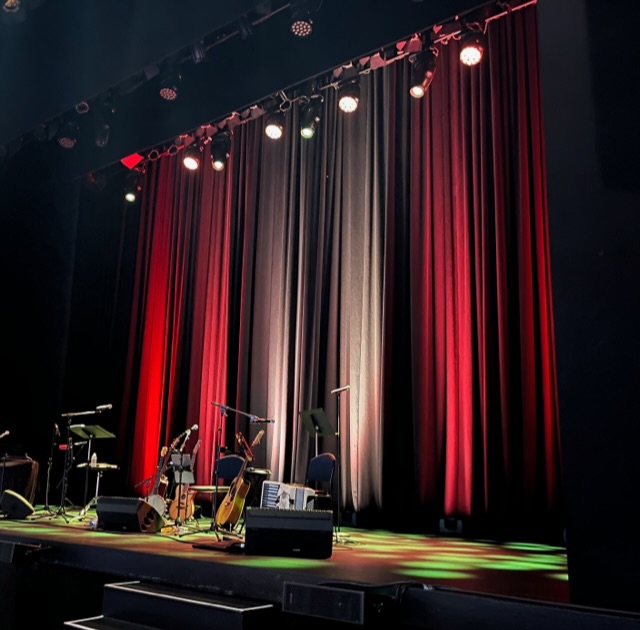
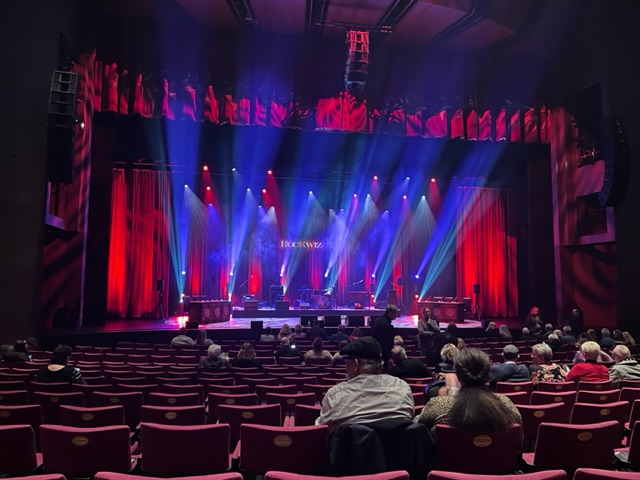
But, today’s pic is another view of a stage. It’s my last Cabaret Festival event, An Australian Songbook from Robyn Archer.

I considered travelling to Melbourne for a couple of days on my week off – now being so physically close and not having any pause to take advantage of it before. Instead, I vacationed at the festival.

Bamboo table. Blogjune 16/23

blogjune

It’s minimalist Blogjune – one pic, one thing I did today.

An image completely taken up by the pattern of bamboo from a tabletop.


What I did today:

Sat around my bamboo table with a couple of good friends eating cheese and drinking gin.

I am going to invite them over at 5pm every Friday just before I go on a week’s leave. The day was a flurry of tidying up loose ends and moving things from my to do list to my “when I get back from holidays” list.. but because I had visitors coming I didn’t have time to faff around and do just one more essential thing before my out-of-office email message went on. I just did what needed doing.

3am journalling. Blogjune 15/23

blogjune

It’s minimalist Blogjune – one pic, one thing I did today.

The pic is sunset over the city, a week out from Winter Solstice.

What I did today: Woke early. Warmed some milk and sat in my special reading nook journalling for an hour until I was sleepy again.

I usually sleep well. I am a great believer in solving problems by “sleeping on it”. My brain works really well at finding solutions overnight and laying them on my lap the next day.

Last night, all that subconscious processing had the volume up. I wasn’t worried. I didn’t feel like I was obsessing, it was just I had to watch all that processing while I was semi-awake, rather than it happening silently in the background while I snoozed.

I have a LOT to do as I finish marking for one study period and prepare my online sites and course outlines for the next one… all due to be made live this Friday so I can take a week of annual leave before plunging back into teaching.

I worked out some improvements for an assessment that is currently being marked. I created a list of tasks I needed to do before a meeting this morning. I thought up new material and changes to make for the first few weeks of a couple of courses next Study Period.

I think my brain just had so much banked up that it forgot to turn out the lights.

BY THE WAY… I need to fix my blog template before I can respond to comments people have made in the last little while. It is stopping me from posting responses and I need to tweak. That may happen next week.

Up in the gods. Blogjune 14/23

blogjune

It’s minimalist Blogjune – one pic, one thing I did today.

In the very back balcony row, waiting for the show to start. It’s all Elvis. Not the good one (Costello), but the other one (Presley).

I am here for the performers – Deborah Conway, Joe Camilleri and Paul Grabowsky. I think I would see any collaboration between them.

I was freezing cold when I saw a show waaaaaay down there on Saturday, so I rugged up with several layers. Turns out all the hot air in the building rises to this level. Phew!

Commenting. Blogjune 13/23

blogjune

It’s minimalist Blogjune – one pic, one thing I did today.

Livestreamed, after work yoga. (Or… yes, I forgot to take pics again today..)

A purple patterned sarong on a blue towel covering a yoga mat on a wooden floor near a cream curtain.

What I did today:

Commented on other blogjune people’s posts about:

  • Whether the time for blogging was many years ago, but maybe there is room for conversation again at Con’s Flexnib
  • Whether blogging is a way to take conversation back from wall builders at Genevieve’s Reloaded
  • The way people are disconnected by having so many platforms to choose from at snail’s snail.
  • Adding library details to Yelp, Google and Bing at Stephen’s Beating the Bounds
  • A history of personal blogging and being comfortable with not sharing deliberately at Andrew’s Bibliotheque Bound.
  • A visit to Miss Marple’s tearooms in Olinda by Graeme at GraemeO28 Librarian and Biker.

… because I think many people in the conversation are on to something. Maybe we CAN build community, chat more, if we play on each other’s blogs, now that commercial platforms are crumbling. While I think it is worth playing, I suspect I would not have stamina to keep it up. Maybe?

I know I should ALSO get back into personalised replies to people who comment here. I would never have left a comment go unacknowledged once upon a time (you came! you chatted! THANK YOU!!).. but I think so much time being overwhelmed by the stream of information on Twitter has numbed me a bit to etiquette of reciprocated conversation.

Computer power and human reason. Blogjune. 12/23

blogjune

It’s minimalist Blogjune – one pic, one thing I did today.

It’s a public holiday for the pretend birthday of some bloke in England. I could even hear a 12 gun salute for it at midday.

What I did today:

I sat in the sunshine and caught up on reading for an AI Ethics bookclub I accidentally joined last month.

Looking over many of the earlier books the group had discussed, I saw several from which I had set readings for students (like Weapons of Math Destruction , Invisible Women and Made by Humans ), so it seemed like a good idea.

This month’s book is from 1976, written over a two year sabbatical by MIT computer scientist, Joseph Weizenbaum. Between 1964 and 1966, he created ELIZA, a very simple chatbot style program that used pattern matching to respond to typed enquiries. The DOCTOR routine imitated a Rogerian therapist, almost as a parody of this style of reflective questioning, where the therapist prompted the patient to speak using a rather scripted set of responses, mainly using the patient’s own words.

So, a session with ELIZA, or with a real Rogerian therapist, would start something like this:

PATIENT: Hello, can you help me with my problems?

DOCTOR: You want me to help you with your problems?

PATIENT: Yes, I am having problems with my mother.

DOCTOR: What about your mother is troubling you?

PATIENT: She doesn’t listen to me.

DOCTOR: Why do you think she doesn’t listen to you?

You can play with it for yourself on many sites like this ELIZA emulation at New Jersey Institute of Technology.

The program was demo-ed to many visitors to MIT to show what was possible. This use was relatable and understandable, while many other early computing uses required higher-level maths or computing to appreciate. But …. people bonded with ELIZA. They asked for privacy when they chatted with it. They were outraged that Weizenbaum suggested recording the data that was being input when many, many people used it overnight. Something a little different was happening. Even scientists who KNEW that this was a prediction tool following a script attributed far more humanity and effectiveness than was reasonable.

The book, Computer Power and Human Reason is Weizenbaum’s attempt to make sense of how we should progress into a world where people may have a tendency to ascribe wisdom or humanity to a set of probabilistic scripts. I am not far in, but this quote from his introduction has already jumped out and shaken me by the lapels:

The reaction to ELIZA showed me more vividly than anything I had seen hitherto the enormously exaggerated attributions an even well-educated audience is capable of making, even strives to make, to a technology it does not understand. Surely, I thought, decisions made by the general public about emergent technologies depends much more on what that public attributes to such technologies than on what they actually are or can or cannot do.

p. 7 Weizenbaum, J. (1976) Computer Power and Human Reason. W.H. Freeman and Company