Eduserv Symposium: Virtual Worlds Real Learning?

Uncategorized

Right now I’m on Cybrary City in Second Life attending the Eduserv Symposium Virtual Worlds Real Learning? which is being streamed live from the London . I’m having my first shot at liveblogging.

[Bit of a break in here. Below is a long steam copied as the speaker was talking, more or less untidied. The first two speakers aren’t nearly as interesting as Stephen Downes at the end, who had a brief to be provocative and took a technoskeptic line. He’s worth looking at.

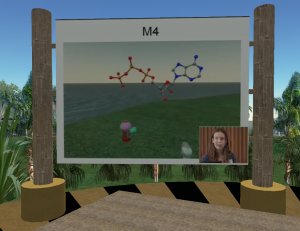
The speakers were streamed into a large screen with audio, a small inset of their face talking in the corner of their presentation slides. As one of the SL audience said, we were still slaves to HorrorPoint.

In between speakers, I got some tips about resources for the introduction to Second Life classes I’m giving in the next few months, I teleported a friend who had noticed on twitter that I was at the symposium, and met with a blogger in remote Scotland whose blog I have read for the past 6 months or so, but hadn’t realised was involved with SL. ]
secondnature.jpg

JOANNA SCOTT: Nature Publishing : SECOND NATURE

The first speaker is Joanna Scott from Nature Publishing, who publish the Science Journal, Nature.

Their island is called “Second Nature”. They started off with a couple of nifty installations, like a 3D display of molecules – you specify the molecule and a model appears in front of you. They also experimented with a representation of a cell.

They decided, however, that they don’t create content in their magazine, they take content from other scientists and they wanted to replicate this model in Second Life.

There have been several people who took up the offer to use the space, including a professor who teaches classes in Second Life and has a Blue Obelisk Cemetary where people can click on blue stones and take a quiz. The value turns out to be that lots of people stop by and chat about the subject area. Also the JCB Center for Open Notebook Science and the Gene Pool are other projects.

Would never consider putting the articles from the journal on the web.

“We don’t exactly know what we are doing in Second Life, and we don’t think anyone really does, but we can see the potential and we’re going to stay here”.

Could Second Life replace the Conference? She raised the point that Environmental Scientists are not attending conferences due to the impact of airflight.

Question: How to justify the time and energy put into SL

Answer: Her department is there to investigate things like this without producing immediate return. SL has potential to be really big, really important..don’t know how..but being there gives us the skills and ability to shape what the future of SL will be.

Question: Are other scientific journals doing anything in SL?

Not that she knows of, although Penguin publishers are there.

GILLY SALMON University of Leicester A SECOND GUESS AT THE FUTURE

Need to start exploiting potential of Second Life. Set up a Learning Futures Academy.

Universities don’t change very quickly 😉 so this project lets students envision how their university will look.

Not creating an artifact, but collaboratively creating a future.

Looking at what can do in SL that you CAN’T do in RL, not what you can do in SL that mirrors RL.

Imagining futures better.

Media Zoo – for evidence from media projects

Want to elicit viable and possible futures by interactive environement in SL. Have been messing about with it, but haven’t come up with the answers yet.

Shouldn’t be looking back in 5 years time and saying “oh, if only we’d known”. Hope to engage everyone now.

“Today’s students are not longer the people our education systems were designed to teach”

Designing for an unknown future.

Activities to innovate…1) Extend and defend core business 2) Build emerging business 3) Create viable options

Hope higher ed will begin focussing on 3).

SEAL research- Second Life Advanced Learning

Aim:

1) Surface learners’ choices

2) Build communities of learners

3) Create models of learning for the future

Methodologies for face to face environments aren’t applicable to SL. They are using Cognitive Mapping. Looked at successful models from other online applications. Work with futurists.

(Cognitive mapping = by Kelly 1955 )

Output: Want to create a framework of learning and a sharable model.

[comment from someone in the SL audience: we dont get far away from the lecture model at conferences even in SL. We’re slaves to power point]

Question: ethics and informed consent

Answer: can use existing approaches

STEPHEN DOWNES: Virtual Worlds in Context

Being cast as a Technoskeptic

Hearing a lot about SL. People are making points about the economics of SL. Gartner Hype Cycle mentioned again: “80% of all active Internet users will have a SL in a virtual world by 2011”. Is that really reasonable?

Teen Second Life library mentioned. When he saw the paper on Teen SL Library, particulalry noticed the “special permission” to librarians to be in Teen SL…language seemed odd for public education

It’s all so derivative. He’s pointing out the ridiculousness of it all. (But without spite I think). Branding in SL.

It’s like a scene from Star Trek until you hit the casinos. Buildings and nothing else. Look at map and see the little green dots where the people are, teleport down and there is a casino.

Clay Shirky. “I’ts a try me virus”.

When SL reached 38 K people online, it began kicking people out. “38K compared to the number of users in the internet is a rounding error”.

The media is largely push driven.

Where is open source in SL? Why was copybot killed?

People forget history. (eg. virtual reality). Before the internet, there was two sides..the gamers side and the text side. When people say SL is not a game, I hear myself saying “how is this not a game?”, when what people are doing is creating things and showing off cf. Sims city.

<SHIFT> Fund in Sim City , can get more dollars. Same in SL, you can cheat and buy Lindens. Crossover between MUDS, MUVES, MUSES, DIKUs.

Mult Academic User Domain. The Palace. Furcadia. Active Worlds.WoW.

Gartner Hype cycle. 5 laws of VRs

  1. Virtual worlds are not games (speaker: yes they are, but it’s OK)
  2. Every avatar is a real person
  3. Be relevant and add value
  4. Contain the downside
  5. This is a long haul (This is what your broker tells you just before the big crash.)

Real issues . David Noble. Digital Diploma Mills. Internet didn’t suddenly commercialise education, BUT the environment for education in SL is what Noble warned against.

Who owns SL? Not the users, not the learners. If you don’t subscribe, you get kicked off if it gets too busy.

Centralised. It’s all in one domain and it doesn’t work. Too much data and can’t be handled.

Can SL scale?

Interoperability. MUDS and Inter MUDS. People would chat between MUDS. Communications between MUDS. Issues of transport of goods.

[Audience comment: Isn’t that what Multiverse was about]?

Why do we tolerate something like SL where we can’t even own our own names.

SL taps into our latent conservativism. This is so NOT Web2.0. It doesn’t empower people. Pedagogy doesn’t change, power structures don’t change. No open standards. SL is where the traditional publishers are creating the content.

Why do people like SL? Is it because you can stream? Because you can lecture…Is that what is unique to SL. We have been able to do these already.

SL isn’t too good at communication. Try to have conversation in a group of 100 people.

Compare to IM, MySpace, YouTube, Skype, Wii.

How much in SL is being done just becuase it’s SL?

What is real value of SL?

1) SL has real economy

2) Can create ownership

3) World must be persistent

Is this the online learning we have been waiting for. Is private ownership what we were looking for ? Is it branding? Proprietary technology.

[Audience:  I view SL as a prototype of a much  more capable future 3D environment.]

Hardware and software should be distributed. Should be open source. Should be non-commercial. Should be diverse and democratic . Want to have ownership in our identities. This will create the Learning Common. But we won’t have it by 2011.

(He had been asked to be provocative)

Q: How can this be a game when I’m doing my professional work and making academic contacts in it

A: I got my start in academic circles via MUDS. Just because it’s a game doesn’t mean it can’t be those other things.

Archiving our online life

Uncategorized

Are you backing up your blog? Do you think you should? Do you think libraries have any role in archiving them?

The UNC Chapel Hill School of Info and Library Science are after 300 bloggers to take a survey answering these questions. Blogger perceptions on digital preservation. I took it and it reminded me to download the blog backup I keep on the very same server my blog is stored on.

In Australia, the Pandora project, run from the National Library of Australia archives significant Australian web documents and sites. LINT was archived there a few months ago, leading us to reconsider our copyright statement. We updated our instructions for contributers so that they understood everything published there was under a Creative Commons attribution license. If you want to know about other impacts on sites that were archived by Pandora, check out Edgar Crooks’ For the Record: Assessing the Impact of Archiving on the Archived in RLG Diginews, 15 August 2006.

Edgar asked me, after my Second Life talk at the National Library, how we could archive the Australian Libraries Building in Second Life. I suggested that we could create a machinima (movie created using the tools within the virtual environment). He liked the suggestion, so a couple of months ago Emerald Dumont gave a guided tour of the library which was filmed by another Second Life librarian, who is still editing it. Interestingly, the Pandora people didn’t want to do this themselves as to enter Second Life you need to create an avatar, which means they are “imposing themselves on the archive” and creating content rather than just recording it.

Come blog with me…

Uncategorized

… or at least post on a blog that I help administer.

Do you have a vision of what your library will look like in 2010?

crystal ball in library

Crystal Ball uploaded to Flickr August 22, 2006 by Isobel T

To celebrate Library and Information Week 2007, we are asking you to write a post for LINT (librariesinteract.info) telling us about your future library. We’re even offering a prize for the best entry – a signed copy of Meredith Farkas’ book Social Software in Libraries.

So hop over to LINT and check it out before May 20th…especially if you are blog shy or blog curious. Even though we always welcome posts from other people now is a particularly good time to dip your toe in the water and get it bloggy.

Six very bad reasons to have a library branch in Second Life

Uncategorized

Yesterday I outlined Ten very good reasons why your librarians should be in Second Life.

I think it is a fantastic idea for many Real Life libraries to have a library within Second Life, but I don’t think a Second Life branch is useful for all libraries and get a bit worried when I hear people using the reasons below to justify it.

embanned.jpg

1. It’s where the users are.

Uh-uh. No way. Not yet.

2. Dell. Adidas, Disney, Toyota, (insert company name) are there.

So?

3. It’s so Library2.0

The whole point of Library2.0 is to take new web tools and tailor them to your clients’ specific needs. Would a Second Life branch do this?

4. It provides access for more people

Yes it does. If they have the high end video card and broadband required by Second Life.

No service that aims to be equitable, should be offered in Second Life unless there is access also via another medium. Sometimes the interface and environment of Second Life do have great advantages over tradtional interfaces.

5. It doesn’t take much time or skill to run a branch in Second Life, so it would be easy to set up and run.

No comment.

6. We need a separate service in Second Life just for our users.

Are you sure? Maybe Second Life libraries would offer your users a better service if you put your energies into an existing Second Life library services like the genealogy library, or the children’s literature island, or the gothic manor, or the science ficiton portal, or a writer talk, or a book display, or the replica of the Globe Theatre, or staffing the reference desk.

AND ONE VERY GOOD REASON TO HAVE A LIBRARY BRANCH IN SECOND LIFE

We have the resources and time to establish and maintain a project in Second Life, we will provide workstations and training for clients wanting to experiment with Second Life, we are willing to see this as both an experimental and a production environment, and a branch in Second Life will meet our users’ needs and matches the strategic goals of our organization.

Is that right? Then go for it!

Ten very good reasons why your librarians should be in Second Life

Uncategorized

I’ve been experimenting with providing library service in Second Life for about 6 months. In the last 12 months, the Second Life library has moved from a shopfront on someone else’s island to a 19 island archipelago staffed by over 500 librarians.

There are great benefits to librarians in getting a Second Life. There are limited benefits to our parent organisations and to our users – at the moment. The same thing happened when librarians first authored web pages – the first stage was learning how to do it, the second stage was others accessing our output.

With Forbes.com reporting last Tuesday that Gartner Says 80 Percent of Active Internet Users Will Have A “Second Life” in the Virtual World by the End of 2011 , we need librarians with the skills to understand virtual worlds.

Here’s my top ten list. Many of them depend on creating and maintaining social networks within Second Life.

emandbook_001.jpg

1. Learn a new interface

Web browsing in the future won’t be identical to being in Second Life. It will probably have elements very similar to the 3D, social, immersive environment of Second Life. Learning how to put out objects, create environments, navigate and interact socially within this environment gives your librarians an edge to learn new web interfaces.

2. Learn to relate to your PC like our users who game.

Second Life – without rules, points, objectives and strategies – is not a game. It has many elements of gaming, however – you control a 3D representation of yourself that has an inventory and interacts with the environment and other people. We all have clients who game. Gaming can be used for recreation, leisure and – increasingly – to provide information. It is an alternate literacy that we should understand.

3. Fun and creative expression

I’ve had several librarians remark to me in Second Life , “I’m having the most fun I’ve ever had in my professional life”. You can build your ultimate library service. Don’t like something? Zap it and start again.

4. Break down professional isolation

Second Life librarians who are geographically isolated, work in one-person libraries or have highly specialised positions can go days without contact with another similar librarian. In Second Life, you can meet other professionals every day.

5. Increase coding skills

You can create a book, make the pages move, make it give out some written information when touched, or force someone’s web browser outside Second Life to a specified web page. There are people around to help and example scripts that you can use, but ultimately it becomes a fun challenge that increments your scripting skills without you even noticing.

6. It’s a collaborative learning community

There’s lots of librarians there. Via meeting in Second Life, the InfoIsland blog and the google group, we share ideas and work together on projects, such as a package of useful bits and pieces for people brand new to Second Life.

7. Networking about non – Second Life library matters

There are official programs about topics like MySpace and book discussion groups and author visits. Dave Pattern and I were chatting one night in Second Life about user ratings on OPACs. I sent him a link to our OPAC and after half an hour of coding, he’d coded a similar facility for his OPAC too.

8. Access to a host of experts – not just with Second Life skills

Within Second Life, I’ve met people who are experts in podcasting in libraries, and single person libraries and library instruction. It’s a helpful kind of place and it’s like having a panel of experts to call on if you get stuck at work in Real Life.

9. It’s free, we can access it now and it has first mover advantage

The Second Life interface is clunky and the environment boring to people used to gaming. There are better online virtual worlds. Second Life does have critical mass and is where you’ll find the most librarians experimenting. It’s free and we can get on right now.

10. Flexibility of thought and learning

Once the tools of librarianship, like AACR and LCSH, were standardised, and could be taught in library school. Our toolkit is now rapidly evolving to include blogs, wikis, multimedia and social software tools. We need people with nimble, exercised minds who are able to adapt to a new environment. There are a hundred different ways to join people with information within Second Life. To do this successfully, librarians need to decide what they need to know, work out how they are going to learn it and find the resources available – including other people – to create the tools they need. This assessment and assimilation of new tools is a transferable, valuable skill that applies beyond the PC.

To give a bit of balance, my next post outlines six very bad reasons to have a library branch in Second Life.

What happened after…

Uncategorized

It’s my blogiversary today. One year ago I staffed our library during a public holiday and thought I’d use the quiet patch to look at those RSS feed thingies and those blog whatsits and write the report I’d been ask to do. I thought it was smart to use one piece of software as an aggregator and a blog, so started my first blog, Kathrynarium, that afternoon using bloglines. NEWB!

I’m using this post as a “what happened after”…..providing a chronological list of updates on some things I blogged about in the last year. It was great fun to do, but you’d be a kind person indeed to read the entire list.

In praise of small things

Uncategorized

A couple of weeks ago, I was feeling a bit despondent about whether our Emerging Technologies Group is going in the right direction. We’ve chosen our first project – it is joyous, creative and collaborative and can involve lots of our staff and our community, but is a bit… well,… “fluffy”. I can see the value in it, but I wondered whether more traditional librarians would find it lightweight, and whether it looked like we were putting energy into trivia.

Avalanche

Avalanche uploaded to Flickr on October 19, 2006 by ben-der

So, I was extremely heartened when I read the May 2007 issue of Walt Crawford’s Cites and Insights. He’s begun a new column celebrating “small successes”. Here’s the passage that cheered me up and made me feel like our small project was worthwhile.

A note about “small successes”

When I use that term, it is not intended to demean the success. It’s an attempt to honor it, noting that something doesn’t have to be world changing to matter. The growing set of microloan programs for third-world mini-entrepreneurs is a classic “small success” approach: $25 here and $100 there may mean more in some cases than a multimillion-dollar project. An effective reference blog in a library may do more than a universal blogging program, even if it begins and grows slowly. Two local libraries making a handshake agreement and using (gasp!) the telephone as a basis for communication: it won’t revolutionize either library, but it does provide significant additional resources at the point of need.

Small successes add up over time.

This week I was reminded that not every librarian who can see the benefits of Library2.0 technology is lucky enough to have management willing to embrace it.

Helene Blowers, who designed the Learning2.0 social software course, posted about being at the Computers in Libraries 2007 conference and meeting many, many frustrated librarians who want to start projects using new technologies but are:

stippled [sic] and oppressed by stale management and old world politics.

She wonders

if what the profession really needs is just to give some administrators a good swift kick in the head.”.

In conclusion, however, she joins the chorus in praise of small things:

It’s hard to fight battles through small change, but with enough small battles, it creates some erosion. And the thing about erosion is … that if it continues long enough, it eventually leads to an avalanche of new opportunity!

So next time I feel like a project that brings new attittudes to our library is small and insignificant, I’ll be chanting my mantra “Small successes are potential avalanches, Small successes are potential avalanches”.

What is Library2.0 and Library2.0+ ?

Uncategorized

I think Library 2.0 is used to describe two concepts. One is applying Web2.0 at your library. The other is the flexible, nimble, evolving, user-centred library, kickstarted by Web2.0 concepts and attitudes. One day the second will have its own name.


Janus face
Janus Uploaded on August 11, 2005 by Marvin (PA)

Laura Cohen has been thinking about whether Library2.0 is just a derivative of Web2.0 and that’s all there is to it, The best part of Library 2.0. She disagrees, but believes that many people see it as no more than this. She would like to extend it further and add “timeless adaptability” into the mix. Within her definition

libraries evolve wisely and nimbly to meet users’ evolving needs as their information culture shapes these needs.

To me, there are two concepts called “Library 2.0” – at the moment more or less covering the same libraries doing the same thing, but which will diverge at some point. The second concept will one day need its own name. I have buzzword fatigue and I’m happy to call it Library2.0 for now, but only for now. To differentiate it here, I’m calling it Library2.0+, but I think it deserves something that will date it less and is friendlier.

CONCEPT 1 – Library2.0 – Web2.0 in your Library

The first concept Library 2.0 definitely involves the elements taken from Web 2.0 and the attitudes and expectations it brings – but not all of the time and not in every institution if it doesn’t fit their community.

  • 24/7 access
  • Social networking
  • Read/write web
  • The ‘net not a single PC as a workspace
  • User controlled tagging
  • Collaborative creation
  • “Humanized” institution where you can hear the voices of real people inside it
  • Focussing on the needs of the user, not what suits the organisation best
  • Mashing up and value adding on top of available software
  • Focuses on open source, not propietary software
  • Profiles, ratings, reviews, chat, “friending”
  • Perpetual beta
  • Tools like RSS, wikis, blogs, forums, photo sharing, SMS
  • Access via many devices – mobile, handheld,desktop,telephony

So, one version of Library 2.0 is “Web2.0 in a library”.

CONCEPT 2 – Library2.0+ – Flexible, nimble, evolving, user-centred libraries

The second concept involves some of what we have always done, and some rethinking. Web2.0 is a catalyst, but not the only element of this.

For years, libraries have worked in a collaborative, user focussed way, implementing high usability standards – we are already Library2.0+ in some ways.

Some of Library2.0+ is tossing out a few of our traditional core functions because they have been replaced (eg. google and reference work..not quite!!) or sharing our core functions (eg. google scholar). We are putting centre stage previously unnoticed functions. The academic library as study hall and social space is an example of this. This fits in with Laura’s idea of “timeless adaptability”.

Ideas like “going where your users are” have been sparked by Web2.0 which created forums and spaces where it’s possible to interact online instead of waiting for our users to come to us. Library 2.0+ extends “going where the users are” beyond our PCs – like Ryan’s suggestion in his Top Ten Zero-tech Library 2.0 “no brainers” for Public Libraries that we volunteer in the community.

Web 2.0 brings us the informal voice of blogs and web site architecture focusing on the users’ needs. Library2.0+, sparked by this change, is applying it elsewhere and takes it further. We are changing signage, re-writing paper forms, rearranging our collections, reconsidering our overdue policies and even how we talk to our users.

What do I think of twitter?

Uncategorized

It’s fun. It’s more useful than I thought. It’s not for everyone. It can be a timesink. It can feel like a popularity contest (par for the course with social networking sites). You can still get spammed.

cathistory: Uploaded to Flickr on March 13, 2007 by ian_delaney

twitter asks “What are you doing?” and people use 140 characters or less to answer, callled a “tweet”. All day. With their friends. It’s microliveblogging.

You can tweet from your mobile phone, or your IM client or via RSS or directly on the web site. From my homepage on twitter, other people can see all the tweets from the people I am following in a huge stream-of-conciousness yawp.

I fiddled with twitter a while back, but like Fiona, I didn’t find it very useful. About a month ago, as twitter began tipping toward mainstream, a mob of bibliobloggers started experimenting with it. I tried again.

I “friended” some of the names I recognised from the biblioblogosphere. Not all of them friended me back, so they don’t see my tweets. This gets frustrating when I want to tweet back to something interesting. Reminds me that we are rethinking privacy and boundaries as sites get more social and immediate. Why should they friend back someone who they never met in another country? Why does it bug me when they don’t? (Because it reminds me of being excluded from the big kids’ games as a kid? I think it’s time to get over that. )

It is exciting to be peeking into other people’s lives. Even hearing about them making udon noodles is interesting. I almost stopped twittering because there are only so many ways you can say “Avoiding housework”, but felt that the price I paid for their trivia was sharing mine.

Then it began being used in other ways.

  • I watched CW‘s progress as she took an overnight trip to a regional campus.
  • Steven Cohen is sending interesting links to twitter, via RSS as he Tumbls them.
  • Rochelle Hartman asked for feedback about her plans for a staff retreat and some of us checked it over and emailed her back
  • Meredith Farkas was twittering about a problem she was having with Elsevier and Michelle Boule, who was in a meeting with an Elsevier rep was able to ask a tricky question about it.
  • I mentioned a really interesting place I’d found in Second Life and one of my Twitter friends (who I’d never met in RL or SL) popped in to SL and we rode some kangaroos around Cybrary City II.
  • Simone posted a request from our state newspaper to interview twitterers
  • The Virginia Tech shootings were reported almost as soon as they happened
  • Currently the twitterati are at the Computers in Libraries Conference 2007, and twitter is being used for liveblogging, to find each other in crowds and people arranging to meet for drinks/meals afterward. There is a separate Twitter user called “cil07” who has been friended by twitterers at the conference so you can subscribe to the feed and see what everyone is doing.

The key to this working is a critical mass of people with a joint interest twittering constantly. I don’t know whether this is sustainable, but it’s fun watching it evolve. If you want to experiment, feel free to friend me.

Asking permission before using a photograph

Uncategorized

Our library is taking part in the 365 Library Library Days project initiated by Michael Porter aka Libraryman. We will join other libraries in uploading 365 images of our library over the next year – more info at Michael’s blog . The most interesting photos have people doing exciting library activities.

It got me thinking: – should you ask for permission before you take/use a stranger’s photograph?

cimg6311.JPG

The unidentified children hunting Easter eggs in this photo have given me permission to use it

Do these things make a difference:

  • If they are the main subject?
  • Just an incidental bystander in the photo?
  • If they can’t be clearly identified?
  • A public figure?
  • Private citizen?
  • They have expressly told you they don’t want their photo taken?
  • If you only use the image in your personal collection?
  • If you post it on the net?
  • If you add an offensive tag?
  • If you are doing it on behalf of an organization?

People in these photos from Flickr would be on the “ask first” side:

I think that this Taxi Driver probably wouldn’t mind. You can find more of these candid shots under the Raw Street Photography group or the steetphotography tag on Flickr.

For the 365 Library Days project, we are rewriting our release form and making sure we have the permission of people featured in the photo. The text is very simple. It includes the name and contact details, an “exceptions to agreed use” section where they can specify any conditions , and can be also used for release to use photos TAKEN by other people. The permission merely states that they agree that we can use it for “any University publication, on the internet and in displays”.

I know this is the right thing to do now, particularly for an organisation, even though people don’t have any ownership/copyright in their own image. I suspect that in five years or so, privacy and content creation will have been redefined further, so this will seem like an archaic “pissing in the wind” kind of exercise.