Four truths and one lie

Uncategorized

I need a break from think posting, so I’m following Hoi’s lead.

Four of these statements about me are true and one is a lie. See if you can guess which one. I’ll tell you tomorrow. Or the next day, honestly.

truth Uploaded to Flickr on October 8, 2005 by jasoneppink

  • I was escorted by police from a hotel bar in the Swansea RSL in Tasmania for disturbing the peace and my photo made the front page of the Hobart Mercury.
  • I used to hold the Western Australian State Schoolgirl’s U12 High Jump record, with a height of 1m 42cm.
  • I am so shy that I still sometimes cross the road if I see someone I know coming the other way so that I don’t have to talk to them.
  • My Year 12 English Teacher told me that I would get marks off in my State Matriculation exam if I used a peacock blue fountain pen, but I proved her wrong by getting 100%.
  • If I had more time, I would love to join the local Roller Derby team which trains on Sunday nights 5 minutes from my house.

What if publishers are the “middle men” between libraries and ebook content ?

Uncategorized

Here’s another way of looking at the question “how can public library consortia and publishers play nicely together so that our users have free, technically simple access to ebooks?”

I said in my last post that digital content makes it easy to cut out the middle men, with an instant path from supplier to consumer… and suggested that it was not attractive to publishers for libraries to be “middle men” between them and consumers.

Source: i can has cheezburger

But – What if publishers are actually disposible “middle men” between library users and content producers ?

What if we can provide a “try before you buy” distribution channel that benefits authors?

What if we guaranteed eyeballs, clickthroughs and a supportive reading culture directly to authors?

What if authors directly supplied “pay to own” ebook downloads to consumers, while libraries paid authors for temporary access copies for our users?

What if the role of library consortia, set up to provide ebook access,  was partly to support authors  with skills, training, facilities, standardised and open formatting and distribution channels?

What if instead of paying publishers, we dealt directly with authors ?

What if instead of trying to persuade publishers to play nicely with us, we turned to our users and asked them to fund us to help directly support authors – or other digital content creators?

Naive crazytalk maybe. 🙂

eBooks and DRM: libraries advocating for what?

Uncategorized

For the music industry, Digital Rights Management did not work as a cost-effective, sensible solution to prevent copyright breaches. It frustrated genuine users and did nothing to prevent people determined to pirate music.

Sarah Houghton-Jan (I am a frustrated eBook (non) user), David Lee King (Library eBooks can be Frustrating!) and Kate Davis (advocacy and econtent (i’m also a frustrated ebook user) have all posted today about the difficulties they have as consumers of ebooks from their libraries, and to some extent blamed this on DRM. They cannot easily get the things to work on their devices without a lot of time wasted and…well… frustration. These are people who have been paid by their libraries to know about technologies like ebooks and implement the best services for their users. If they can’t read ebooks on their own devices without a whole lot of kerfuffle, then what hope does the home consumer have?

Source: i can has cheezburger

Paint me purple and call me paranoid if you wish, but I suspect that this lack of easy usage- and not copyright protection- is what is behind strict and ridiculous DRM controls on ebook services available for library subscription. It is not in publishers’ interests for ebooks to be easy to download in libraries. More charitably, there is little incentive for publishers to get this right for the library market. The three bloggers above call for unity and advocacy from libraries to make it easier for us to deliver ebook services to our users. Let’s take this idea to the utopian conclusion for public libraries, and then look at where this leaves publishers.

To me the logical model is for libraries to pool their funds and create a single consortia that purchases and manages access to ebooks (and other eResources while they are at it). Authentication issues could be solved by having a single library card for all users of the system, or – again with consortial funds – adapting a cross-authentication system like Shibboleth so that authentication can happen between disparate local systems and the ebook providers. Let’s not get too giddy, so we’ll just limit this to a state by state effort in Australia (although the national licensing “One Library” model being proposed by the National and State Libraries Australasia looks promising ).

So – now we have probably eight large, cashed-up consortia ready to provide free and user-friendly access to ebooks for library users in Australia. They approach the publishers. What will be in it for the publishers?

Digital content, without a need for physical storage, inventory and delivery,  can cut out the middle men and deliver directly from the supplier to consumer. CD stores, video shops, newsagencies, travel agencies – all businesses with models based on being middle men – are folding or morphing out of recognition if they want to survive. With ebooks, wouldn’t the library consortia be offering to take the role as a “middle man”?  The iBook store, Amazon’s Whispernet – although without decent content yet – are simple for the user and create direct profit for the publisher, so a library interface would  just be complicating the delivery channel, not making it easier for the publisher. If not a role of “middle man”, then is the role that the large library consortia are offering that of competing distribution channel? One where the publisher does not make nearly as much profit per copy consumed?

Isn’t that what we already do with print books? Aren’t libraries undercutting the sales of print books already? Yes. We are. A little more on that later.

Source: i can has cheezburger

What I think we need , if we are going to advocate and work with publishers to create easily accessible ebooks for our users, is reasons why it is in publishers’ interests to provide such a model. This is in a country where publishers argue that they need parallel importation limitations to protect their industry, while much cheaper prices at thebookdepository and Amazon destroy independent booksellers. A country where publishers are not selling ebook versions of print books even to consumers because they are worried about the effect on their profits.

Maybe one of the attractions would be to keep libraries happy because we are clients for print books. I would also  argue that libraries create a culture of reading and of consumption of publisher content. Good libraries support their collections with events, tools and staff that promote and encourage the use of that content. Many of our users could not afford to buy ebooks and (libraries would like to think, but it remains to be proven) would only read them if provided by a library.

Libraries can offer a “try before you buy” service, where an ebook borrowed temporarily creates a market for users to buy their own copies of that work or other works by the same author.  I find the “digital rental” model of journal subscriptions very  challenging – I want my library to own their content outright, not have all back issues disappear when we can no longer afford the subscription…but maybe this is a model that would work for library ebooks. Although there is absolutely no technical reason why an ebook should have a short “loan” period (unlike physical books), or any loan period at all, maybe this is what libraries should ask from publishers. To pay lower rates to provide free short term copies of digital content to our users.

I am not sure that this is enough of an argument to persuade publishers. Apart from altruism, supporting the underprivileged or creating a more robust and democratic society, what arguments do you see to persuade publishers that they should provide affordable ebooks for libraries to lend for free to our users without complicated technical kerfuffle?

This must be post 17  of the  30 posts in 30 days challenge.

Using WordPress 3.0 for a library website

Uncategorized

Our new library building requires a newly branded website, with room for information about the sustainability features. Our problem? The current simple and elegant site created by a design firm is a little too simple (no site searchbox, no social features) and if we want to make some pretty fundamental changes (like remove a menu item) the firm charges us each time.

The solution? Create our own site using self-hosted WordPress, which long ago stopped being just an excellent blogging platform and now counts as a Content Management System. This is Part One, where we transfer the current site structure and content over to WordPress and have something ready for opening day in the new building. Part Two will be in eight or so months, where we totally restructure the site, re-examine the content and possibly switch over to Drupal.

Our main motivation for using WordPress is to create a site that, once it is set up, is easy to add to and change – with the skills of a regular librarian and the budget of a regular library.

I am busy in the next two weeks working full time on the project.

I am going to use WordPress 3.0 which is due for release today. Kind of risky, but this is the release where single-site WordPress and Multi-site WordPressMU become a single entitity. Just one brand of WordPress. No more “does this great plugin work with WordPress MU? or “Oh, I wish I could create more blogs on this URL”.

There are other advantages. I’ve installed an early release candidate of 3.0 and today I have been playing around with the new option to create custom taxonomies and custom menus. . (There is also an option to  expand beyond pages and posts to add new content types – like “book”  or “podcast” or “cat photo”, but I won’t go into that here)

To match the current structure of the old site,  I have set up my pages with a simple parent/child structure. This lets me have six main dropdown menu options, with child pages underneath. But, there is another way that I want to facet my pages.

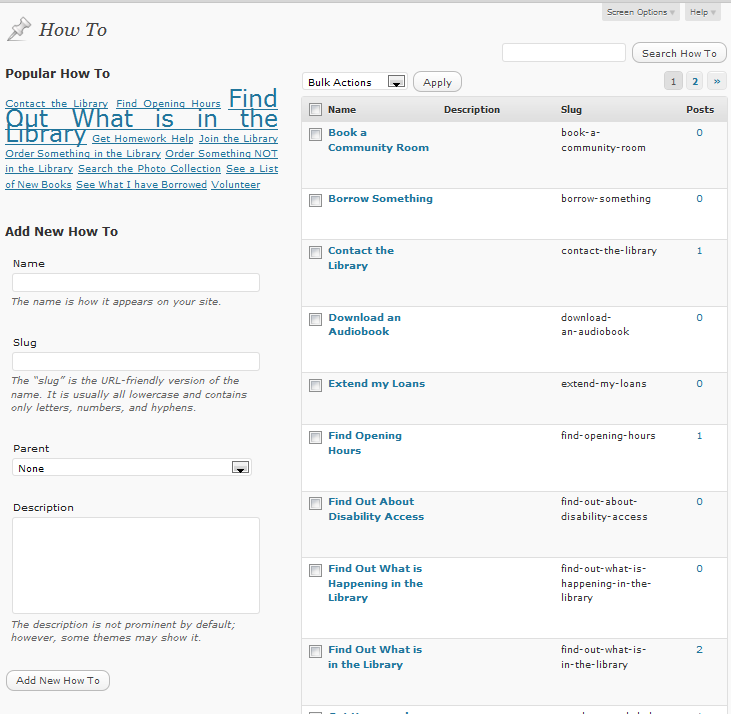
I also want a drop-down menu of “How Do I?” questions like How Do I “join the library” or “use the free wifi”. These will point to the pages, but I cannot use categories for this, as they are only allowed for posts. The solution is to create a new heirarchical taxonomy (that I called HowTo) and associate it with the content type, page. This means that:

  • All pages will have an option to add a “how to” field
  • I can assign the same “how to” to pages under different heirarchies (eg. “Get homework help” to a page under the “Teens” page heirarchy and to a page under the “Kids” page heirarchy)
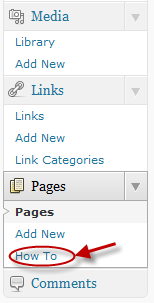
  • The dashboard panel gets a “How to” administration option added on the left sidebar under the “pages” option
  • I can create a “”How to” heirarchy to my heart’s content using a dashboard, like this:

This combines beautifully with the “custom menus” options. I will write a bit more about that in a later post. I will also totally rave about the incredibly customizable free WordPress theme that I am using, Suffiusion. including a bit about the way it creates a “for dummies” interface to create custom content types and custom taxonomies.

Post 14 of the  30 posts in 30 days challenge.
Unread by my bed

Uncategorized

Adding my 2c to the “unread by the bed” meme for the 30 posts in 30 days challenge.

Currently reading: Margaret Attwood’s Oryx and Crake on my iPad.

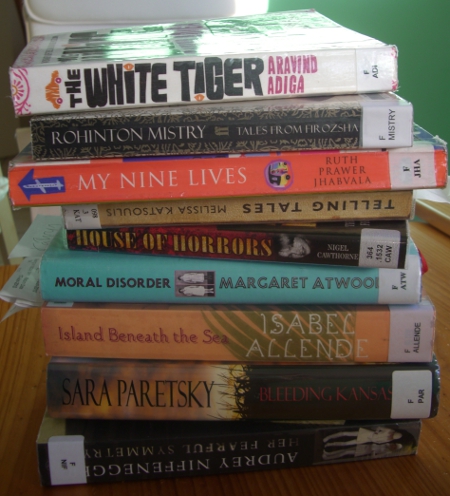
I work in a public library. Good books  follow me home. Most sit in the pile by the bed for a couple of months and then are returned, briefly opened, but unread.

By the bed pile:

Most  seem to be less known works by authors who have had a bestseller.

  • The White Tiger, Aravind Adiga
  • Tales from Firozsha Bahg, Rohinton Mistry
  • My Nine Lives, Ruth Prawer Jhabvala
  • Telling Tales, Melissa Katsoulis
    • history of literary hoaxes. I almost bought it as “aeroplane reading” last time I was in Melbourne, but it didn’t look wonderfully marvellous, so I saved my $$
  • House of Horrors, Nigel Hawthorne
    • about the guy in Austria who kept his daughter locked away and had a second family of several kids with her. I picked up just any book when I was testing things on the database, forgot to return it and so I’m somehow reading it – sensationalist and voyeuristic
  • Moral Disorder, Margaret Attwood
  • Island Beneath the Sea, Isabel Allende
  • Bleeding Kansas, Sara Paretsky
    • set in Lawrence, Kansas where I spent a couple of weeks last year. Totally separate from the V. I. Washawski series
  • Her Fearful Symmetry, Audrey Niffenegger
    • half way through then read a review panning the last third of the book, so have a dilemma – I’m enjoying it so far, do I want to ruin it by completing the story ?

Not next to the bed pile

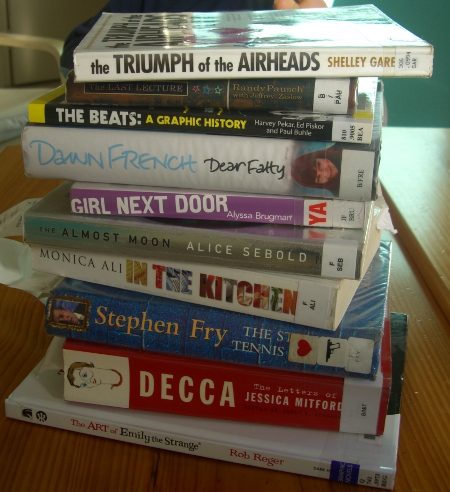
These ones are on the “library book” shelf and I haven’t picked them up, or they are on their way back and I can’t quite part with them yet.

  • The Triumph of the Airheads, Shelley Gare
    • About the decline of public intellectual standards in Australia. Skimmed it already
  • The Last Lecture, Randy Pausch
  • The Beats: A Graphic History, Harvey Pekar et al
  • Dear Fatty, Dawn French
  • Girl Next Door, Alyssa Brugmart
    • YA title. I try to read one every couple of weeks
  • The Almost Moon, Alice Sebold
    • I enjoyed reading “The Lovely Bones”, but the tone of “Lucky” made me feel like throwing the book across the room at times.
  • In the Kitchen, Monica Ali
  • The Star’s Tennis Balls, Stephen Fry
    • Must get on to this one
  • Decca: The Letters of Jessica Mitford, Peter Y Sussman (ed.)
    • I’ve been reading this for the last four years. I left my copy on the plane in Brisbane and am slowly getting through the library copy.
  • The Art of Emily the Strange, Rob Reger
    • Totally read and needing return

And there’s more

Probably the same amount again are on the shelf but I didn’t photograph them …. you get the idea from what is here …

Post 13 of the  30 posts in 30 days challenge.

Memey shrink lit

Uncategorized


I’ve been reading the book meme (Con) , TV meme (Mal), travel meme (Ghylene), the film meme (snail), the two things about you meme (Ghylene) and the “what’s your start screen?” meme (Jenelle) in the 30 posts in 30 days blog posts.

Rather than write a post for each of  the memes, here is the shrink-lit version.

I snack with most activity,

Reading Garner, Helen or Smith, Zadie.

Books are never marked or mutilated,

I remember where my eyes were situated.

.

I don’t watch news, I do download stuff

Being Erica,  Big Bang, and Big Love

90 second ABC News on iPad saves my time

(Which I wouldn’t spend with Channel Nine)

.
Amsterdam is furthest North I’ve been,

Cygnet in Tasmania most Southern I’ve seen,

Calcutta’s bustle, history and vigour I’d recommend

But not to a squeamish or nervous friend

.
Being There, The Graduate, Singin’ in the Rain,

I could watch again and again,

I love movies shot with 3D

Sound of Music I’m yet to see*.
.

Two names I’ve had (from my mum),

Bugalugs and Sparrow Bum,

I’ve worked in a parade as a clown

And  in an orchard thinning apples down

.

Now for the starting screen

Briefest one you will have seen

‘Cause this is a shrinklit one

Here’s the ap that I find most fun

.

.

.

.

.*not really, I just wanted to give snail a heart attack – seen it 5 times and sang along each time

Post 12 of the  30 posts in 30 days challenge.

A post about my cat

Uncategorized

OK – in the attempt to get more personal in the 30 posts in 30 days challenge.. as promised yesterday and requested by Hoi… A blog post about my cat…

Her name is Nougat, after the brown and pink speckles in her cream fur.

Christmas 1995.

She spends as much time as possible during Winter like a joey, zipped inside the front of my jumper.

She’s almost fifteen years old this year, very small, very vocal and eats twice as much as the average cat. When anyone visits she follows them about asking for a cuddle and making sure that they do to her satisfaction whatever they are there to do.

1996. Both much younger than today

She’s a Cornish Rex. She has just the “down hair” layer in her coat, without the other two thick glossy layers of fur that most cats have. In 1950 a mutant barn kitten was bred back to his mother, and the breed started. Keeping herself warm takes much energy – hence the big appetite and snuggle compulsion.

Not content with creating a mutant cat, breeders went a step further and created a Siamese marked version, which is how Nougat got her bright blue eyes, torti points and conversationalism. The variation is known as a Sirex …. Yup that’s where my profile name comes from.

Oh – and as this photo taken tonight shows, she writes all my blog posts:

Post 12 of the  30 posts in 30 days challenge.
Putting yourself out there in context…

Uncategorized

This post isn’t really  personal enough to fulfil my week of personal blogging part of the 30 posts in 30 days challenge. I promise that the next one will be about my cat.
Yesterday, I tweeted something that touches on two great conversations that are going on in the 30 posts in 30 days blogging community:

@katiedavis FWIW My problem with “Libs do Lady Gaga” was – nooo… don’t make them use catalog, get ur good stuff out where they are looking

It was in response to Kate‘s tweet a couple of minutes before,  talking about how she was in a debate over at Sophie’s blog about what was the “hub” of students’ experiences, how the library can position itself there and what the future and role will be for the library. The comment that she had just written was:

as new educational environments develop, the classroom is definitely not the hub – especially because in some contexts, there is no classroom, no physical coming together of the cohort.

imho, i think students’ hub is the web, full stop. there are nodes scattered around the web that represent particular places that they frequent – facebook, their favourite search engine, twitter, wherever comes next – but ultimately, i don’t know that students really care where on the web services and resources are positioned. It’s about whether they can find services and resources when they want them. the web is the hub – that’s their environment.

student’s couldn’t give a shit that libraries buy millions of dollars worth of content in aggregator databases and that it’s all authoritative and whatever else. they care that they can find the information that they want and need, when they need it, in the format they want it. in a student’s mind, if they do a google search, they should find everything. and who’s to say that attitude is wrong? rather than focus on directing students back behind our walls, why don’t we figure out some way to expose all of our content through google? are we focussing on the wrong problem here? yes, we want students to be literate in their use of information, but surely the answer is not to force them to use our clunky interfaces?…

Kate’s comments immediately gave me an earworm of  “you can use my catalog” – from the Librarians Do Gaga clip, hence the tweet. (And another couple of tweets  when someone admitted they hadn’t watched it – to the effect that I thought the librarians were cool, but wondered whether the message was one that we wanted to project)…

And then here comes the other conversation connected to my tweet (and other peoples’ comments)  Putting yourself out there . Mal talked about the Librarians Do Gaga clip in the context of librarians putting themselves out there, having fun, showing their voice and showing guts, initiative energy and imagination. Yep the clip showed all that. And yes, it was very worthwhile in that context. And I liked the production values too – great voice and a very good job with the scenarios and the editing. And full of tongue-in-cheek references to stereotypes that showed they were aware of them and *playing*. And in that context I absolutely applaud what they did.

My comment, though, was made in the context of a discussion about “forcing users to use our clunky interfaces”.  In that context, the vision of (albeit cool, well intentioned and technically clever) librarians endlessly repeating “you can use my catalog”  scares me. In the context of the discussion on Sophie’s post, some of the lyrics (which are here at Sarah Wachter’s site ) do read like “your’e doing it wrong if you’re not using our tools, even though you won’t understand them without librarians’ qualifications”…

I think part of putting yourself out there is to do with letting go of the context in which you will be read… So my tweet could come off as ill-tempered grumpypantsing if read out of context, and the Gagabrarians could come off as my worst nightmare if read in another …

I’m also open to the possibility that I was just grumpypantsing. Anyhow, this Norwegian video about plagiarism below made me feel a whole lot less grumpypantsy, although it’s slickness is almost antiGagabrarain….

Taking a leaf from two other 30 in 30 bloggers,  moonflowerdragon and newgradlibrarian‘, I’ll have a go at citing it…

Selvik, S. (Producer). (2010, May 27) Et Plagieringseventyr . Retrieved June 10, 2010 from http://www.youtube.com/watch?v=Mwbw9KF-ACY&sns=em

Post 11 of the  30 posts in 30 days challenge.
Learning, breathing and flowing

Uncategorized

With my week of personal posts, I may as well jump straight into something meaty. Con asked to know about

how you learn. How you choose what to learn. How you practise what you learn?

… and no, in answer to your question,  it’s not too meta… Kylie also wanted to know about this one.

It’s a bit like asking me how I choose which pocket of air I’m going to breathe next. Ummm… it just finds me and I just do it.

I don’t seem to have moments when I sit down and think “what shall I learn next?”, or “I’d like to know about xyz, I think I’ll go out an find out more about that”. I’m just like a vacuum cleaner sucking up everything that gets in my path – and I seem to find most things fascinating.

Not switching off a lunchtime at LIANZA Nov 2008

The more I read about ADHD the more I think that I am probably a case of ADHD gone right…or rightish. This would put me in some very good company.  People with ADHD don’t have problems with paying attention to things, they have problems with modulating their attention. This means that some kids with ADHD can get caught up doing a project for hours and hours without eating dinner – and their parents conclude that they can’t possibly have ADHD because they can pay attention so well. Kids with ADHD may have trouble switching off one channel of information (eg. visual) to pay attention to another (eg. auditory) – classic “oooh , look shiny!!!!!” stuff.

For me, I seem to be paying attention to everything all at once all the time, and I seem to have learned how to modulate this artificially. In maths lessons I used to draw the teacher and my classmates, which took the edge off my desire to pay attention to something else – so it actually helped me focus better on what the teacher was saying about maths. In conferences I take notes and tweet because it takes the edge off my mind that would otherwise be wandering, so helps me pay better attention to the speaker. I seem to need to switch on more than one channel (visual, kinesthetic ) at the same time so I can focus on listening – otherwise my need(?) for stimulation on the other channels makes me go off searching for it, and I lose track of what the speaker is saying.

How does this relate to learning? Well, being immersed in learning is one of the best modulators I have found. I suspect – and correct me if I am wrong – that I have a higher motivation to get into a state of “flow” than other people. This diagram from Wikipedia is a nice encapsulation of where flow sits in relation to relaxation, boredom, worry and control:

Mental state in terms of challenge level and skill level. Released into the public domain by its author, Oliverbeatson

I am very, very lucky in that I don’t get bored.  Or really worried too much. But then again, I don’t spend a lot of time relaxing either. Whatever staying still and just being does for other people, being in a state of flow does for me. I used to meditate, which is a great way to still the mind,  and I find exercise a really beneficial way to relax. When I look at the chart above, though, I see that theses activities are still in the “High challenge, high skill” sector.

Hey – thanks to your question, I just learned that  Mihály Csíkszentmihályi (the main Positive Psychology flow guru) has a concept of  the “autotelic personality ” – people with a high level of curiousity and persistence and desire to do things “just because”, rather than external reasons. … maybe that’s me ??

But, that doesn’t answer how I decide what to learn, just that I am highly motivated to be learning all the time. It really does feel like whatever I end up learning just finds me. A common thread in my writing and projects in the last couple of years has been around people organising together outside formal and traditional structures – but I wouldn’t say that I consciously set out to learn as much as I could about this. As to practicing what I learn, again, it seems to just happen. I do like to get out of the abstract and set up a concrete project – but usually one that involves extending my skills and learning as I go, rather than repetitively doing the same task that I have thoroughly mastered.

I don’t know if it answered your question, please let me know if it didn’t.

Post 10 of the  30 posts in 30 days challenge.
First have something to say…

Uncategorized

“First have something to say”. That’s my cardinal rule of blogging, which is what makes this 30 posts in 30 days challenge…well… a challenge. It’s similar to the Twitter365 Challenge, where sometimes I ended up with the oddest photos just to take a photo of something…

265/365 How to eat a Choco-bat

I’ve had less to say over the last six months with a change of jobs and completing my studies, and this blog has reflected that.

A couple of days ago, Sue wondered about blogging about professional issues and the effect on one’s career – the effect of having too much to say and it being taken the wrong way. She kicked off from a couple of posts from the insightful, wise and direct Dorothea Salo who has been concerned about her blog damaging her career as she moves to new responsibilities. Con and bookgrrrl put a different slant on the topic, looking at one’s own perception of having something to say – what made one “worthy” to have a voice in the professional area (conclusion – sensibly- there is not qualifying criteria, just do it).

Kate’s response has been closest to where I am. She has no problem with blogging about professional issues. That’s why she created her blog. She blurs her personal and professional anyhow, but wonders whether she could now start putting more of the personal into her blogging.

I’m wondering the same. I have another 22 posts to go in the 30 posts in 30 days challenge. After a week of trying to do “think posts” I’m going to change my goalposts and aim for a week of getting more personal. I’m not going to avoid the professional, but will maybe push it over to librariesinteract.info .

Now, I was going to talk about my motivation for blogging and how I have so far blended/separated my personal/professional…except I have written a post’s worth already and after reading Michael Agger’s post about How We Read Online, I daren’t .

(Except to say that I find it really confronting to think about blogging personally. I think I have built up my readership around the professional topics and “voice” of the blog – and mixing it up might disappoint my readers who come here for library thoughts, not to find out about me.

Maybe it’s a bit like a restaurant though – mix it up every couple of years or go out of business ( although here I sit in Gino’s coffee shop in Freo that has been the same for 25 years or so…)

So – to keep it useful to my readers, what do you want to know? What would you like to hear about? What have I been omitting in the blog-me that you would like to know about? What’s something you’d like me to talk about? )

Post 9 of the  30 posts in 30 days challenge.