Library unconference for Western Australia

Uncategorized

I’m involved in planning a library unconference for Western Australia, hopefully at the State Library of Western Australia and hopefully in the first half of the year. You are welcome to join in – you don’t have to work in a library. You can just be library-curious.

The Yarra Plenty folks look like they had a ball with theirs a couple of weeks ago. Michelle and Genevieve were there.

Yarra Plenty unconference

Uploaded to Flickr by YarraPlentyLibrary on 2 March 2007

Topics covered on the day were:

  • Web 2.0 = library 2.0?
  • Wikis
  • RFID in libraries
  • Literary blogging
  • Information literacy : overcoming fear
  • OPACS and mashups
  • Library education
  • Young people social networking
  • Virtual services universal? /sharing resources
  • Second life tour
  • Re-engineering reference, IM and virtual reference
  • Library 2.0 : 23 things program
  • Tagging reader recommendations : creative tools
  • Convincing stakeholders of our worth

For our planning group, defining success was really interesting. We’ve decided that if people come away inspired and think that the time spent was valuable, then the event will have been successful. We’re not basing success on the numbers of people who turn up, or the money we make, or how orderly the proceedings.

The unconference wiki contains this information so far:

You can subscribe to the RSS feed for changes to the wiki or to the unconfwalib google group to receive unconference planning emails.

The accidental avatar

Uncategorized

Are avatars only pictorial representations of your self online?

Not necessarily, according to Susan Wu in her post about a panel session at SXSW – SXSW:Virtual worlds and avatars.

… But the truth is that everyone who uses any web site today already has an avatar – we just aren’t using the graphical metaphor of a virtual character to represent them.

So when I post a cutesy “unavailable” message on my google talk, or blog here, or twit way too much from my twitter account, or send an email, I’m creating an online identity which may or may not have the same characteristics as my offline personality.

Let’s presume we can call this online presence an avatar. If so, then it would be interesting to see how research done on avatars in 3D environments can be applied to this creation. For example, this paper about The Proteus Effect: The Effect of Transformed Self-Representation on Behavior , where the authors found that:

…participants assigned more attractive avatars in immersive virtual environments were more intimate with confederates in a self-disclosure and interpersonal distance task than participants assigned to less attractive avatars. In our second study, participants assigned taller avatars behaved more confidently in a negotiation task than participants assigned shorter avatars.

Makes me wonder what an equivalent to physical attractiveness would be in a non-pictorial avatar. Collegiality? Friendliness? Ability to make sharp and intelligent observations? Supportiveness? Adhering to the conventions of the online “place” and not seeming totally newb?

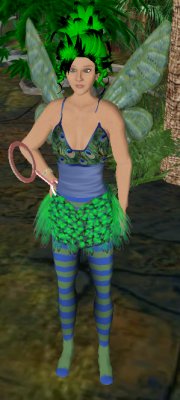
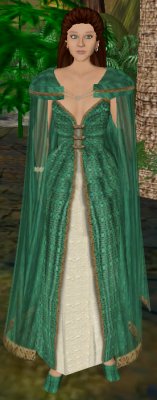
I also wonder whether the avatar I create with words is closer to the first or second image below. Or something completely different – a pink bunny or a talking spotty teapot maybe.

emsvargafairy.jpg emsvargacape.jpg

Virtual Learning Commons at University of Manitoba

Uncategorized

MPOW is currently renovating a couple of floors of the library to make a Learning Common. We’re creating an area with lots of bench space and PCs, where students can gather and access services in the one spot – like library materials and staff, the First Year co-ordinator, IT service desk, print shop and our Teaching and Learning staff. Part of the building will be open 24/7.

I’ve been chirping on about how our online space should match the attitudes and philosophy of the new physical space, but didn’t have a clear picture of what I meant. Until I read a post on Linda Bedwell’s “Five Weeks to a Social Library” course blog. She linked to the University of Manitoba Virtual Learning Commons. “Aha!” said I, and “aha” again.

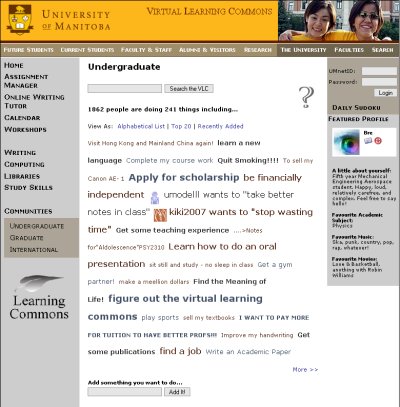
unimanitoba.jpg

They have made a mini social network, based around a tag cloud of “what I’d like to do” suggestions similar to 43 things. A random profile is featured to the right. There is a Flickr stream on the bottom of the page (not shown).

I wonder how moderated the “something you want to do” list is. Surely their thoughts are more pop culturally, hormonally and substance driven than that? But maybe, just maybe…these kids can read and understand the social space and have set an appropriate norm without intervention.

This page would have kept me coming back when I was at Uni. Heck, I came back to read the “feedback to the library” suggestions and answers on paper cards pinned in the library lobby when I was a student. It let me know that other people were thinking the same as me, and having the same experience of Uni.

Just like a physical learning common, where a community of learners socialise as they learn but have access to expert university support when they need it, the sidebar provides links to several university services to support their learning. Writing, computing, libraries, study skills, asssignment management, online tutor – all the things we aim to have in our new physical space are there online.

UPDATE: 20 March 2007. I’ve just discovered that the software that generated this is Open Source and available on Sourceforge.

What libraries don’t do anymore

Uncategorized

I’m a Philosophy Subject Librarian, I’m supposed to know about existential angst.

In the last week, I’ve been obsessing about what libraries and the profession will look like in 30 years or so when I retire. I’ve been wondering what we should do now to shape that.

OK, I’ll start with what don’t we do anymore.

  • We’re not only about books. And haven’t been for decades
  • We are no longer gatekeepers of knowledge, popular and obscure. Public libraries are reducing their non-fiction and reference collections. Not only are undergraduates using information from Google Scholar as the basis of their assignments, but academics are letting them.
  • We aren’t “halls of shush”. Unless your library has a silent floor, there is no longer an oasis of peace and studiousness in our buildings.
  • Archives and libraries of deposit have become representative rather than comprehensive records.
  • Not all of our collection is contained in our buildings anymore.
  • Our clients can use our services without direct contact with any of our staff.
  • Most of us do very little original cataloguing.

This destabilizes me a little. Back when I was 8 or so and catalogued my Enid Blytons, I knew that when I grew up and was a librarian, I would work in a quiet library looking after books, cataloguing and processing them and helping people find information. It was what librarians DID.

I think tonight’s bout of “I don’t know what we do anymore”, was partly prompted by reading Karen Schneider‘s rant on ALA Techsource, Dear Library of Congress…. where she suggests that instead of loooking at bibliographic control as a major issue, the profession is in a state of emergency and we need to address what we are selling out, to whom and what that does to our basic tenets – one of which is the right to read.

Here’s a chunkette that I found particularly relevant. (By the way, I hope “rant” isn’t offensive – ranting articulately and effectively is a talent I wish I had).

It is both ironic and poignant that librarians are still worrying about “bibliographic control,” after ceding so much of the same to the companies that now rent them journal access per annum at usurious rates, digitize their book collections into DRM obscurity, or sell them ponderous, antiquated “management” systems that on close inspection do little more than serve as storehouses for the metadata specific to the formats of bygone eras, bold days when we saw our central roles as defenders and curators of our cultural heritage.

We have moved from the librarian as information artisan—a professional creating and using tools to manage information—to the librarian as surrogate vendor, facilitating what is essentially the offshoring of thousands of years of information into private hands.

UPDATE 10.03.07: CindiAnn was also was struck by this passage in Karen’s post and her response, Library Agitprop , presents 7 theses about the future of libraries. Worth checking out.

Anyone can be a futurist…

Uncategorized

…and ought to be.

So said Richard Neville during his “Future Quake” talk last night as part of the University of Western Australia’s Universitiy Extension program.

trialoz.jpg

In the late 80’s I lived across the street from school, and rushed home at lunchtimes to see whether a particular sparky brained, fast talking “social commentator”was on the Mike Walsh Show . The Trials of Oz was my favourite book as a teenager, which made me wish I’d founded a radical underground magazine and been arrested in the late 60’s for “encouraging urination in public ” (Australia) or “conspiring to corrupt public morals”(Britain).

(If you want your mind expanded, baby, here’s an archive of each Oz magazine. If you venture there, ensure the under 18s are not near your machine)

One of his theses last night was that “your whole life can change by noticing something and acting on it“. For example Felix Dennis, co-defendent in the Oz trials, made an awful lot of money with hand printed Bruce Lee posters, and a Kung Fu magazine, after noticing the crowd at a cinema showing one of the first Bruce Lee movies in London. In 1971, if you saw one of the first hand held calculators you may have said “good, that will help me add up”, but what you probably wouldn’t have noticed was the “weak signal of portability” that it encompassed. These “weak signals” are all around, but noticing them, and then acting on them is the key.

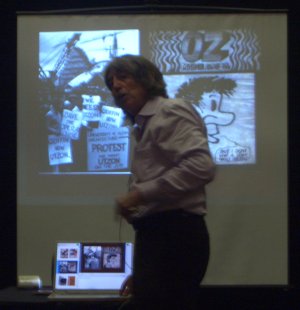
nevilleoz.jpg

He’s an incredibly mobile speaker -fast talking, wide hand gestures and often threw questions to the audience to answer (How many people worldwide are moving to urban areas each week? How much did the CEO of Exxon earn per minute?) – and prompting us with “come on, come on” when an answer wasn’t forthcoming.

We looked at how future perils may hold promise – like the creativity that we’ll need to embrace to cope with environmental crises. Here’s some new ideas I picked up:

  • Bio-mimicry – observing nature and applying its solutions to our technical problems.
  • The Eastgate Building in Harare which using principles from a termite mound for cooling
  • Ratio of poor:rich worldwide changed from 6:1 in 1980 to 220:1 now
  • Glocalization – being able to think and act both locally and gloabally at the same time
  • Dong Tan City in China is a new eco-cty which aims to be energy neutral.

Nice to learn new ideas, but for the teenager in me, the highlight was this exchange:

  • RN: What was one of the starting points for the information revolution in the 60s?
  • Crowd: Televsion, TV???
  • Me: Paperbacks
  • RN (to me): You’re a soulmate
  • Me: I’m a librarian

Ning network for Library 2.0

Uncategorized

Want to play with a social network? Practice adding friends, contributing to forums, blogging, uploading photos and files?

Like to explore the ideas of Library 2.0?

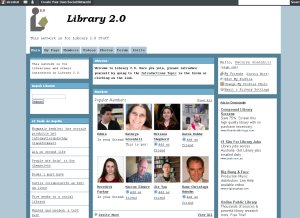
The newly created Library2.0 Ning network may be just the thing for you. To join up, go here.

ninglib20.jpg

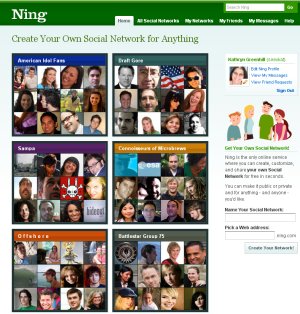
Ning is a site that allows you to create a community on a Content Management System kind of background. So, why not just create your own social network on a CMS, and invite your friends over? I guess because it’s all “up there” on the web, you can create a number of networks at once, and you can poke about to find other networks and join with your Ning membership. For developers, it’s even more. It’s a platform that allows you to make changes and feed them back into the Ning community.

ningpage.jpg

I’m coming out of the closet here to admit I HATE the label “Library2.0”. I’m happy to explore the new attitudes and demands that new web tools bring, and to work out how new web tools can serve our clients better. The “Library2.0” name smacks of faddism and impermanence. This is a pity, as I really support what it stands for, just hate the easy target of such a dumb name. Ideas good, name dumb. I don’t have any better to suggest, so I’m stuck with using it.

Over 150 people have joined since the network was set up a couple of days ago by Bill Drew. It’s had over 13000 hits so far. It’s taking a long time to load pages right now, which I hope is just a temporary glitch and that it can handle the volume. The delay would be enough to stop me using the site.

Anyhow, worth checking out. I have found four other Australians there so far. If you do join up, feel free to add me as your friend.

Books and circuses

Uncategorized

Circuses? They’re all about performing animals and clowns that do slapstick and must have a ringmaster with a big black moustache, right?

Libraries? They’re all about books and being quiet and must have a circulation desk and a reference desk, right?

I’m just back from ooohing and aaahing at the latest offering from Circus Oz called Laughing at Gravity (gotta love those puns). Their high energy performance showed how circuses have morphed to fit their audience. The ring master was a high octane woman with glam silver boots, a style which crossed diva with Frank’N’Furter and who belted out songs like “La Vie En Rose” and a piece about trying to be an object of female beauty in the age of global warming.

circusoz.jpg

There were no animals involved, but people doing amazing things with their bodies and circus apparatus. The style was distinctly Australian, but edgy and owed a lot to musical comedy – although much more Caberet than Oklahoma. One of my favourite parts was the strong woman who did a bendback, had three concrete slabs placed on her abdomon and then…and then….kept still while a man with a sldegehammer smashed the slabs to smithereens. They even incorporated new technology – a bloke who swang out on a rope, missed his target and kept swinging until he hit a wall and…stuck!. The velcro fuzz on the front of his tracksuit met the velcro hooks of the wall.

Yesterday, I heard from a library manager who, like Circus Oz, has been transforming his craft to fit his audience. Chris Szekely ,who has just finished as City Librarian of Manukau in New Zealand, gave the closing keynote at the loclib biennial conference. The conference is aimed at Western Australian public librarians, but some of us from other sectors (Hi Sue!) came along for a couple of presentations from US library blogging legend, Jesssamyn West (Hi Jessamyn!).

Chris described how they redefined and repositioned their services when they were faced with a growing population, the need for more libraries but not many more staff allocated. Among other points he described the Botany Library, the Idealibrary (gotta love those puns), which was built in a new retail hub taking a lot of service ideas and design elements from the surrounding shops. There are no service desks, but staff who wander the floor restocking, serving the customers and acknowleding everyone who walks in within 90 seconds of entry. They implemented RFID as a security system – which lets someone checking out their entire limit of 35 items to do so by placing them in a single pile on the self-check machines.

An area aimed at youth (covertly – not with signage!!) takes design from night clubs, with a mezzanine and subdued neon lighting and a disco ball. Magazine displays compete with those in nearby newsagents. Display walls of books, which look like bays in a video shop, can be turned to create a separate space for study or events. A quiet area is enforced not by signage or staff, but by having a totally different ambience to the rest of the building. The Staff were chosen not for librarianship skills, per se, but for their ability to fit the customer service model. Consequently, 90 percent of the staff are men under 25. A very unusual proportion in a traditional library.

circusoz2.jpg

Like Circus Oz, we need to embrace new technologies, define the core of what we do and then highly hone those skills – maybe throw in a bit of glitter and disco – and continue to do our best to delight our audiences.