Murdoch University Library needs a Repository Co-ordinator and a Repository Technical Officer.
If you are interested, follow the links above, look at the descriptions and apply before Friday 27 June 2008.

Murdoch University Library needs a Repository Co-ordinator and a Repository Technical Officer.
If you are interested, follow the links above, look at the descriptions and apply before Friday 27 June 2008.
Half of the people who commented on my Steampunk, Edupunk and Libpunk post said they wanted a libpunk t-shirt, so here it is:

Amy Buckland emailed me to say she was making a libpunk sticker for her laptop, and asked whether I wanted one.

Amy fiddled around with some designs reminiscent of the “Edupunk” badge. At one stage we had the tagline “DIY libtech”, but that made even less sense.

It just grew from there, so now there is a CafePress Libpunk shop where you can also get a mug, a button or a particularly nice looking messenger bag:


They are selling more or less at cost price and I’m not making any money from this. Thanks so very much to clever Amy who set this up.
Walk on by this post UNLESS you are thinking of getting a laptop running Vista soon. It documents a solution to a problem that I hope you will never have.
Work bought me a new *red* Dell XPS 1530 laptop which is running Vista. Delivered last Thursday. Brand spanking new. Ready to serve, for the next three years or so, someone with the cryptic job title of “Emerging Technologies Specialist”. A primary need is that I can run Second Life. So we went for pretty high specs.

There is a know problem with NVIDIA and ATI graphics cards and Vista and the position of the planets and goodness knows what else. No-one seems to know (=take responsibility) for the problem. People attribute it to badly written driver, overclocked machines, Vista bloat, overheating PCs, not enough RAM – who knows.
THE PROBLEM
High intensity graphics use causes the individual program to freeze, flicker and then the screen to go black … and the dreaded error:
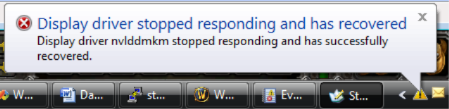
DISPLAY DRIVER NVLDDMKM STOPPED RESPONDING AND HAS SUCCESSFULLY RECOVERED
Googling “nvlddmkm” brings back 63800 results – waaaaay back to the advent of Vista, and still no solution. It seems that some fixes work for some people some of the time. Sometimes replacing the graphics card works, sometimes not. Sometimes it just appears and sometimes it goes away.
WHAT COULD HAVE WORKED BUT DIDN’T
1.Upgrading the graphics drivers and the bios
2. Administrative tools > Task Scheduler > Scroll to the bottom, in the bottom box, scroll down till you see ‘TMM’. Double click ‘TMM’. Right click it and select disable.
WHAT DELL SAID:
Dell didn’t really have any solutions but suggested:
3. Going to control panel > personalise and turning off AERO (That thing in Vista that lets you see blurry windows under the current one)
4. Going to the Second Life icon, right clicking on it and selecting “properties”, then running it in XP SP2 compatibility mode (yes, *turn off* DirectX10 – which is why I wanted Vista in the first place )
5. Installing this Vista update: http://support.microsoft.com/?kbid=938194
6. That they send out a technician to replace the video card in my laptop.
WHAT I DID IN DESPERATION
More goolging. Came to this post on the SteveX Compiled blog: Display driver stopped responding and has recovered – from 15 months ago. Among the 115 comments, I found the comment from klasu that *I hope* provided the fix for me . It involves tweaking the settings on the NVIDIA control panel. Reproduced below:
My fix is here:
1 unninstall nvidia drivers
2 Let Vista install display driver itself. Now display driver is 11.9.2007 / 7.15.11.6369 (check device manager/display adapter)
3 Use following settings in nvidia control panelanisotropic filtering = 4x
antialiasing gamma correction = ON
antialiasing mode = override ….
antialiasing seting 4x
antialiasing transparency = OFF
conformat texture damp = OFF
error reporting = ON
extension limit = OFF
force mipmaps = none
multi display…= SINGLE…
texture filtering anisotropic sample optimization = OFF
Texture filtering negative lod bias = ALLOW
texture filtering quality = HIGH QUALITY
texture filtering trilinear optimization = OFF
triple buffering = OFF
Vertical sync = use 3d application settings
I’ve been running Second Life for the last three hours or so with no crashes. I haven’t switched DirectX10 back on, but it seems fine without. I’m crossing my fingers.
I note, however, that today UnliscensedFish left a comment on the post indicating that no solution is working for her and that she thinks it’s time for class legal action.
UPDATE 4 hours later: Aaaaand … I took a screenshot in Second Life using Jing ….. and I had the same problem. I hate the idea of asking Dell to replace the video card when it may not fix it … and of being deprived of my PC …. any ideas anyone ?
UPDATE 30 June 2008: I tried installing a different driver for the card about 2 weeks ago, available from here: http://www.laptopvideo2go.com/forum/index.php?showtopic=18049
Since then the whole system seems to run a bit slower, but I’ve only crashed with the nvlddmkm error three times. If it keeps doing it, however, I will be asking Dell to replace the card.
All will be revealed by the time I wake up tomorrow.

Want to know how to do it? What are the tools and issues? How to implement a 2.0 service ?
Check out Meredith Farkas‘ slideshow on slideshare.net – Building Academic Library 2.0. While many of the points made will possibly not be new to you, it is very nicely encapusulated and summarised, with heaps of screenshots.
STEAMPUNK
OK, so this keyboard is steampunk :

And so is this dalek:
Steampunk Dalek – colour render
EDUPUNK
And on 25 May 2008, Jim Groom coined the term “Edupunk” in his post The Glass Bees . He’s continued to define it and the self-identified edupunkosphere has been buzzing to join in. Today, my friend Wikipedia has the following to say… although being a neologism, the inclusion of it at all is being contested.
Edupunk is an ideology referring to educators and education strategies with a do it yourself (DIY) spirit. Most instructional uses of blogs, wikis, various mashups, and podcasting among many other uses of emerging technologies might be described as DIY education or Edupunk. The term was first used on May 25, 2008 by Jim Groom in his blog, [1] and covered less than a week later in the Chronicle of Higher Education[2].
Examples of Edupunk are Legos, Edusim, chalk, Hypercard, Moodle, use of the Bliki (blog and wiki mashups), students’ art work on the outside wall of the classroom, and students teaching their teachers how to use technology.
Edupunk is also a rejection of efforts by government and corporate interests in using emerging technologies to exercise control over education, its processes, and its stakeholders, somewhat similar to punk ideologies. There is also an element of resistance to large and influential education businesses like Blackboard cooping emerging, collaborative, DIY technologies and techniques and repackaging them as their own product.
Soooo…..
LIBPUNK
Does that mean that these actions *might* be an example of what we could, if we wanted to join the hysteria, call “Libpunk” ? Librarians using non-proprietary products and groupings not based on institutional alliances to practice their craft and communicate their practice? Open, collaborative enterprises based on not making money, but often on increasing social capital or extending knowledge?
Discuss.
…for teacher librarians this time – School Libraries and Web 2.0 Unconference . And other people interested in Web 2.0 and school libraries. That’s me! I’ll be there.
The unconf is being hosted by the Educational Computing Association of Western Australia. The association had their Echalk 2.0 unconference in May. I watched the twitter streams of several people as they attended it and it looked like a great event with lots of learning.
DATE: Saturday 28 June 2008
TIME: 9am – 3:30pm
PLACE: Guildford Grammar School Senior Library
COST: Free . They want registrations for catering purposes
WIKI: The agenda for the day is here.
I like the way they have asked participants to list what they already know about and what they would like to find out about. I see that someone wants to “Learn how to be a good trendspotter and an early adopter”. I’m going to offer to do a session on that, not because I think I know all about it, but because I *don’t* know all about it, and I think it would be a good way to learn.
Thanks to Merriwyn for giving me the heads up when commenting on my post about the Library 2.0 and beyond: getting our hands dirty unconference on Friday 22 August at the State Library of Western Australia.
UPDATE: Password to edit the wiki is ecawa2008
Morgan Wilson started it with his discussion of how to reconcile one’s personal ethics with the system and practices that one supports professionally, Living with myself as a law firm librarian . He asks the question that I hope all of us ask about what we are paid to do:
It is important for me to go to work knowing that I am doing good of some sort in the world. At the very least, I don’t want to be causing harm. How are these concerns resolved in the law firm environment?
After a very interesting discussion of the pros and cons, he concludes
I cannot know on a day to day level if my work is causing good or harm in the world. All I know is that without lawyers and law librarians, our complicated legal system would grind to a halt, and that would be a bad thing.
Michelle McLean continued it with her discussion of ethics in public libraries,Personal ethics in the library. She looks at her approach when stock in the library conflicts with her own personal preferences and beliefs, and also at the general ethics of her workplace. She draws an interesting conclusion that I’d agree with:
Library staff can be highly ethical creatures and will do much to serve our users and to protect their interests (including potentially lost property, however insignificant to us). That doesn’t mean we are perfect, maybe its more a case of library work drawing those who are community minded, etc. That’s who we are, both personally and at work.
I’ve run services in both a law library and public libraries. A major reason I left law libraries was the ethics. I worked as a librarian/researcher in a commercial law firm in Perth during the peak of the 1980’s WA Inc. years, when much money was made and much honour lost. It was a totally wacko environment. I was studying law while I was working there, and used to tell myself I was there to “know mine enemy” – to reinforce to myself that my aim to be a feminist based, community lawyer was right for me. It actually totally turned me off continuing law, as I couldn’t bear to have the majority of my professional peers as lawyers.
I was doing research that was “billable”, so clients were charged in units of 6 minutes for my time. When I did tasks that weren’t billable against any client’s file, but lawyers wanted to justify my time, they used to bill it to a tobacco firm that they represented in a case against a dying man. I could never get my head around the ethics of that – on the one hand ripping off the cigarette company softened the ethical dilemma of the fact that the firm worked for them, on the other hand, it was still ripping off a client.
One of the reasons I later worked in public libraries was again the ethics. It really did feel like a “higher calling” – providing necessary services and enhancing the beauty and the utility of people’s lives. I liked it that the aim was to build social capital, and that I was paid because regular citizens ( through their local council ) were prepared to pool their money to provide library services. I worked in community information for a spell, and just reading the phone book for someone, or telling a little old lady where she could get a foam rubber wedge cut to prop her invalid husband’s leg, was probably the most valuable work I’ll do in my career.
Michelle asked about ethics in other libraries, like academic ones where I work. I guess a major part of our ethical dilemmas is around the fact that a proportion of our first years are under 18, so not legally adults. What do we do if in the name of academic freedom and enquiry, we buy an item that is classified as restricted to 18+ . What do we do if our 17 year olds want to attend one of our Second Life workshops, when we know that Second Life is restricted to those over 18? What about serving alcohol at a library based function where 17 year olds may attend?
In an academic library, I don’t feel as though I’m Doing Good, like I did in public libraries, or like I’m Doing Evil like I did in a Legal Library. These days, my personal ethical dilemmas tend to centre around the best use of resources, like staff time. For example, I would be very uncomfortable supporting educational practices that I believe to be unsound and detrimental to students, like a learning technology that makes them disengaged, or is too cumbersome for instructors to use. Or financial resources – like spending a high proportion of a program’s budget on print resources that only the lecturer and one other student will read at all.
These ethical dilemmas, however, are not unique to libraries. Anyone in any workplace can be “back seat boss” and concerned about the way their organisation’s resources are being used. I guess the solution is similar to Morgan’s – when working within an imperfect system one should always try to do one’s best by one’s clients, and hope that the good done by their workplace outweighs what it does in a flawed way. I’d go a little further, however and add in the Serenity Prayer – one should be able to accept the things that cannot be changed, have the courage to change what needs to be changed, and the wisdom to know the difference.
How are things changing?
ACMA Report
If you want an official Australian Government version, read Top Six Trends in Communications and Media Technologies, Applications and Services – Possible Approaches produced by the Australian Communications and Media Authority in March 2008, but only released this month. The ACMA is Australia’s regulator for broadcasting, the internet, radiocommunications and telecommunications.
The trends identified were:
1. Accelerating pace of change
2. Diversity in physical infrastructure and higher-speed broadband networks.
3. Distributed connectivity
4. Emerging content and network management technologies
5. Web-based services and the emerging “social web”
6. Continuing scientific and technological innovation
The report authors seem strangely comfortable when they talk about wires and gizmoes, but when it gets to the more slippery areas of social networking, they seem to want to just define what these things are and then run away as fast as they can. Maybe these topics are outside their brief. Sentences like this, however, do have me scratching my head in puzzlement:
SNS [social networking sites] may evolve over the next five years to become integrated hubs for individuals, organizations, and their extended networks to connect, communicate, access and share tailored news, information and entertainment
*May* ? *Next five years* ?
It was clear that they were also uneasy about those crazy kids and their mesh networks :
. .. in a self selecting community of mesh users, it may be difficult to distinguish between public and private communications over a mesh network. Individuals who set up and/or use mesh networks may not be fully aware of the consequences or risks associated with open access arrangements.
Those Wacky Kids
If you want a much more entertaining look at how things are changing on the education front, check out Mark Pesce‘s recent presentation to a group of educators in Brisbane: Those Wacky Kids . It looks at the effects of having a hyperconnected bunch of people – many, many of them under 15. I like this slice of life of a schoolkid:
These “hyperconnected” and ever-more wacky kids get up in the morning, put on their uniforms and go to school. When they get there, they’ve got to turn off their mobiles, put away their iPods, close the chat windows, unplug themselves from the webs of co-presence which shape their social experiences, sit still and listen to teacher.
And they’ve got to do this inside of an environment – the classroom – which is so thoroughly disconnected from the rest of life as they have always known it that it must, deep in their co-present souls, resemble nothing so much as a medieval torture chamber. An isolation tank. Solitary confinement.
It’s not just that school is a pain in the ass. It’s that it looks – to them – like a completely unrealistic pain in the ass, one which is out of step with the world beyond the classroom walls. It’s as if, every morning, these kids are marched into a time machine which transports them back to 1955.
Hyperconnectivity in the workplace
If you want to find out more about the effects of Hyperconnectivity on the workplace, you could read the paper that telecommunications company Nortel commissioned, the Hyperconnected: here they come (May 2008). It does, of course, try to lead the reader to conclude that they need products just like the sponsor provides – but if you can get through all that, it’s quite useful. If you don’t want to give them your email address in return for reading the paper, you could still glean much of it from this ArsTechnica article: No off switch: “Hyperconnectivity” on the rise . Snippets from the report:
Finally – hyperconnected friends, enemies and armies for action
Returning to Mark Pesce again, here’s a clip of him talking about twitter and what it can do,Friends, Enemies and My Army. , from the 2008 Next Wave Festival, Mercat Hotel, Melbourne, on 25 May 2008
There is some strong language.
…this was the theme for an event held at Murdoch University Library on Monday night. The Academic and Research Libraries group for Western Australia invited library leaders from five university libraries to give their reflections on future challenges for academic libraries.
Dan Archibald, Manager of Library Services at Edith Cowan University talked about the challenge of staying relevant. He quoted from two of OCLC’s reports – College Students’ Perceptions of Library and Information Resources (2005) study and Sharing Privacy and Trust in our Networked World (2006) about the starting points for college students doing searches (not us) and our recognised brand – books. Although we may be more effective and findable combining our efforts and putting our libraries into Google, he was not convinced that we could maintain control or that Google would continue to “do no evil”. He pointed out that Google’s mission statement is very much like a library’s: “organizing the world’s information and making it universally accessible and useful.”
I’m not sure I agree that this puts us in competition, as I can see benefits that would not violate our mission or Google’s. The divergence, I guess is that we are funded by our parent bodies to provide our search services for free to end users whereas Google wants to make money by providing its search services for free to end users.
Lynne Vautier, Associate Director Flexible Delivery and Learning Services at Curtin University, talked about the future of physical space. Like most academic libraries in our state, Curtin has just remodelled part of their library. They had to take into account client behaviour and preferences, the greater focus on the library as a social space, the demands to install and accommodate new technology and to justify the Return on Investment to the university. Students, staff and academics all wanted different things, so they had to make careful judgments with their pre-building feedback. Their focus has been on space and furniture that students can configure how they want. A desirable aim for libraries is flexible, functional, beautiful spaces.
I liked the idea of laptop lockers that is being investigated – a place you can slot in your laptop and have it recharged. I liked the idea of their staff going to the Graduate Art and Design show and picking pieces to buy and display in the library.
Ralph Kiel the Associate Librarian, Information Systems from University of Western Australia, talked on the future of print. He referred to OCLC’s Library Storage Facilities and the Future of Print Collections in North America. The number of books in print has grown from 1.1 million in 1993, to 2.5 million. Print books remain at the core of the collection of academic libraries, even though only about 15% of the budget now goes on monographs. Nonetheless, OCLC is predicting fewer items in academic libraries. Ralph floated the idea of how Western Australia might apply the model of sharing holdings data and jointly managing storage for single archived “last print copies” . He mentioned the challenges of moving a library to a more online environment – new systems and services, more PCs and other tech, , organisational structures, positions and roles and the use of physical space.
I was interested that, rather than face constant restructuring, UWA has a generic “librarian” Position Description. This PD describes generalist skills, so that staff can reasonably be deployed into different areas and projects.
Margaret Jones, Director, University Library Services at Murdoch University, contextualised library challenges within global and national ones. Global – energy crises, food shortages, technological change. Australian – inflation, water shortages, future of rural sector, aging population, social inclusion. Australian higher education – funding changes, valuing pure research, encouraging collaboration when competition is ramping up, retaining staff in an academic environment, growing maths and science, how to keep the curriculum agile. She mentioned the challenges of coping with changing generations and changing usage patterns. She talked about some of the measures that Murdoch library is taking to cope with these challenges, focusing on integrating the library into the larger life of the university and on honing staff skills.
At the end of her talk, she asked a very useful question: “How do we ensure we know what clever people are doing globally and locally, and how do we apply this to our local environment? “. Some interesting snippets – the average age of librarians at Murdoch Uni Library is 53, the Australian dollar was around 96c this week but was less than half of that in April 2001, Gartner analysts are predicting that in all likelihood most users will be customising their own information tools in the future.
Question time afterward raised some interesting questions about the aging of the library workforce. Is it really a problem, given that librarianship is often a second or third career? Is it more important to ensure that staff of all ages have skills and attitudes to match new challenges? What happens if a whole bunch of librarians retire suddenly in one batch? Do we have succession plans in place to deal with this? I liked the comment of one mature aged library student – “At entry level, I’m not paid enough to even think of retiring in the next 20 years”.
