I started using Feedly to read RSS feeds again during Blogjune around 2015 I think.
I still use it for feeds of the ABC Just In stories and the Conversation each night, but not a lot more.
Each Blogjune, some blogs in the the bundle of RSS feeds I saved the previous year become active, but fewer and fewer each year.
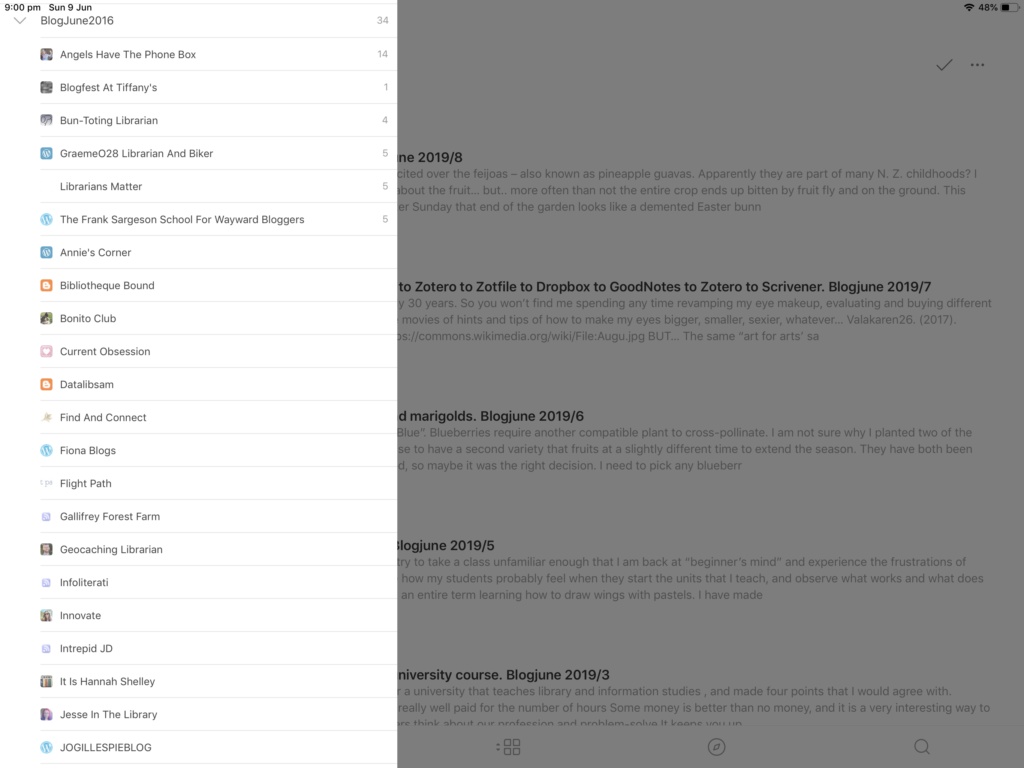
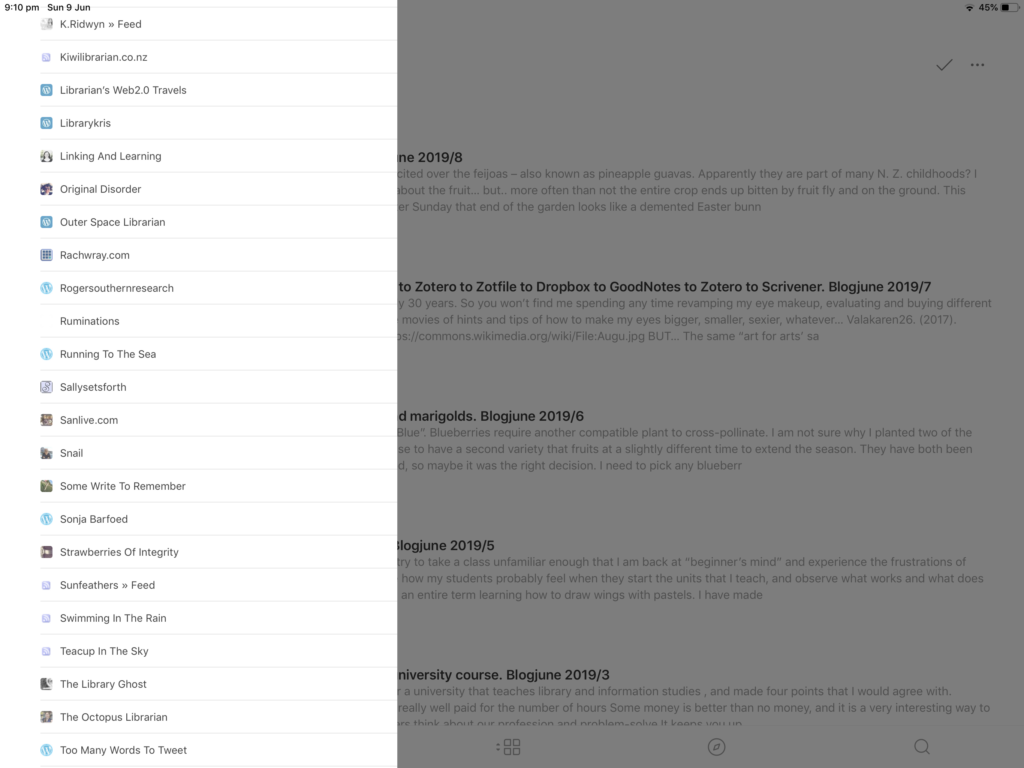
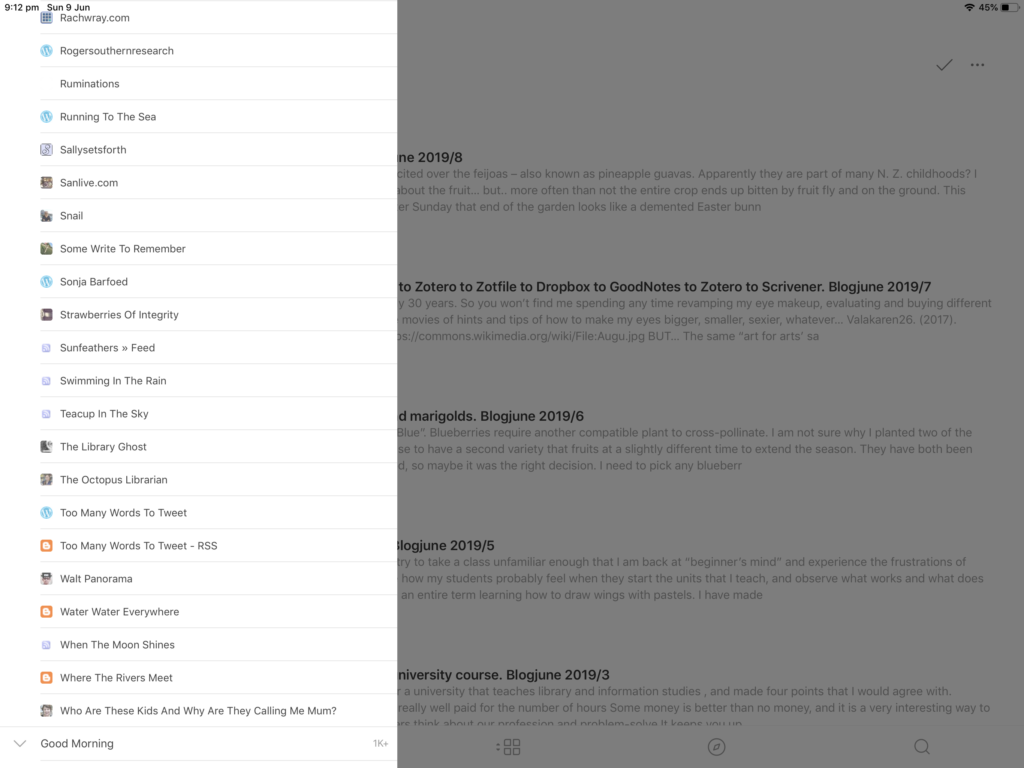
I took a screenshots of the list from 2016. I miss so many of the different voices. I would love to see even one entry from any of these this June …hint, hint 🙂
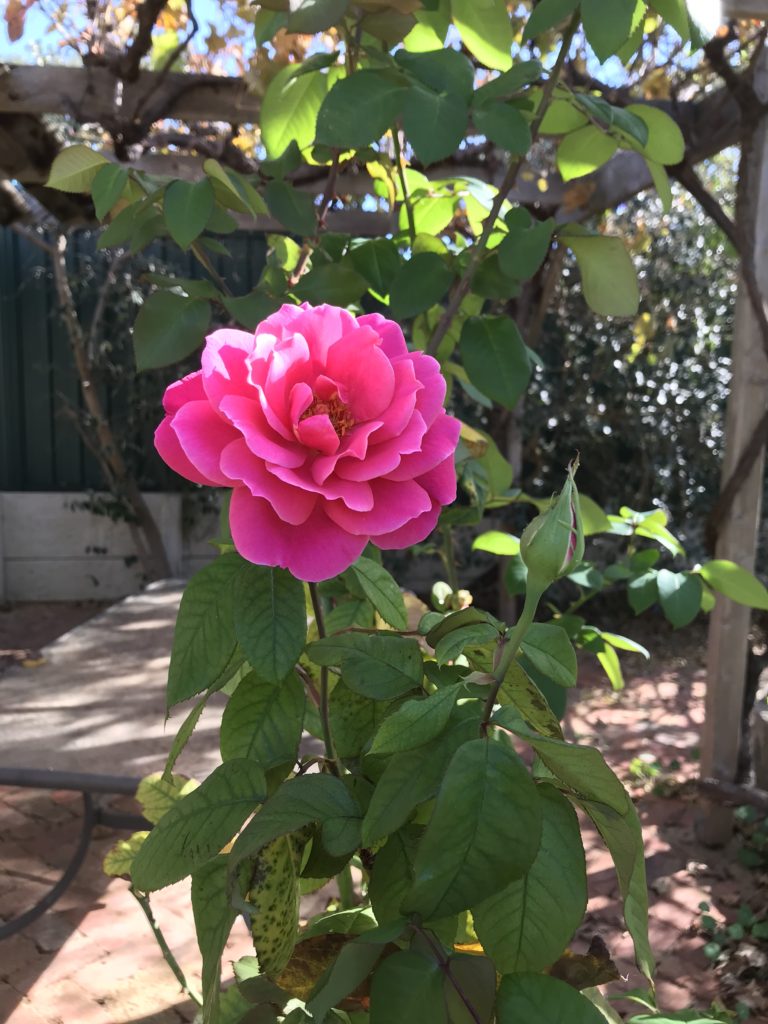
Sylvia was planted for my mother after she died, and blooms every year on the anniversary of her death.
“Best Friends”, pictured here, was a gift from a friend when I married, in the hope that this would sum up my married life.
“Cecile Brunner” is a teeny tiny, perfectly-formed miniature rose that clambers over an arch at the front of the garden. I used to walk past my next-door neighbour’s bush each morning on the way to school, and was captivated by the smallness and delicateness of it. The bush itself is hardy as an elephant’s foot.
A climbing white iceberg is on a second arch, next to Cecile Brunner. A good, solid type of rose bush for traditionalists.
Rose petals can be candied. You paint individual petals in a syrup of sugar and water, or even an eggwhite meringue mix. They can be very, very slowly dried in a very low oven, or left overnight.
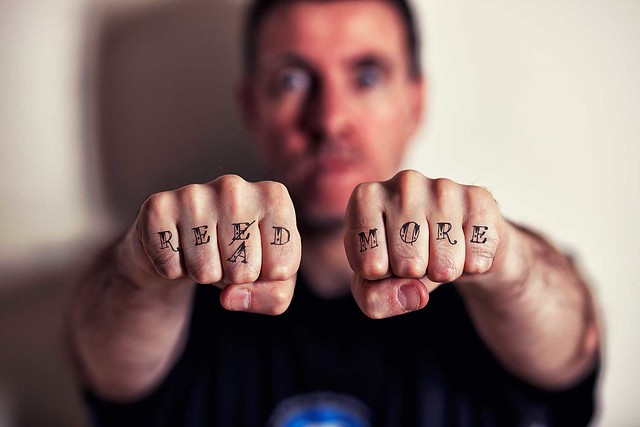
Unless my professional reading is shoved under my nose as part of my workflow, I tend to neglect it.
David Blackwell. (2014). Read More [Photo]. Retrieved from https://www.flickr.com/photos/mobilestreetlife/12134731775/
I have three major sources of leads for what to read next.
1. Twitter.
I strategically follow people who are good at flicking out links that I will want to read … or even links that I will not read, but know that they exist in case I want to go looking for them later.
Generally I use the “2 minute rule” for productivity and during time in my day set aside for Twitter I will read useful links then and there. Those too long to read in two minutes are either:
Nodded at politely, thanked for existing, then ferreted away in my brain under “may be useful if you could only recall it exists and where it is”
If I know it has use for my writing/research – saved to my citation manager in a specific collection for later academic use
Those with general interest (e.g. articles from the Conversation about academic mental health) – saved to Pocket for leisure reading
Those useful for teaching – emailed to myself, to be processed when I next do my email, generally transferred to my “Teaching to Read” folder.
I hit “peak curation” last month when I realised that I was co-curating with Jane Cowell in a very, very odd way.
When I specifically taught Twitter to my tech students, I set up a “paper.li” paper called The Infoventurer Weekly. Paper.li is a great little tool that collates the most popular/followed links that the people you follow push out, and sorts them into a magazine-format webpage. My Twitter account automatically tweets out a link to the paper.li paper every week.
Now, I don’t always see the most popular links from the people I follow on the day they send them out, and while I would like to say I generally read the paper.li each week, I simply wasn’t.
But – Jane was. She would then tweet out a very interesting link, hat-tip to my account by including @infoventurer in the tweet. I would see it, and discover a delightful, relevant interesting link that I would not have seen otherwise.
2. Email alerts
Email is another “in your face” way to make sure I will read. I want the link to come to my inbox, and then to be filtered into its own file called “To Read”, sitting on my sidebar with the number of entries obviously growing each day…nudging me to set aside time to read, or at least browse.
Each source has its own folder that it is automatically filtered into.
The sources that I use are:
Those pesky emails I email to myself when I find articles but do not have time to read
Automated alerts of new items added to the discovery layer for my university library, about my research interest
Automated alerts from some of the large journal databases provided by my university library, about new items that meet my research interest
The UK-based JournalTOCs (Tables of Contents) site. You can set up a profile and then select alerts of newly published items in journals that you specify. There are over 300 Library and Information Science titles listed.
ALIA’s Professional Development Postings, ALIA Weekly , and the Australian Public Library Alliance News
3. Exploiting my poor students dreadfully
I set an assessment in my technology unit where postgraduate students are required to locate an authoritative journal article published in the last two years that is specifically relevant to whichever Topic we have studied that week, and provide an analytic summary.
(Not all students, the task is evenly divided over the weeks. Those who do not summarise an article have opportunity to answer questions posed by the students who summarise the articles)
This is a really good way to ensure they do actually understand what the topic was about, as they have to articulate how the article is relevant. It also makes sure they understand what the disciplinary literature looks and smells like, and the quirks of the “how we done it good” papers, and the not-so-authoritative journal articles that still manage to be not-so-helpfully indexed by sources like Proquest.
The summaries are shared, so it builds up for all students a far wider survey of current reading than I could ever provide in my Topic notes.
BUT – It also is a way I can check that I am on top of the latest literature in the area I teach. Sometimes I will incorporate a reading a student found the previous semester into the Topic readings. Even if I do not, by following the citations in the articles I am forced to get a pretty good handle on some of the current disciplinary thinking in the areas I teach.
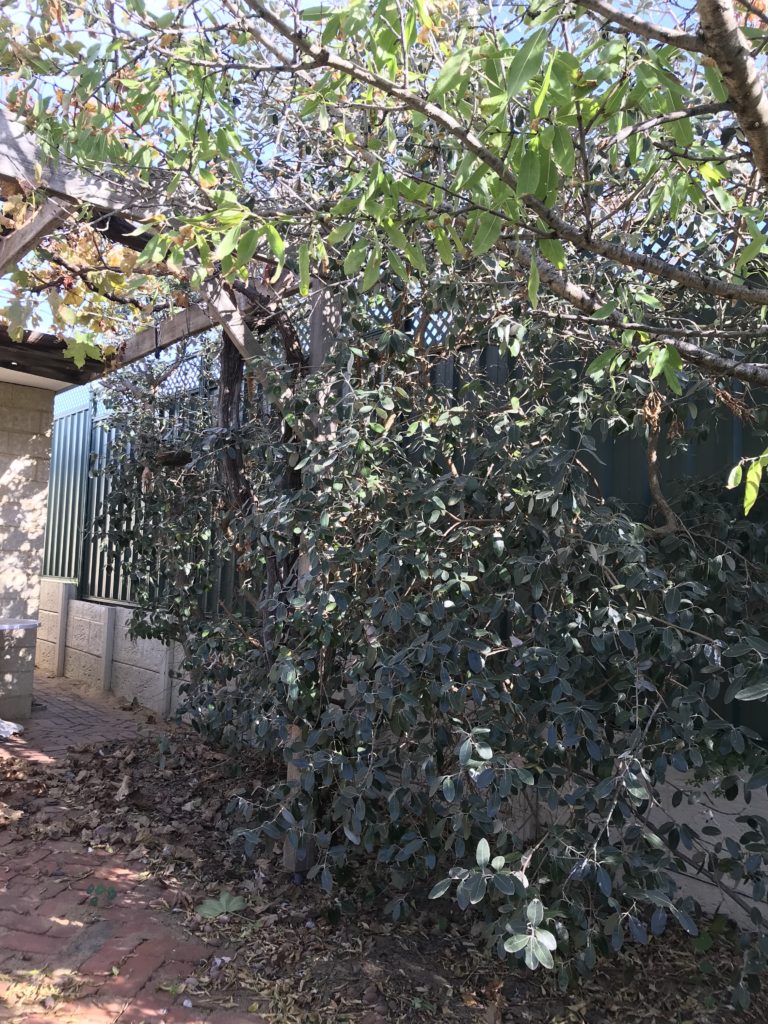
New Zealanders who visit get very excited over the feijoas – also known as pineapple guavas. Apparently they are part of many N. Z. childhoods?
I would like to say I feel the same way about the fruit… but.. more often than not the entire crop ends up bitten by fruit fly and on the ground. This tends to peak at Easter, so every Easter Sunday that end of the garden looks like a demented Easter bunny has dropped green and brown fruity Easter eggs.
By contrast, I DO get a bit excited by the flowers. The petals are like a thick, crisp suede, but have a lovely, fruity flavour. Even though I don’t eat the fruit, I can’t bring myself to eat many of the flowers because it feels like I am stopping the life-cycle… which really makes no sense if they are just going to end up on the ground.
I haven’t worn eyeshadow for probably 30 years. So you won’t find me spending any time revamping my eye makeup, evaluating and buying different cosmetics to try or watching YouTube movies of hints and tips of how to make my eyes bigger, smaller, sexier, whatever…
The same “art for arts’ sake” urge that has some people fiddling with the look of their eyes seems to have me in its grip around workflow for taking notes for my thesis. It is beyond just trying to find a way that is fast, suits me and will just do the job with no more need to think. I’m a big tweaker.
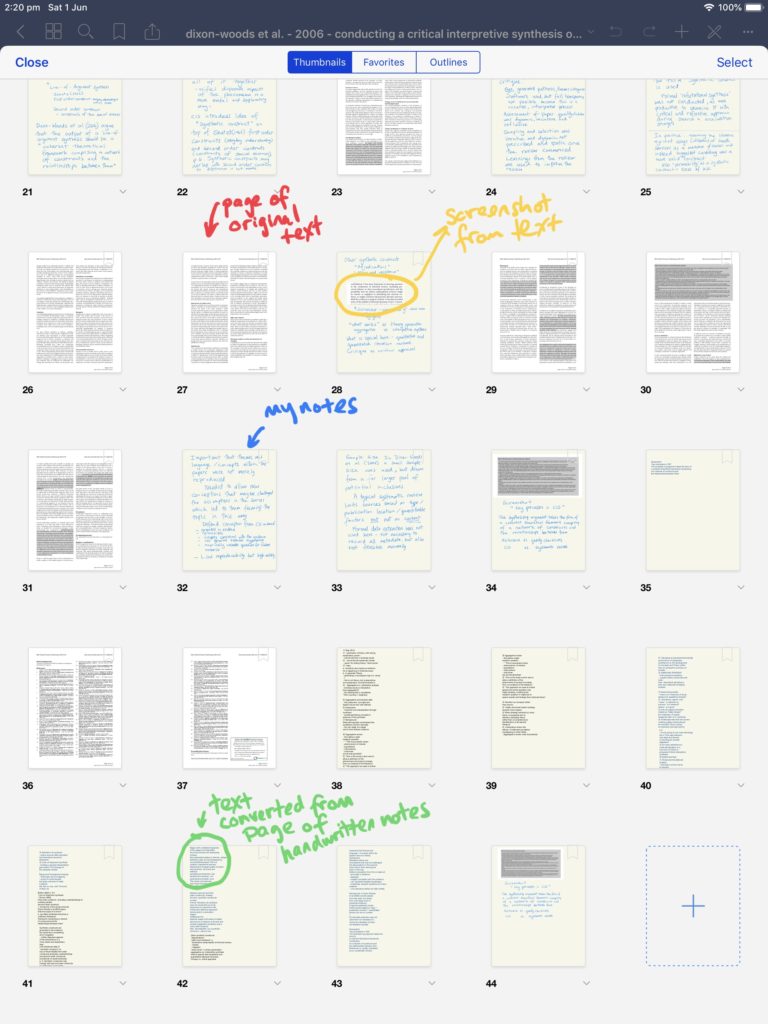
Recall and understanding is improved wildly for me if I take handwritten notes as I read, so my iPad and pencil are central. But, months later I want to be able to search the text of my notes too.
And if I start writing something while immersed in my notes and sources, then need to come back to it months later, I want to be able to pick up where I left off, with the original notes and ideas handy.
The system I have now allows me to:
interleave my handwritten notes within the text of a journal article
automatically convert these notes to typed text
have my handwritten notes searchable in my citation manager
have the PDF + notes at hand and searchable at point of writing.
Insert a blank page after the first page of the PDF. Handwrite notes associated with the first page on to the blank page. NEATLY!! (this becomes important)…And scribble as much as I want over the text itself.
When I start reading a new page, I insert a sheet after that and continue to handwrite notes
When I have finished, I use the lassoo tool to highlight my handwriting and use the CONVERT function to convert my handwriting to text. It is about 95% accurate if I write neatly.
Copy converted text to the clipboard.
Paste converted text from each interleaved page to a series of text boxes on pages inserted at the end of the document.
Upload the annotated version of the PDF back to Zotero
Copy the text converted from my handwritten notes and paste it in an accompanying Zotero Note.
When I want to use the PDF contents in my writing, I open Scrivener, where I do most of my writing.
Then I just drag and drop the PDF from Zotero into the “Research” area of the Scrivener pane. It automatically formats the citation and stores a copy of the PDF in the writing project. Then I can see and browse the source (and any others I am have saved there) as I write.
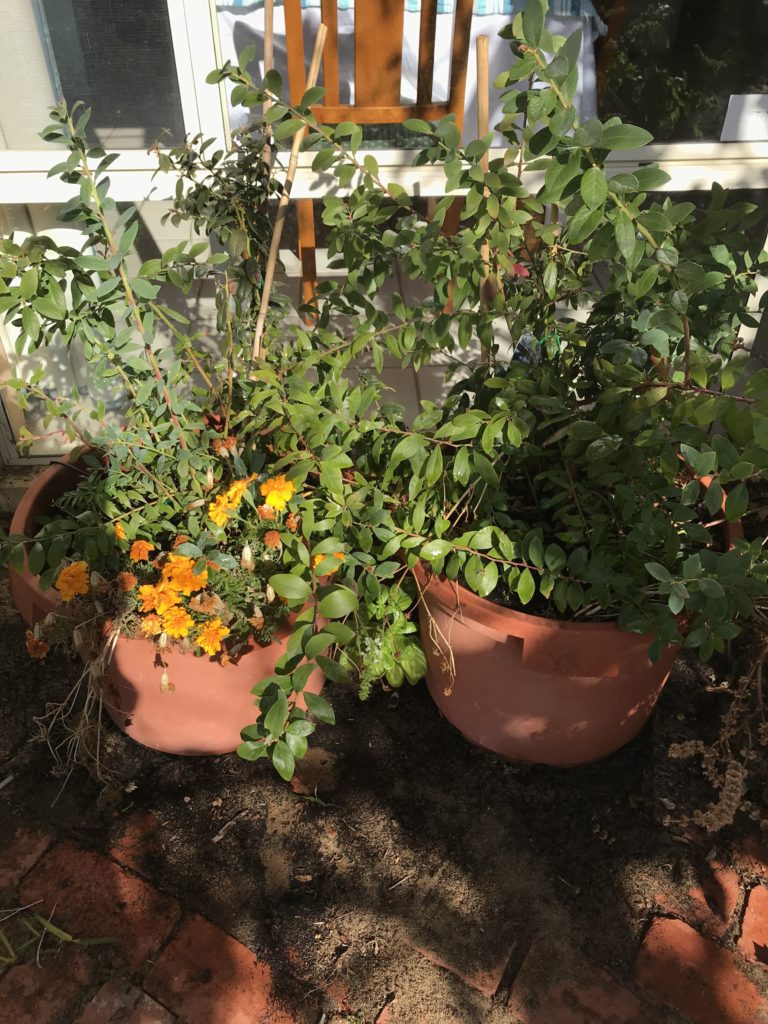
Dwarf blueberry bushes – “Sunshine Blue”. Blueberries require another compatible plant to cross-pollinate. I am not sure why I planted two of the same variety. It would make more sense to have a second variety that fruits at a slightly different time to extend the season. They have both been been prolific fruiters over a long period, so maybe it was the right decision.
I need to pick any blueberries before I let the chooks out to forage, as they will go straight to them.
The marigolds are just to add colour, but the petals look pretty in mixed salads.
Some of summer’s basil is still green and lingering between the pots, and you can see the brown heads gone to seed in the right hand side – hopefully about to self-sew all over the garden.
To improve my teaching, every year I try to take a class unfamiliar enough that I am back at “beginner’s mind” and experience the frustrations of being a new learner. I want to capture how my students probably feel when they start the units that I teach, and observe what works and what does not for me as a learner.
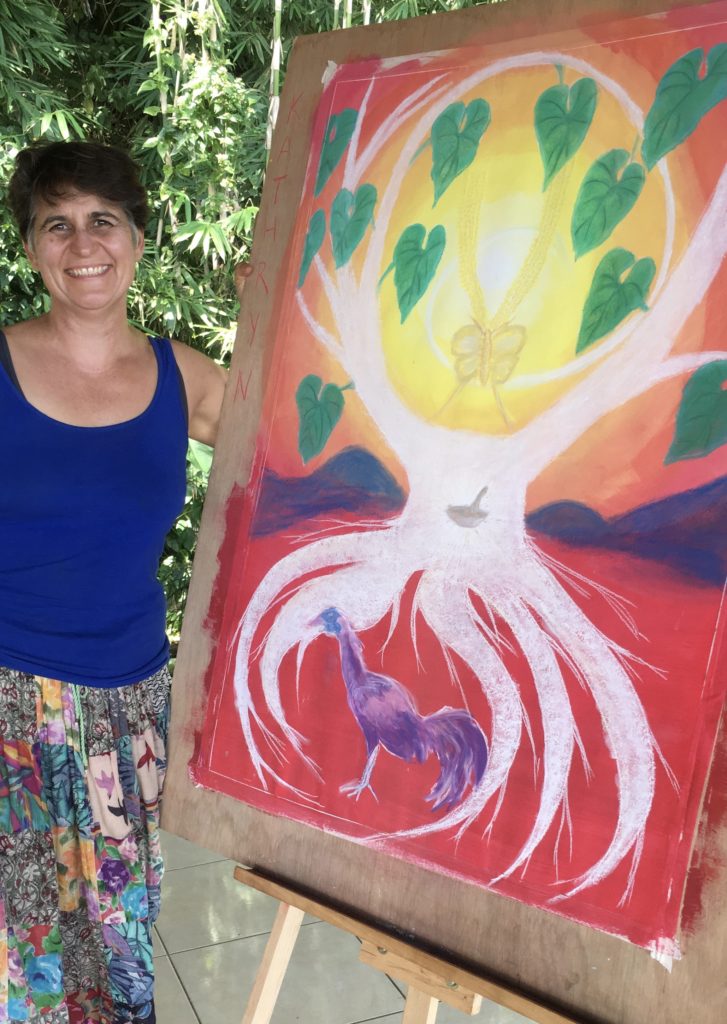
One year I did an entire term learning how to draw wings with pastels. I have made felt hats, gone on yoga retreats with no previous experience, become a Zumba instructor, tried mountain biking and sketched nudes at my local hotel’s weekly life drawing night. I tried my hand at an art retreat in Bali, with no previous experience in acrylics or watercolour.
I attended the Digital Humanities Summer School last year and deliberately sat in on the coding classes rather than ontologies and Linked Open Data – where I would have been far more comfortable. This year I learned to kayak.
I need to be reminded how it feels when grasping concepts for the first time and integrating this into existing knowledge. Part of my challenge is to not take it all so very personally. I am used to knowing what I know, and being competent, and then suddenly I am faced with something I am not good at – in fact have no idea how to do it at all.
It takes me quite a while to stop beating myself up as incompetent, rather than just … learning. I KNOW how to tie my shoelaces, keep chickens and cite using APA6 style, so WHY when I try to work out how to read in a file using Python can I simply not do it?? I feel cross and frustrated, but really need to get a grip and understand that if I already knew it, there would be no need for me to be sitting in the class. All is as it should be. Feeling incompetent is exactly where I should be.
It may mean that my job as a university teacher is as much about creating an environment for confidence and small successes in my students, normalising transitory confusion and frustration and a feeling of not knowing what is going on… as it is about providing useful course material and assessments. I try to keep that in mind with my teaching style.
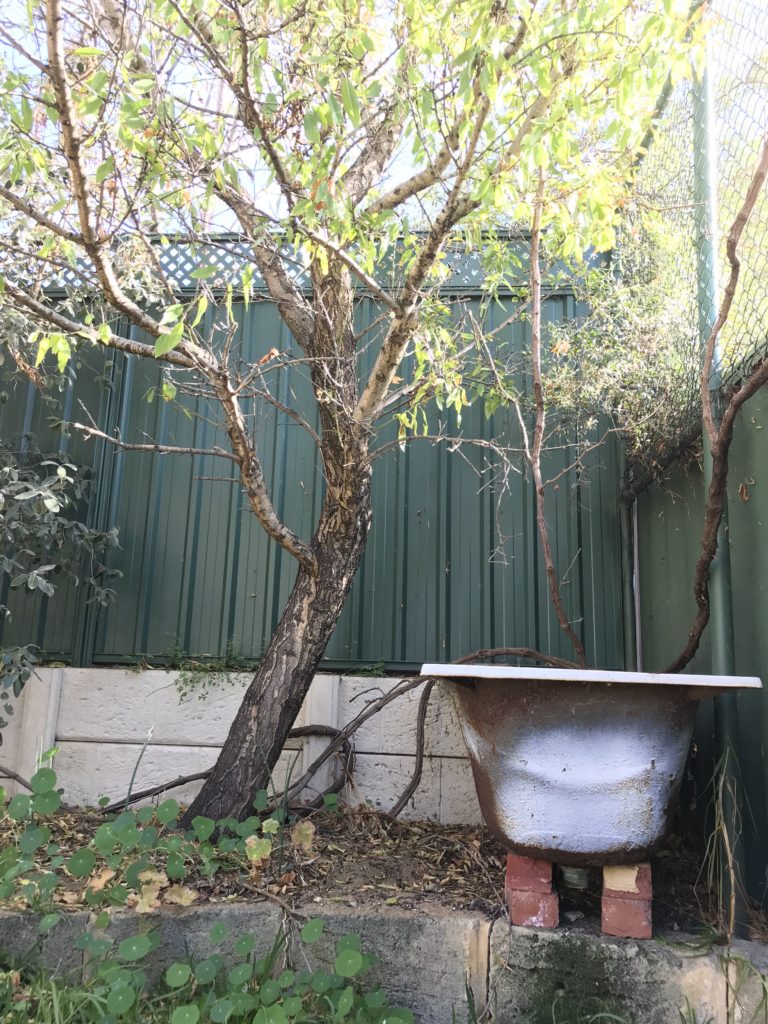
The almond tree was planted about 18 years ago for the kids to climb. The blossom is beautiful in the spring, lasting about a fortnight from first bud to over. It fruits plentifully, but I have never eaten any nuts from it. Each year the parrots descend in one afternoon when the nuts are way too early for picking, and eat the lot.
Nasturtiums bloom everywhere over winter. The entire floor of the garden is covered with them. I shared an old house in Subiaco where this happened, so when I moved here I started with one small packet of seeds. Recently I have planted the 30-metre-long driveway with any nasturtium seedlings that grew in the wrong spot. One side of the drive has taken beautifully and leaves are nowbeginning to spill out to the street. I use the flowers as a contrast to the chocolate glaze on a chocolate cake when serving. The leaves can be used in salads, but I am not overly-fond of the peppery taste.
A bobtail lizard lives in the bathtub underneath the almond.
Step 1. Ask me, or any other academic you know, whether they need a marker.
University courses are set up presuming that a large part of the work will be done by casual staff – certainly markers, and often tutors also. We always need reliable, academically-able people who want to give back a bit by mentoring the next crop of professionals.
I have excellent markers in my units at the moment and would love it if they stayed on forever… however often student numbers fluctuate, or we get asked to take on some new duty, so have a few more hours to fill.
Step 2. Adjust your expectations about doing it very well
My university pays for one hour to mark all work submitted by one student in a unit.
Economics trump pedagogy here. We adjust our assessments to try to provide meaningful activities that can be quickly marked, but I still have not got the balance right. I do not think it is actually possible.
So, as a casual marker, you would be marking in an environment where you probably could not give the amount of constructive feedback you would like to, nor spend as much time as you would like in double-checking that you have made the right call. Or, as John alluded to, you spend longer than allocated, so the rate per hour effectively decreases.
However, I would far rather have a well-intentioned marker who does their best within the limitations and who understands that they cannot do half the job they would like to … rather than someone who cynically would turn up, be paid, and work to rule to do the minimum possible job.
To make it a *little* bit easier, I spend a lot of time creating comprehensive marking guides and make myself very available to markers when an assessment has been submitted.
Step 3. Check you meet other requirements
For my units you would need:
At least a Masters degree in the area
You would be marking postgraduate as well as undergraduate work.
Seasonally-available time.
Generally there is a 18 day turnaround between work being submitted and me looking over the marks to moderate them before returning work to the student.
Most of the work is May/June then September, October, November.
You are looking at around 5 – 60 or so assessments to mark in one sitting.
Tolerance for a high learning-curve the first semester.
Aiming to “just try it for a semester” would probably set you up to fail, because there is so much to learn the first time about:
the admin requirements of the particular university
the online system(s) used
how the individual unit coordinator uses the system
the unit materials
the assessment instructions
the marking criteria
your own ability to judge, make a call about a mark, and just move on
BUT – once that first semester is over, there may be small things that change, but it is all much, much, much easier and quicker.
Efficiency and reliability.
Excellent academic writing skills – grammar, spelling, expression and citation
Understanding how to evaluate sources for authority – both scholarly and technological. So understanding of recency, authorship, purpose, peer-review, valid evidence, logical conclusions, contextualising within disciplinary debate.
Disciplinary and tech knowledge. My units have a focus on how tech is used in the field, and I really value markers who can judge whether student work is of a standard that would be acceptable in the workplace
Tact and clarity. The ability to encourage and support, while being very clear with students how to improve
Step 4. Email your CV directly to the academic, asking them to consider you as a future marker and whether you can provide further information.
Include information about:
Your highest qualification
Any experience you have with teaching or marking. This can include teaching in other areas (e.g. as a music teacher) or information literacy sessions with clients, or being an embedded librarian in your university learning management system.
Someone who could chat about your previous teaching/marking work
Your work history
Step 5. Wait.
Generally we will not have any work right now.
We often do not know until right before semester whether we will have any work, and then will suddenly contact you about starting in a couple of weeks
We sometimes share CVs for potential markers with other academics in the same area, and sometimes do not.