
Nice to see the folk at the Curtis ( Curtin University Information Studies club) blog are going to be blogging 30 questions relevant to the field for this year’s #blogjune.
It’s been lovely to see the students in our department get united and get active via Curtis. When I was a student, our group was “Adlibs” … but it has been many, many years since there was an Information Studies group.
I didn’t really want to start #blogjune with some kind of reflection on blogging, or create one of those “I am answering 10 questions using the names of my favourite pork recipes” filler posts … so I thought a bit about what I now feel qualified to talk about … and it is probably offering polite, sage-sounding hints to Information Studies students…
I think I will have a few up my sleeve this June. While snail and Paul and Ellen and Ceridwyn confess to having pre-scheduled posts, I have not been nearly so organised – so my hints will be more random than in priority order.
So…
Number One:
Do some nipping and tucking to change a “one-size fits all” unit to something that fits you.
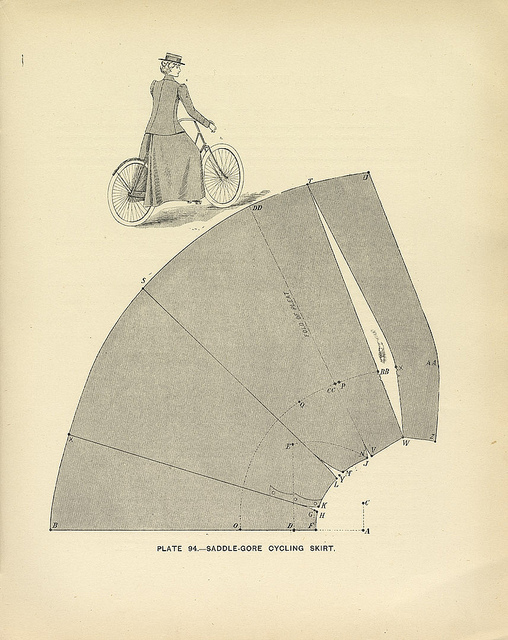
Library, S. C. T. P. (2013). Thornton, J.P. Thornton’s Sectional System of Ladies’ Garment Cutting. 1901. [Photo]. Retrieved from https://www.flickr.com/photos/43021516@N06/9802322314/
Professionals in the field would give their eye teeth to be able to spend even two hours devoted to this. Managers would love to spend hours engaging with the latest disciplinary thinking about staff rewards and motivation, understanding it enough to be able to write cogently about it – but are often too busy, trying to reward and motivate staff, to do so.
When you write that management essay, you are not just learning things that these professionals know, but are immersing yourself in the latest thinking and, through writing, forming and articulating your own philosophies and opinions of how we do this thing of managing an information service. In a lot of ways, this time to immerse yourself in the discipline is the learning gift, rather than the single actual topics that you study.
While we lecturers set readings and notes that are useful to find out about a topic, we are setting these for a “one size fits all” student, not for you. Use the time that is set aside to do the reading that YOU need to do to understand what you want to know about the topic. Don’t neglect the “do this to get marks” reading that is essential, but if your time budget is such that your choice is between having slightly higher marks or having a better understanding of the topic, go for the latter. Employers would prefer it.
You know where your strengths lie. You know whether you are already familiar with a topic or something is totally new ground to you. You know the skills you would like to develop. You know where you interests are. You know whether you prefer conceptual, or hands-on, or passionate types of readings. Do the basic reading, but you will get the most out of your studies if you are curious and follow up your own programme of readings (or YouTube viewings, or chats with mentors who know their stuff, or try to teach what you know to your granny because that is the BEST way to discover whether you know something thoroughly or not) … follow your own programme that lets you tailor a unit from “This Unit For EveryStudent” to “This Unit for ME” (or if you are feeling hipster, “An Artisan-Wrought Bespoke Unit”).
Your lecturer does not know all of the above about you. If you think the readings are too hard, old or irrelevant or that you need extra reading to get up to speed, first have a look in the library databases to find some disciplinary reading around the topic. Even the hunting about can give you a nice feeling of the “shape” of the knowledge landscape about the topic that you may not have had before. Then, share it on the Discussion Boards with your fellow students. In an upcoming post I will share why I think this step is so important..
Good Morning, and Happy #Blogjune, Kathryn — you are my first new post to read this Blog June of 2017 !!
I could relate to what you said about how “professionals in the field would give their eye teeth to be able to spend even two hours devoted to “reading and thinking about” our discipline and what we do — that is actually in a nutshell part of what #blogjune is to me.
Oops, I’m afraid that probably counts as “a reflection on blogging” that I should probably also be avoiding : ), but you have definitely struck a chord there for me. Hmmm, I think I feel a new blog coming on ….
D’oh! That is so obvious (that this is what #blogjune is) … and I simply did not make the connection before your pointed that out. Thanks.
Thanks for giving your p.o.v. It is one thing for someone who is an academic to give an opinion to students about the field, whereas I think if they hear about it from people in the profession then it actually has more cred.. so thanks.
One of the features of new reading list products like Talis or Leganto is the ability for students to comment and suggest additional readings, listenings and viewings. I really hope students who have access to these at their institutions make use of them.
Keep em coming, Kathryn, what you have to say just makes a lot of sense!