
I have been working in libraries for about 28 years and been professionally qualified for about 25.
Here are some things I have done in my career that we don’t do any more.
1. Found pictures of (insert name here) .
Working in a Fine Arts and Architecture specialist library in an academic library, and in a public library, I was often the only person with the resources and training to satisfy a request for a “cow grazing” or “picture of Anais Nin”. Often the request was from a trainee teacher who absolutely needed this for a class. I presume that school libraries have felt the change in this demand even more…
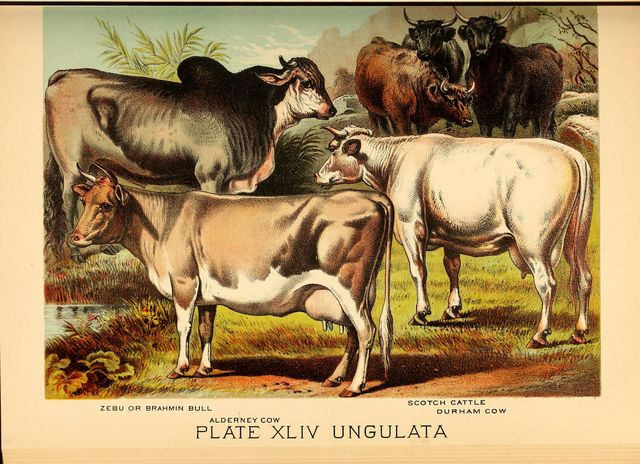
Mammals-7-147 – Zeby or Brahmin Bull, Alderney Cow, Scotch Cattle, Durham Cow. (n.d.). Retrieved from https://www.flickr.com/photos/artvintage1800s/15908916478/
2. Found phone numbers, street directions, names of specialist professionals, statistics about countries, names of local government representatives.
All these were common questions on reference desks – not just from people with issues with functional literacy, but almost anyone who wanted to find non-local information.
3. Maintained a collection that would answer all the queries in 2.
Keeping electoral roles up to date, Australian Bureau of Statistics pamphlets in order, street directories re-shelved, seeing in an article in the daily newspaper that the Dental Association had issued a new directory and ordered it.
4. Taken a student’s library card while they used the University Handbook to find the units that they may want to study, or to photocopy a record of the units they previously studied.
If the University Bookshop had sold out of recent handbooks, or it was night time, or the student had the financial position of most students and could not afford to buy a handbook each year – then the library reference desk was the place to go. Of course, if not carefully guarded by library staff or students were not forced to hand over something of value, then the items would surely walk, so at least one query each night involved this transaction of suspicion.
5. Public library. Car service manuals. Driver’s licence, See 4. above.
6. Advised people about the author of a book, when it was published and how to get hold of it
Once upon a time libraries had copies of “Books in Print”. Librarians knew how to use them. Booksellers did too, but did not necessarily do so for members of the public. Members of the public had to go through one of us to find out bibliographic information
7. Photocopied indexes of recent journals, stapled a circulation list to the top and sent them around the in-trays of professional staff in the office.
… and called it “Current Awareness”. I suspect this still happens in some places where older members of staff expect this – but I could be totally wrong.
8. Showed a student how to use a printed Citation Index to find academic papers on a particular subject.
Once upon a time the path to a relevant journal article was far more of a tiger safari than it is now. Students would get an article from the unit reading list, look at the references at the back, physically go to the shelves and hunt down the next journal article and leap frog onwards and onwards toward on-topic nirvana. Citation indices were about finding the information needed not just about bibliometric impact.
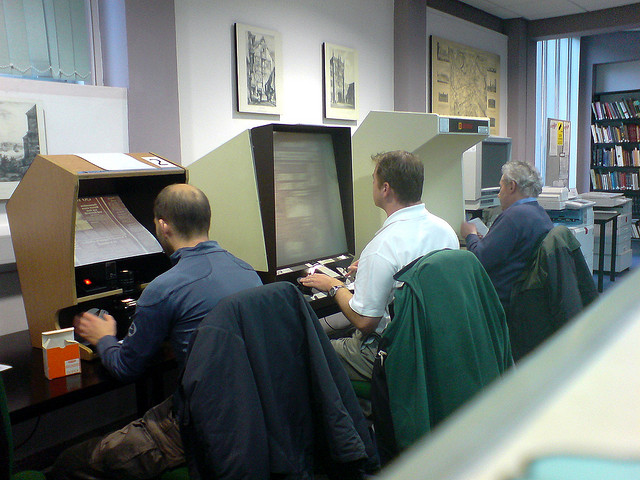
Microform Readers. (n.d.). from https://www.flickr.com/photos/kapungo/1697320296/
9. Advised a dizzy patron to just sit down, get a drink of water and then turn the knob on the microfilm reader more slowly next time.
Microfilm readers were like a long strip of film with negative photographs of pages from articles, books and newspapers. Each frame could be magnified to display on a screen and (in really flash ones) print out a smudgy copy of the page. People would get a page reference (if lucky) and then turn a knob to view the right part of the filmstrip. Those who just knew the item had been “in the Times in February 1975” would have pages and pages to look through, and did so by whizzing the filmstrip, stopping, looking then whizzing on to the next page … and usually did so too fast and ended up getting motion sickness. Microfische? – even worse because you were dealing with a grid of pages on a flat plate and could whizz in all directions all over the page, and still had to keep an eye on what you were seeing so you knew when you hit the right spot.
10. Re-spliced the tapes and joined the ends together in an attempt to keep an audio cassette circulating for a little longer.
I know my local public library still has cabinets of microfilm and microfiche of old local newspapers and genealogical records- though thankfully those intrepid explorers know how to use the equipment :). While many of the tasks we have undertaken over the years have been rendered obsolete by the greater accessibility of information online or in different formats, librarians are hopefully evolving and adapting to new roles. I still get asked about the photocopier…
We have so much information on micho-forms. I know there is some effort to bring the information into the computer age by scanning them in. But microfilm and microform last long than than most of the new technologies. Although they are harder to use, microfilm can last up to 500 years. No computer can hold up to that storage longevity.
Hi Kathryn! 2 & 5 and alive and well at our public library! We get lots of calls for phone numbers of all types, including elected officials, and map look-ups from older people who can’t read the phone book and/or don’t have internet. We still have auto repair manuals that get used, but have never taken IDs. Microfilm is still a thing here too due to our fantastic archives department and very successful National History Day program where we connect students with primary sources. It’s great to see your face!
Indeed, microfilm isn’t dead: plenty has yet to be digitized–and certain articles are on microfilm but not in databases because of copyright restrictions. Not sure I understand #4: some car service manuals are in a couple of databases, but not all libraries can afford those expensive sources.
Oh I was going to comment about journal distribution lists but I think you took that bit out. I remember fondly getting a tech journal in my in tray 18 months post publication. Also I think maybe this post should be titled things we *shoukd have* stopped doing cause I think a fair bit of this stuff still goes on!
What Kate said, a lot of this still goes on. I echo others re microfilm/fiche as that remains the primary source for a lot of material that has not otherwise been digitised. However the reading machines themselves have experienced major technological improvements as well.
I printed a list of state and federal ministers for a patron last week. She wanted to write to all of them to ask for marriage equality 🙂