Blame Genevieve. She asked about Blogjune on Mastodon and then jolly well posted something.
I don’t think I will wholly Blogjune this year.
I’m moving on from my huge city balcony, back to an urban eco-village which focuses on community. I rented there, bought my apartment a couple of doors down and am now going back there to rent again. A family from the community who have been squeezed into a tiny apartment are going to rent my place. Trying it for a year and seeing if everyone likes it.
I’m going from 90 metres square to about 65 metres square. I’ve know about the move for several months, so spent two weeks over Easter very leisurely working my way through all the stuff I scooped up in an absolute whirlwind when I moved here from interstate, when state borders were still closed due to COVID. I had to guess everything I needed, with a job starting very soon, because once I was here there was no going back across the border to arrange a more sensible move with what I would *actually* need.
I’ve been doing one moving job a day for months, which has made this the least stressful move ever. I have a miracle-working friend in the community whose life-mission is keeping things out of landfill. I had heaps of clothes and duplicate items and weird stuff to get rid of (academic robe and mortarboard anyone?). She looked through my pile and sorted clothes that seemed indistinguishable to me – these warm coats to the refugee group, these worn-ish clothes to the Salvos, those pants to the Baptist Care group down the road, these skirts and tops to Dress for Success , this jumper to the monthly community clothes exchange, academic robe on local Buy Nothing group, bath mats to dog shelter.
The lovely family moving in are happy to keep my apartment garden set up, so I don’t have to dismantle that and get the balcony back to pristine blankness. I am very grateful for that.
The ecovillage has heaps of fruit trees, a rooftop veggie garden with bee hives and a thriving huge veggie patch, so I will still be able to garden… and in a space far better used for green things than for car parks, like my current place.
Anyhow – happy Sunday. Off to take down curtains, fix a light, grab shelves from my storage unit and box up another lot of books…
Below is an email sent to the Director General of the National Library of Australia and the Minister for Arts about the revocation of Tim Sherratt’s Trove API keys. Many cultural and research tools produced in the last 15 years rely on Tim’s API key, such as the GLAM Workbench , QueryPic , The Trove Newspaper Data Dashboard and the The Trove API Console. These works have won awards, been cited in research papers and used as guides for development of other tools internationally.
Last week, the National Library of Australia, without discussion or forewarning, cancelled Dr Tim Sheratt’s Trove API keys.
Reinstating Dr Tim Sherratt’s access to Trove API keys is essential to restore a set of cultural, educational and research tools that enhance access and usage for National Library resources.
I write in two capacities.
As a former university lecturer of 13 years in Libraries Records and Archives, I’ve used Tim’s work to teach students about the Trove API, developing valuable data skills sought after by cultural institutions. Tim’s efforts in developing tools and models using the Trove API significantly motivated students to learn and understand. His work provided rich and important context for an assessment where students designed a procedure to use the Trove API to present harvested data in an Excel spreadsheet.
The second capacity is as someone whose current employment involved presenting Tim’s work with the Trove Data Guide to an audience of researchers at the ResBaz research bazaar at Monash University in November last year. Researchers found the
Trove API console an accessible way to understand how the Trove API works. It made it far easier for them to understand why they should apply for an API key for themselves. The guide itself relies on Tim’s API key for the many practical examples included. More researchers conducting data-enriched research using resources of the National Library is surely the outcome the library wants. The National Library’s Mission is:
to ensure that documentary resources of national significance relating to Australia and the Australian people, as well as significant non-Australian library materials, are collected, preserved and made accessible either through the Library itself or through collaborative arrangements with other libraries and information providers
(emphasis mine)
Tim’s work is pivotal to this mission by making the works of the National Library far more accessible to librarians, researchers and the general public. Restoring Tim’s Trove API is crucial to continue supporting this mission.
This is the second of a monthly series of conversations my team is hosting around research skills in Australia. The Australian National Skills Forum (yes, we are working on that template we need to submit for the webpage, so no link yet…) aims to shine a spotlight on the skills researchers need to use national research infrastructure and participate in a national research data commons.
We are rotating topics and hosts monthly. This month I am hosting a session to discuss research skills takeaways from the recent conference in Melbourne, eResearch Australasia 2024. The ARDC Skilled Development Workforce team and guests will recap some of the sessions they presented, and highlight sessions that caught their attention.
Lots on this week that I thought I would share in a series of posts.
Sometime between the ResBaz Vic presentation today, flying home tonight and a very full day catching up with work on Friday I will write a 5 minute lightning talk.
Here is the brief that I believed I had a lot to say about when I submitted back in September:
Aims to start a conversation about whether there is a skills component to increasing the knowledge/confidence researchers need before they co-contribute or partner in digital research infrastructure projects.
Is the reason researchers with potentially valuable disciplinary contributions don’t come to the table because they believe that it is only for people with tech skills, and they are not “techie”? Is it about knowledge, confidence, interest, time, institutional recognition or something else? Can skills initiatives help here?
Once researchers have their toes in the water, what new skills beyond tech do they need to successfully partner in research infrastructure projects?
I have loved my work days preparing for it. Tim Sherratt has been so generous and thorough in creating the Trove Data Guide. I knew it’s documentation of the quirks and data structures in Trove was useful, but until I tried to prepare a session about how to get the best out of the guide I had not realised just how comprehensive he had been. I particularly like the construction of a set of start to finish self-paced lessons in the last section of the guide, Research Pathways. These are stand-alone and each one steps people through every component, for example from getting a Trove API key to using a Jupyter notebook. This design decision, where people don’t have to jump around from an earlier part of the guide to work out how to do things, makes it easier to recommend it to researchers. I ALSO enjoyed using the Newstalk tool to download 52 comments on a news story about a Quokka eating a cigarette, and being able to call that work.
Here is the synopsis of the session.
Get hands-on with 2 tools from the ARDC HASS and Indigenous Research Data Commons, the Crate-O metadata editor and the Trove Data guide. After 2 forty minute deep dives, learn how other parts of the Research Data Commons help researchers solve another 8 research challenges, in a series of 5-minute lighting tours.
By the end of the session, you will know how to use a tool to package your research data and its metadata together in an RO-Crate and be better equipped to locate and manipulate data from the National Library’s Trove research portal. You will also have new leads for research with Indigenous data; social media data; data about creative arts; and social sciences data.
Lots on this week that I thought I would share in a series of posts.
On Monday, before I flew to Melbourne for ResBaz Vic, I presented a webinar about the topics we will cover, the conversations we will have and what it is like to attend the annual Summer School that I organise.
It’s running 4-6 February in Brisbane and you should register and come and play.
This year we also are running an Indigenous Data Governance Masterclass at the State Library of Queensland the day before. You should register for that one too.
Watching the recording back, I could really see my tendency to “dance with my hands” as I speak. Chatting with a colleague about this, she said that she sees it in her own recordings from Zoom… and that noticed she actually brings her hands up so the camera can see them. I realised I was doing exactly the same – movements that may look more integrated and smaller suddenly involve my hands in front of my face trying to do a puppet show to make the message clearer…
Today is the last day of Blogjune. This is the first one in a long time where I lasted to the end, and managed to post every day. Like the last years, it’s the post where I muse that this was actually quite fun and, while I would not want to keep up banally posting whatever is in my head each day, it might be nice to post more often. Where I regret not commenting more, or responding in more depth to comments here. Where I wish that all the people who posted for Blogjune would keep it up because I really like being inside their heads.
Let’s see what happens.
A big difference this year is that I was not all-consumed by extra hours (and hours and hours) at a job where I felt like I could never do it well, no matter how hard I tried. One where I saw others doing excellent, extra-effort work non-stop, but also feeling the same way. I get to rest, to regroup and look up now.
Mending
Today I had a mending day with a friend – cups of tea, chatter and piles of mending. I have a number of merino camisoles that are about 15 years old, all with similar moth holes and ladders. It took me most of the morning to darn just half a run, so I have a nice project for winter nights in front of the TV. Tonight I take a tray of spicy apple bake to the eco-village for a soup and movie night.
Lapsing
Today is also the last day to renew my ALIA (Australian Library and Information Association) membership for next year, before it lapses after 35 years of membership.
I always admired those people who qualified and worked as librarians then stayed involved and interested through ALIA after they moved out of the profession or retired. I like their mix of wisdom and willingness to learn. The way they enrich conversations with their experience and ability to say “this new thing is a bit like this other challenge we had in the past, here’s what we did then”. Or, recognising when their knowledge reached a limit, but encouraging and mentoring younger professionals to explore and learn, reminding them of values and ethics that surround us.
That’s not me.
I value mentoring, but this is a role I took professionally as an educator for the last 13 years or so. I think the kids are alright. I am happy that I have contributed a bit to that.
ALIA does have an essential policy role to play, working with governments and the non-government sector on creating a fairer and more supportive society, where citizens can access information freely without censorship or barrier. I think it has done that very well in recent years, and current moves to codify professional ethics in Australia are commendable. It’s a conversation I trust other voices to carry well. Although my membership could sponsor this activity even if I am not actively involved, I am moving on.
In some ways, it’s just happening naturally.
Lapsing and mending
I love the VALA Conference and in past years loved the new knowledge and connections I made with people. If you enjoy libraries and technology, then you should be there in a couple of weeks. Me? Spending the week catching up with my son as he visits from interstate for the week.
For 13 years I had to follow anything to do with the International Federation of Library Associations and Institutions (IFLA) like it was my religion. Any standard, any policy statement, any report I needed to read and keep up with, so I could add it to the huge framework of knowledge about libraries that I had to balance in my head and in my Zotero library, crowding out room for many other ideas. In previous years, I would have done all I could to fully participate in the upcoming IFLA Information Futures Summit. An IFLA event finally happening in Australia in September! I found out about it a couple of months ago, felt a tiny bit of FOMO, until I realised that week I have booked a week-long yoga retreat. Priorities are making themselves clear without any effort or great thought from me.
I don’t quite consider myself a lapsed librarian. I’ve become someone who makes things like this happen, and that is fine for now….even if I cannot really explain what it is at parties.
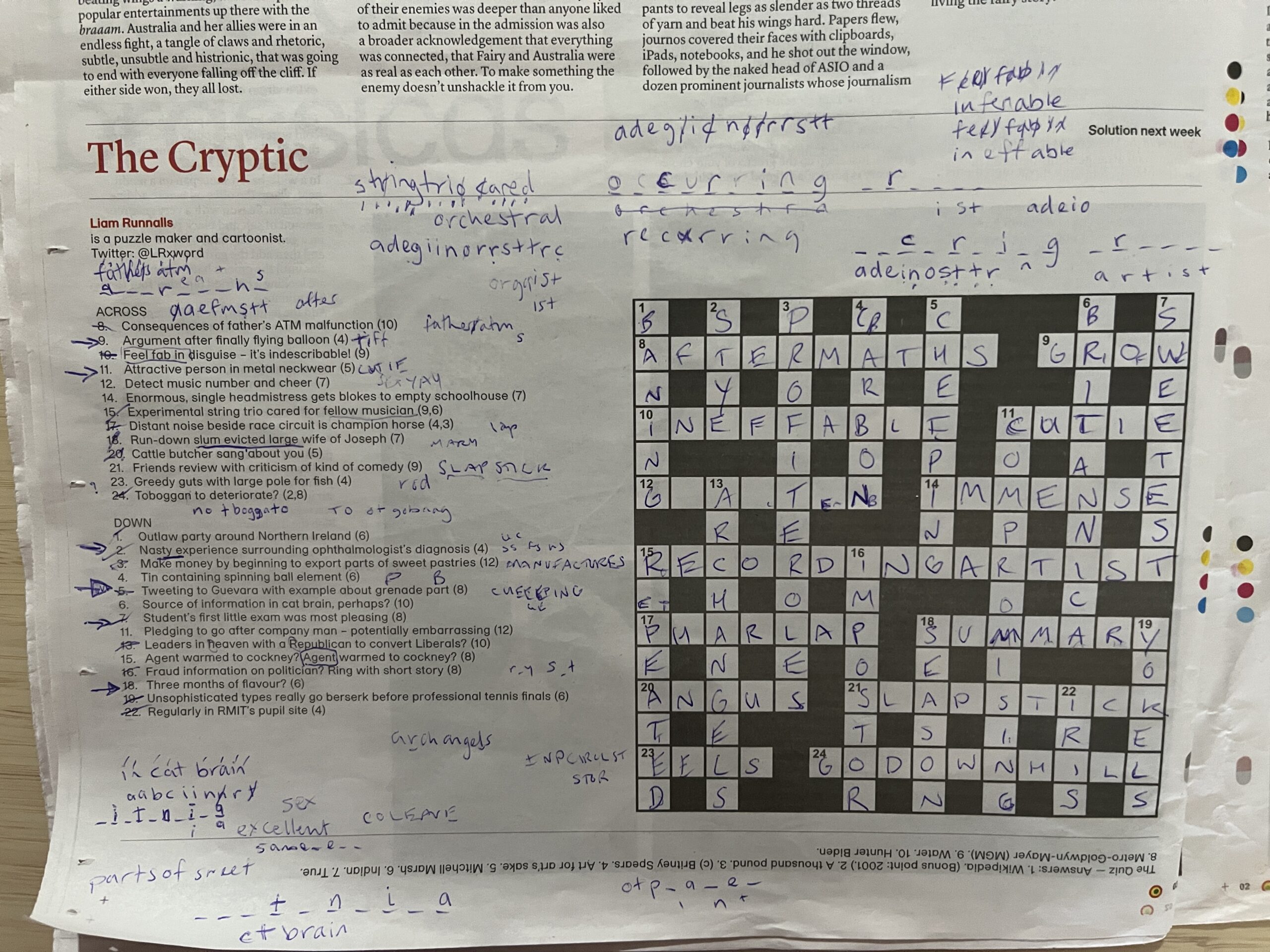
You get a clue like a regular crossword. THEN you get a big other clue that narrows the answer right down.
Here’s some examples from today’s Saturday Paper:
1. Portmanteu words
11 ACROSS: Attractive person in metal neckware (5)
Let’s go from the very end – Neckware = TIE, Metal = CU (Copper). Put them together and you get a five letter word for an attractive person, a CUTIE. This defined word was “in” the second part of the clue.
The hardest bit is working out which is the definition and which is the extra honking big hint. For most clues, it is either the first or last word. Here it could have been “attractive” or “attractive person” or “neckware”.
Like regular crosswords, the number of letters, plus any other letters filled in by other clues on the grid, narrows it down further.
2. Anagrams
After a while you get used to trigger words, like “metal” probably means a couple of letters from the periodic table. A hidden anagram is often signaled by words indicating the next part of the clue is scrambled, like “In disarray” or “ruined” or “distressed” or “about” or “perhaps”.
Try another, librarian themed:
6 DOWN: Source of information in cat brain, perhaps (10)
Here “perhaps” tells us to look for an anagram, so we start counting letters in phrases to find some that together match the length of the target word. “In cat brain” has 10 letters. The meaning, then, will likely be either “Source” or “Source of Information”. So, we put the letters in alphabetical order, aabciinnrt and stare hopelessly at it. Go on to another clue, until letters of the clues crossing it are filled in:
_I_T_N_I_C_A
Giving us, after too long of staring,: BRITTANICA
3. Homonyms
Portmanteaus and anagrams make up about 75% of clues. Sometimes the clue will just list a homonym. In these, there seems to be no trigger words to point to which part is the hint (like “distressed” for an anagram or “contained in” for portmanteau words). It looks like just two possible meanings. So, with this one:
18 DOWN: Three months of flavour (6)
Three months could be a “quarter”, but that has nothing to do with flavour. What about SEASON ?
4. Hidden words
If the hint is not an anagram or a portmanteu, it is often letters of a word spelled out somewhere directly in the clue text:
Well, obviously “opthamologist’s diagnosis” is such an odd phrase that is where we could try to find a hidden word, but nothing jumps out. Look again at the first part. The word “surrounding” could be read as “the letters in the bit before are around the target word”.
NaSTY Experience = STYE
5. Bits of words, or words stuffed into others, common abbreviations and…
There are many, many other types of clues that occasionally appear.
“Cockney” often tells you to drop an “H” at the start of a word. Unless is it rhyming slang (like “apples” for “apples and pears” = STAIRS).
“Spooner Says” tells you to look for a Spoonerism (where the first sound at the start of one word is swapped with the sound at the start of another. So “Oil my Bicycle” becomes “Boil my Icicle”)
Common abbreviations signal two or three letter sequences which will be combined with something else. So, if “example” features in a hint, the definition word will probably have “EG” or “EX” in it. We saw that at the start with “CU” (abbreviation for copper) for “metal“.
Let’s go for one that combines lots of techniques:
5 DOWN: Tweeting to Guevara with example about grenade part
The definition part here is “Tweetingto“, with “Guevara with example about grenade part” forming the hint. There is no easy way to tell which is definition and which is hint, you just try both.
Guevara = CHE
With = add CHE to the next bit
Example = EG
About = “put the letters “E” and “G” around the next word. (This is a bit tricksy because sometimes “about” means “the letters before will go about, so the letters in the words before make up an anagram”)
Grenade Part = PIN
So we have CHE , then the letter E (first bit of “EG“, that goes about the next word), then PIN, then G (The last bit of EG around the word PIN)
Giving us …. CHEEPING
6. My ulterior motive
I have been training you up in this because I want you to help me.
I am stuck on one last clue.
Usually I have one or two undone on Saturday, then come back to them during the week and manage to nut them out before the next weekend.
12 ACROSS: Detect music number and cheer (7)
The other words across it fill in some letters:
G_A_T_N
Definition word: It could be detect as in find out, or something to do with what investigators do. Or maybe “detect music”? But I cannot think of a word for that. So, maybe the definition word is Cheer … which could be an excited utterance, or happiness, or even a code word for alcohol?
Possible directions
The T_N could be the number TEN
Maybe it is a music number? Before I had the extra letters, I tried “HIT” or “ACT”. ACT still fits
I’ve tried saying the word out loud, trying every letter of the alphabet after “G” to see if I could sound out a plausible word that I could then reverse engineer.
7. Best places to learn
The clues to the Saturday Paper crossword are hoovered up by a yukky site that will tell you the answer on the day the crossword is published. Just Googling the clue above will give you the answer. I’m not going to do that… so if you do, please don’t tell me. If you work it out for yourself, let me know and I will marvel at your genius.
Have a look at the clues I have completed in the image above and see if you can work out how they were obtained. Feel free to ask me if you are still scratching your head.
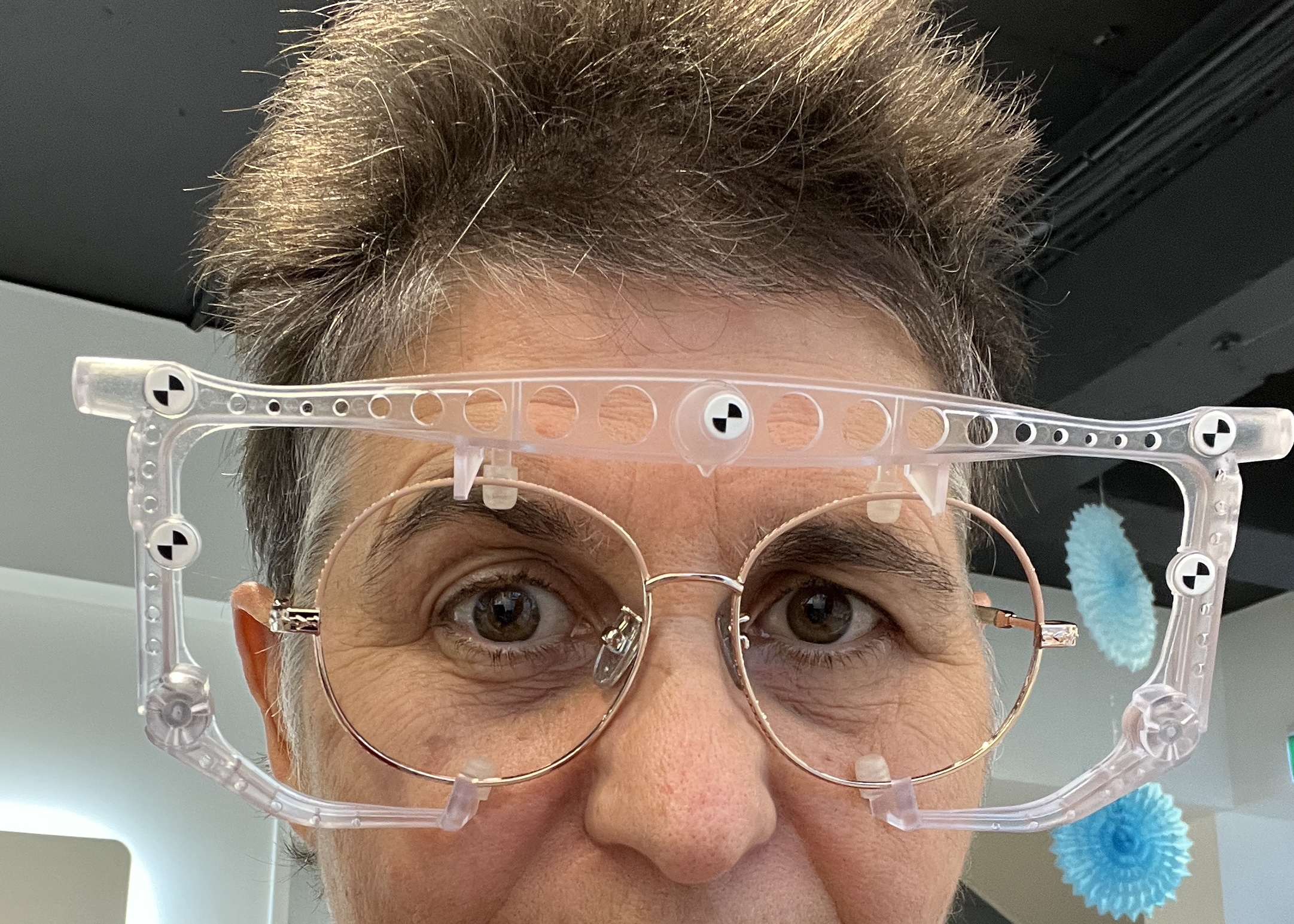
I spent too long choosing glasses that are too expensive. Apparently they don’t just do the old cross in texta on the lenses any more. I wore this frame with reference points around my new glasses while the technicians took a photo face on, and then from the side. Just like a mug shot.
I replaced both my reading + computer glasses and my multifocal glasses. The latter let me see distance while I am cycling, read the signs in the shops AND read the small print on tinned foodstuff, but for long term close up work I prefer lenses with less variability.
His comment, reflecting on the demise of Twitter as a central meeting hub, gave me pause:
I don’t know if it matters that there is no longer a single community, perhaps it was time to take a break and try other directions.
It matters to me because it affected how well I did my job and the value I could bring to any organisation. As a teaching academic, I had a window into the daily routine, challenges and solutions of people in the profession I was preparing students to join. The theory I could bring, and skill I had at helping people reach their own aha moments, were not the complete package I could offer. I often said to my students “There is a lot of experience here in this class. If we just rely on my knowledge, experience and ideas; and only hear about that, then everyone is shortchanged and we miss the richness”. Being connected to a group of engaged and sharing professionals let me bring all that into the classroom. Once Twitter was not there – or rather I did not welcome the evil overlords and bailed – I felt myself getting out of touch with the profession. I had far less confidence and spidey-sense that what I was sharing or pointing students toward exploring, was best for that moment.
What scares me is that this applies also to my own sense of knowing about what is happening in the world.
I remember reading that when the Brexit campaign happened, and in the US elections in 2016, people trying to sway the result did not try to make voters agree with their position. They went for lower-hanging, easier to harvest fruit. Convincing people that their vote had no impact. There was no point voting. To stay away, not care.
In Australia, with compulsory voting, we saw this tactic with the “If you don’t know, vote no” slogans around the Indigenous Voice to Parliament referendum last year. Not trying to convince people to think or engage. In fact, encouraging people to believe they are incapable of knowing what is going on, and should just be apathetic. Normalising not knowing and not finding out…. then turning that into a vote for a particular position.
Today in the course I am doing about community management/engagement for communities of researchers, we were discussing scaffolding we can create to help participants get what they need from a community. Someone shared their challenge the week before where their community decided they wanted to keep in touch, but this person hated Discord, and that person couldn’t use Slack at work, and the other person had not heard of any of the alternatives… and we all nodded our heads empathetically. In the end? Too hard, no regular communication channel set up.
Snail wonders whether blogging will be a way around that disconnect. I remember the blogger’s meetup I was part of in 2007 going from people talking knowledgeably and passionately about blogging one month, to the next month everyone raving and excited about the immediacy and connection they were feeling from Twitter. Yes, we were physically in the same space (the balcony of a pub), meeting in real life.
Perversely, I think that people feel, after the endless Zoom meetings of the last three years, that meeting in person is a luxury with little to gain compared to the inconvenience of physically getting to and from a location. We are in a spot where online networks are diffuse and spread across so many platforms that the centre does not hold – but also people are avoiding in-person contact because they somehow believe they can achieve the same online.
Solutions? I wish I had some. To me the world feels smaller and more unknowable, and I miss my friends in the computer.