Twitter is evil. Elsevier is evil. Wikipedia is evil.

Uncategorized

…or maybe not…

Librarians need to know about authoritative sources of information. Librarians need to teach other people how to evaluate the reliability of resources.

Nothing new there.

What is new is how widely distributed the sources can be and how important context can be to their authoritativeness – and how much librarians need to understand about these new contexts.

Three examples of the need to understand context crossed my desktop this week.

EXAMPLE ONE: Twitter is evil

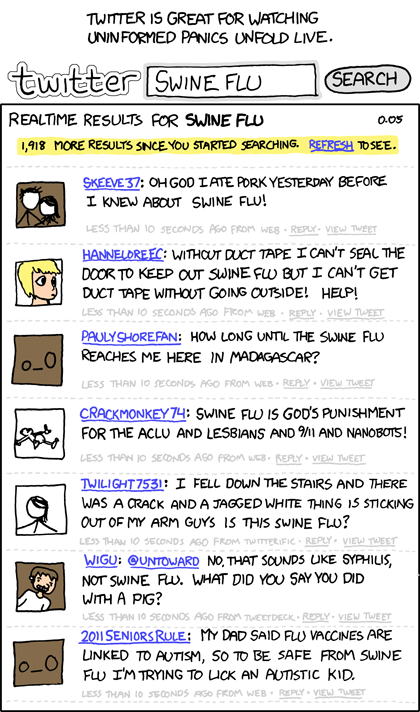
Swine flu: Twitter’s power to misinform .  Evgeny Morozov, Foreign Policy, net.effect. 25/04/09. In Evgeny Morozov’s opinion Twitter is noisy and full of misinformation about Swine Flu and likely to scare people who will encourage others to panic.

I can’t quote the article due to possible copyright restrictions.

Instead, here’s a cartoon from xkcd, Swine Flu .
EXAMPLE TWO: Elsevier is evil.

Elsevier published fake medical journals: Elsevier published six ‘fake’ Australian medical journals on behalf of pharma companies Kate McDonald, Australian Life Scientist, 08/05/2009 .  The Australasian Journal of [insert term here] will no longer be taken quite so seriously now that Elsevier has revealed that the Australasian Journal of Bone and Joint Medicine was actually funded by pharmaceutical company Merck, contained only reprints or summaries of articles from other Elsevier journals that contained positive references to two of the company’s products and only had advertisements for the same two products.

I can’t quote the article due to possible copyright restrictions.

Instead, here is a link to a great conversation  from a mob of librarians on Friendfeed.It starts with a comment from Steve Lawson and continues with over eighty comments that range over the deficits of academic journals in general, I think the LSW needs to get Elsevier to publish the Australasian Journal of Library Science.

Oh, and a cartoon from Organisation Monkey, Australasian Journal of Bone and Joint Medicine

EXAMPLE THREE – Wikipedia is evil

Student’s Wikipedia hoax quote used worldwide in newspaper obituaries Genevieve Carbery , Irish Times, 06/05/09.  When composer Maurice Jarre died at the end of March 2009, newspapers around the world carried a beautiful quote from him: ““One could say my life itself has been one long soundtrack. Music was my life, music brought me to life, and music is how I will be remembered long after I leave this life. When I die there will be a final waltz playing in my head, that only I can hear,””. The source? Wikipedia. The problem? A 22 year old student had placed the quote in Jarre’s Wikipedia page the night of Jarre’s death, and kept adding it even though Wikipedia’s editors deleted it several times.

I can’t quote the article due to possible copyright restrictions.

Instead, here is a quote from the discussion page for the Wikipedia entry for Maurice Jarre: ” Although I may agree it’s something of a rude experiment have a bit of proportion. This is not equivalent to getting someone arrested or poisoning their Tylenol. It’s more like doodling on a library book or at most streaking at the Oscars.–T. Anthony (talk) 05:38, 8 May 2009 (UTC) ”

What conclusions can we draw from these articles?

1. Twitter, Elsevier and Wikipedia should be legally stopped before they can do any more damage?

2. There is no context in which Twitter, Elsevier and Wikipedia will be a reliable or useful information source?

3. Librarians don’t need understand the many different ways  Twitter can be used, the funding patterns of academic journals nor how references are quality controlled in Wikipedia?

Nope. Librarians need to understand how information on Twitter, in academic journals and Wikipedia  is created, distributed, re-used, re-purposed and the criteria for sensible evaluation.

Why Learning About Emerging Technologies is part of every librarian’s job – Educause Australasia 2009 presentation

Uncategorized

This afternoon, I am presenting a paper at Educause Australasia 2009 called Why Learning About Emerging Technologies is Part of Every Librarian’s Job .

The slides are rather cryptic in places as there are a lot of images. I recorded audio while I was practicing last night, so when I get time, I will turn this into a slidecast.

You can download the accompanying, peer-reviewed paper from my site here, Why Learning about emerging technologies is part of every librarian’s job (WORD doc). (The conference papers were not available online at the conference site when I made this post).

Personal Learning Environments: what works for librarians

Uncategorized

This morning, Penny Coutas, Peta Hopkins, Con Wiebrands and myself were on the panel for a symposium called Personal Learning Environments: What Works for Librarians.

We ran the session as a discussion. We started out asking the participants what they wanted to find out in the session. This is a technique that Con and I first used at LIANZA as a way to show people how an unconference may work – but it actually looks useful for conference presentations in general.

We focused on going where the participants wanted to go, so we didn’t cover all of the material in our slides (below). Penny Coutas is the clever clogs who made them pretty and found the cartoons on most slides. We also created a wiki where each of us listed the tools that we use everyday, plus a number of unusual tools that we rely on, PLEs: what works for librarians . I found reading everyone else’s favourites just fascinating.

Educause Australasia 2009 Twitterfountain and more

Uncategorized

I am attending Educause Australasia 2009 : Innovate, Collaborate & Sustain here in Perth from Monday 4 May – Monday 6 May.

Although there is a closed social networking site provided by the conference organisers, I don’t think I will use it, for many of the reasons that Peta Hopkins gives here in her post about Preparing for edaust09 . Peta is right when she talks about a “subversive back channel”. For me, often the most enriching comments via social networking come from someone several time-zones away who is watching remotely. I can almost see the point of a closed chat channel for attendees, but I’m puzzled about why we have to log in to a walled garden to find the tag being used for the conference or to see tweets and photos that use the conference tag.

If you are interested in seeing the public tweets and Flickr photos that have been tagged with the conference tag, edaust09, I have set up a TwitterFountain in this post. It updates every three minutes.

Peta and I (and maybe a few others) are feeding our live tweets from 8am – 6pm each day from @petahopkins and @libsmatter into three CoverItLive sessions.  I’ve embedded them over at LibrariesInteract.info, as we are officially reporting for librariesinteract.info, Educause Australasia Conference 2009 – Librariesinteract.info reporting. It updates in real time and anyone can make comments or ask questions.

I will be presenting two sessions for the conference, both on Tuesday 5 May.

Personal Learning Environments: What Works for Librarians Tuesday 5 May, 10:00am to 11am, Meeting Room 8:

Educational Institutions no longer provide all the tools required for librarians to keep up to date with new technologies, collaborate with colleagues and share professional knowledge. Journal articles, conferences and formal coursework are no longer the primary methods of keeping up to date.

In this panel discussion, Kathryn Greenhill and Penny Coutas from Murdoch University, Peta Hopkins from Bond University and Constance Wiebrands from Curtin University discuss the online tools they use daily to create their own Personal Learning Environment. They describe how some of these tools work, what suits their daily workflow and may even vigorously defend the merits of their personal favourites.

Why Learning About Emerging Technologies is Part of Every Librarian’s Job Tuesday 5 May 4:00pm – 4:30pm, Meeting Room 6

In the last two years, several libraries have conducted formal learning programmes to familiarise staff with emerging technologies. Learning about new technologies should not begin and end with a formal learning programme, but should become part of every librarian’s job.

As staff learn about disruptive new web tools, then it is likely that the workplace will change to become a more flexible and nimble environment – reflecting the rapid change and flexibility that is happening online. Managers should be prepared for this, and for resistance to this change.

There are several objections staff raise when asked to make time for learning about new technologies in their already overcrowded day. Anyone implementing a staff learning programme needs to listen to these objections with respect and try to address these concerns.

If library staff understand why they should learn about emerging technologies, then they are more likely to find time to do so. This paper outlines twenty one reasons why learning about emerging technologies is part of every librarian’s job.

The paper concludes by offering some techniques for motivated staff to find time to learn about new technologies – either in a formal programme or as personal and professional development

What kind of “better than free is your library” presentation – U Game U Learn.

Uncategorized

In about an hour I will be giving a presentation at U Game U Learn called “What Kind of Better Than Free is your Library”. I will be recording the audio on my iPhone, so if I get time I will make a slidecast or post the audio on this blog entry.

It is partly based on these posts on my blog about Chris Anderson and Kevin Kelly’s ideas about “free” – What kind of “better than free” is your library service? and
What kind of free is your library service?

Until there is audio, here are the slides:

U Game U Learn, Delft Netherlands. Liveblog

Uncategorized

I will be speaking at U Game, U Learn at GMT+1 on Thursday 23 April 2009 – in a few hours.  This is the second year of a conference that was all about gaming in libraries last year, and this year is more focused on New Media, marketing, libraries and education. It is a joint effort of the local public library, the DOK Library Concept Centre and the academic library at the local univerisity, TUDelft. There should be more cooperation between these kinds of sectors.

My topic is:

What kind of “better than free” is your library?
Kathryn Greenhill looks at new marketing models where “free” services are the basis of making money, and at how libraries can use the same techniques to grow social capital. She examines how libraries can give value to their communities with the “better than free” qualities of trust, immediacy, personalisation, interpretation, authenticity, accessibility, embodiment, patronage and findability.

Door: Kathryn Greenhill


It turned more into a jazz riff on libraries and free, than any serious disucussion of social capital. I’m arguing that the stories that we tell about our library value – which often consists of number of books issued or people counted on door counter – should be expanded to include other values to our community.  There are new marketing models that incorporate elements of no cost to the consumer, where people pay for what they could get for free. We need to look at some of the things that people value in these transactions and see whether we can argue that the library, that provides a “free” service to users, should continue to be funded due to the new values it can bring within a reputation and attention economy.

I will embed the slideshare set here when I have given the talk.

I’m going to be part of the “Battle of the Babes” in the afternoon. No idea what it involves other than four of us women with passionate views arguing over a number of theses about the future of libraries, plus some audience SMS voting. It *may* involve jelly, but I don’t think so.  Erik promises some surprises that it  will top the Storm Troopers from last year’s conference.

I will be recording my live tweets of the sessions via libsmatter and using CoverItLive again:

Librarians Matter blog is back after 3 days offline

Uncategorized

Sorry about the last post – a goodbye and then my blog was unreachable for three days or so while my husband sorted out a rogue database he had added to our shared web hosting account.

The minifigs and I move on from London tomorrow morning, after spending a couple of warm, sunny days riding double-decker buses with Jenny Evans , who was the perfect tour guide and companion.

Next it’s a couple of days in Delft with the ebullient chaos that is the Shanachies, where I hope to liveblog and live tweet the U Game U Learn Symposium. Then I tackle the jigsaw puzzle of trying to fit myself back into my home and work after such a stunningly enjoyable  and professionally rewarding time away.

I was going to claim that I haven’t had jetlag at all this trip, but since I am writing this at 2:30 am, I’m not sure I can do so…

So Long, Thanks. Until we meet again

Uncategorized

I’m off to London in the morning.

Since I arrived in the US on 11 March (38 days ago),  I have been passed from one set of warm welcoming arms to the next.

There have been so many imaginary friends who have stepped straight out the internet to be warm, smart, funny real friends. Often the first time I met people offline, it was with a big mutual hug – and it was totally appropriate. (Ummm…I *hope*).

If I could guarantee not to forget any names, then I would thank people personally who shared a conversation, their thoughts, a meal, their rooms, their homes or so much of their time with me. I hope you all know who you are – thank you. I hope that the connections we have formed can thrive across the world.

I’m deeply grateful to have been given this once-in-a-lifetime opportunity.

If you can make your way across the world – and it *can* be done – feel free to come and stay with me in Western Australia.

Koha Con 09 Plano Texas

Uncategorized

Today I am in Plano, Texas at a two day conference for the community that uses the Koha Open Source library management system – KohaCon 2009 .

I have set up a CoverItLive session so that I can easily aggregate my tweets for later. This is below.

There is also a conference-wide CoverItLive session as well, KohaCon09 ,  pulling in all tweets with a tag kohacon09 .

Text of Darien Statements on the Library and Librarians.

Uncategorized

Other people have been reproducing the text of the Darien Statements , so I thought I would put it here too.

I’m really enjoying the discussion this on John’s blog and via various posts. I’m even happy that people are disagreeing with some parts, as the idea is to start discussions that we need to have if the Library, libraries and librarians are to flourish in the future.  I’m deliberately giving people space to reply to each other, rather than weighing in with comments in a lot of places.

The Darien Statements on the Library and Librarians
Written and endorsed by John Blyberg, Kathryn Greenhill, and Cindi Trainor

The Purpose of the Library

The purpose of the Library is to preserve the integrity of civilization.

The Library has a moral obligation to adhere to its purpose despite social, economic, environmental, or political influences. The purpose of the Library will never change.

The Library is infinite in its capacity to contain, connect and disseminate knowledge; librarians are human and ephemeral, therefore we must work together to ensure the Library’s permanence.

Individual libraries serve the mission of their parent institution or governing body, but the purpose of the Library overrides that mission when the two come into conflict.

Why we do things will not change, but how we do them will.

A clear understanding of the Library’s purpose, its role, and the role of librarians is essential to the preservation of the Library.

The Role of the Library

The Library:

  • Provides the opportunity for personal enlightenment.
  • Encourages the love of learning.
  • Empowers people to fulfill their civic duty.
  • Facilitates human connections.
  • Preserves and provides materials.
  • Expands capacity for creative expression.
  • Inspires and perpetuates hope.

The Role of Librarians

Librarians:

  • Are stewards of the Library.
  • Connect people with accurate information.
  • Assist people in the creation of their human and information networks.
  • Select, organize and facilitate creation of content.
  • Protect access to content and preserve freedom of information and expression.
  • Anticipate, identify and meet the needs of the Library’s community.

The Preservation of the Library

Our methods need to rapidly change to address the profound impact of information technology on the nature of human connection and the transmission and consumption of knowledge.

If the Library is to fulfill its purpose in the future, librarians must commit to a culture of continuous operational change, accept risk and uncertainty as key properties of the profession, and uphold service to the user as our most valuable directive.

As librarians, we must:

  • Promote openness, kindness, and transparency among libraries and users.
  • Eliminate barriers to cooperation between the Library and any person, institution, or entity within or outside the Library.
  • Choose wisely what to stop doing.
  • Preserve and foster the connections between users and the Library.
  • Harness distributed expertise to serve the needs of the local and global community.
  • Help individuals to learn and to use new tools to create a more robust path to knowledge.
  • Engage in activism on behalf of the Library if its integrity is externally threatened.
  • Endorse procedures only if they guide librarians or users to excellence.
  • Identify and implement the most humane and efficient methods, tools, standards and practices.
  • Adopt technology that keeps data open and free, abandon technology that does not.
  • Be willing and have the expertise to make frequent radical changes.
  • Hire the best people and let them do their job; remove staff who cannot or will not.
  • Trust each other and trust the users.

We have faith that the citizens of our communities will continue to fulfill their civic responsibility by preserving the Library.