Hopefully most of you have seen the official launch of the Australian v3.0 licences earlier today.
We’re very pleased to announce that the licences, only a few hours old, already have their first significant adopter. A couple of weeks ago the Australian Parliament officially announced, via the Australian Library and Information Association’s mailing list, that it will be porting its centralhttp://www.aph.gov.au website across to a Creative Commons v3.0 BY-NC-ND Australian licence. This is the website which houses all the most important documents of the Australian Federal Government – including all bills, committee reports and, most importantly, the Hansard transcript of Parliamentary Sittings – so this is a major move for the Australian Government.
From the Australian Parliament announcement:
The Parliament of Australia is committed to open access to the resources it publishes to support a vibrant democracy. Recognising the important of ensuring access to its resources published on the website the parliament has approved publication under a Creative Commons 3.0 Attribution-NonCommercial-NoDerivs license (http://creativecommons.org/licenses/by-nc-nd/3.0/au/) instead of copyright protection. Full implementation will occur when the new web site is released in late 2010. Until then a notice appears on the copyright page advising of this change.
…
We are enormously excited at this step to open up parliamentary information.
Since its endorsement of open access as its preferred default in its response to the Gov 2.0 Report last month, the Federal Government has released the Budget, the NBN implementation study and the Gov 2.0 response itself all under CC licences. This latest announcement solidifies the government’s commitment to openness and transparency, and means that the entire public record of our government will now be available for non-commercial reuse by anyone, without the need for additional permissions.
Today I print out the final version of my thesis to hand in tomorrow. After 18 months of living with it is a great relief.
I’m not sick of the topic. The idea that librarians are getting out there and developing their own software and sharing it is still very, very exciting to me. When I compare my findings to the other scant literature about motivations for organisations to develop Open Source, it looks like libraries do have different reasons – less focus on economics and more on functionality. After so long with the same topic, though, I have lost the ability to critically look at my research and how I’m expressing it.
It is not a full Master’s thesis, just a way to top-up my Post Graduate Diploma to a Master of Information Management, designed to be finished in 6 months full-time. I’m so, so glad that the VALA Travel Scholarship gave me the chance to travel through the US and meet so many fantastic library heroes and be welcomed so warmly by them. As you can see from this embedded video of the Gables Bed and Breakfast in Philidelphia, I suffered great physical deprivation in the name of research:
I am not sure that I have the energy right now to continue further research into the topic, but there are questions I am itching for someone to find answers to… like:
Is it libraries’ non-profit status that makes them less concerned about economics of Open Source than other organisations ?
How does the software produced and the community that arises vary between libraries and higher education institutions that develop OSS like Zotero or Connex ?
Do motivations and perceived risks for those who develop Open Source library software differ greatly from those who adopt Open Source software?
Is there a correlation between being an already innovative organisation and developing Open Source Software? Adopting it? Not adopting it?
Excellent in bed…and on my lap…and as a social gaming device with the whole family watching (and touching the screen) as we complete a level of Bejewelled or Plants vs Zombies together. That’s different from my iPhone, desktop, laptop or netbook. I can put it on the window sill to watch TED talks as I cook, and the speaker is loud enough to be heard easily – unlike my iPhone .
It is this form factor that makes it feel like a different class of device. I agree that most of the time it feels like a big-arsed iPhone.. . or rather it makes my iPhone suddenly feel too small and inadequate for the touch interface and viewing movies or browsing the web. To me it is more of an “at home” device than an out and about device, although I have paid Telstra $30 for 1GB of data for the next month. My main motivation for this was to use the Google Maps ap for navigating in the car – I’m not great at squinting at the iPhone screen as I miss yet another turnoff…
There have been criticisms that the iPad is more a consumption device than a creation device ( The iPad? Well, it’s not exactly the Apple of my eye ). It doesn’t multitask, it is hard to use the keyboard, has no direct audio or video input …. but….but…
This is the first generation of the iPad, the one made to suck in the early adopters, make us part with too much cash, the version with the cut-down features so that there is somewhere to go in the next generation iPad.
Two applications give me an idea of the potential of this as a creation tool. They are much better on the iPad than their equivalents on PC. They make me suspend my judgment about the iPad as a creation device – at least until we have had 6 months or so of people creating aps for the gesture and touch based interface.
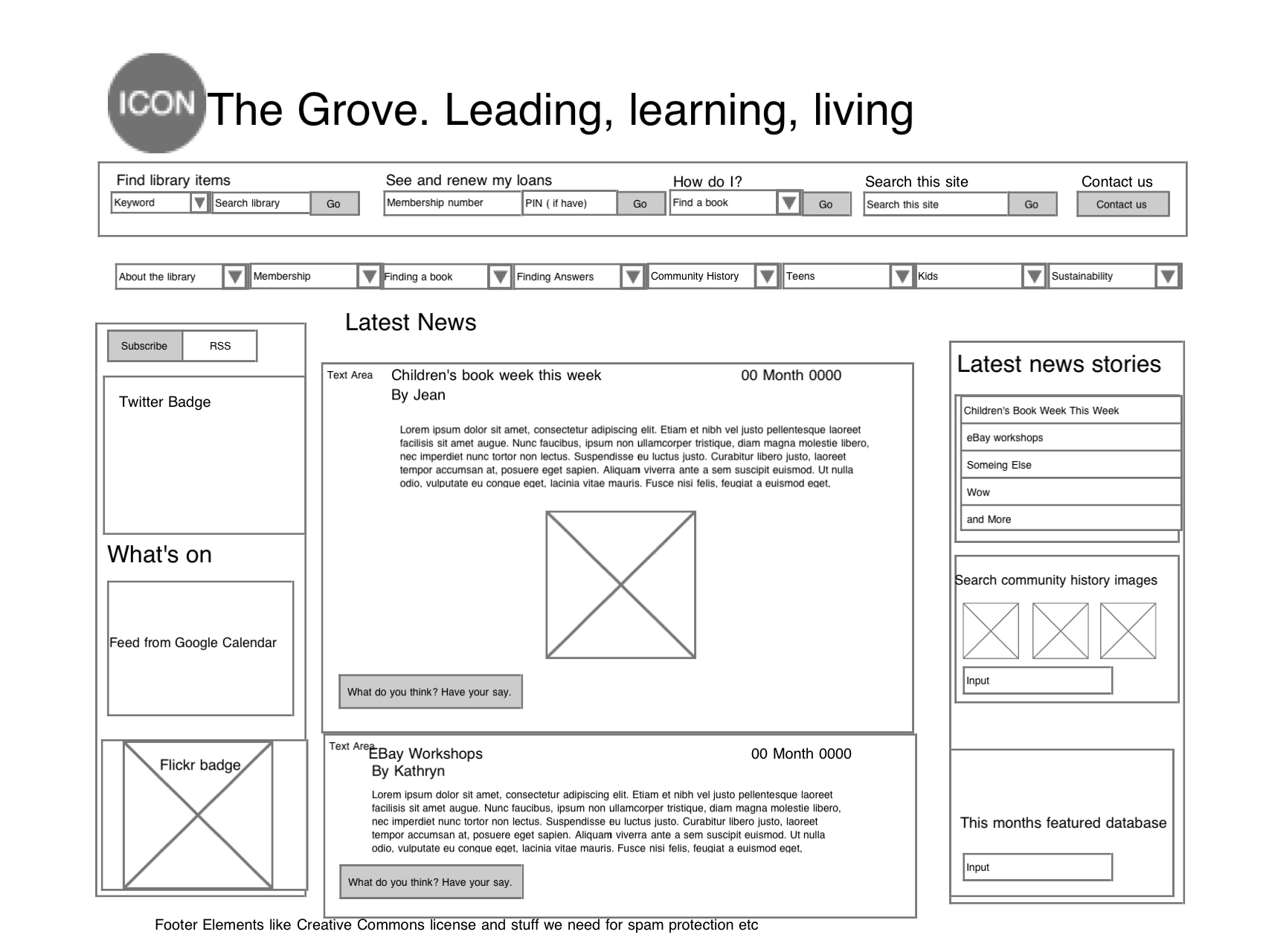
iMockups is a wireframing application, used to create mockups of websites. If you’ve ever resorted to using paper cutouts of furniture to move them around on a floor plan to work out how to furnish a room, then you have an idea what it is like to use iMockups. Being able to flick a data entry box to one side of the page, or pull on the edge of a header to make bigger, or use a gesture to capture all elements and move them all up a smidge makes it all so easy. I was using post-it notes on an A3 bit of paper to layout the new webpage for our library, but this is even better. I did the one below in just a couple of hours while sitting on the sofa watching tele at the same time… easy peasy … are we revolutionary yet???
The other application that I have used to paw my device, in ways I am unused to, is Autodesk Sketchbook Pro. I found out about this when someone in my Twitter stream (Kim? Joyce?) pushed out a link to these notes taken during a conference session:
Byan Alexander's Keynote Uploaded to Flickr on May 8, 2010 by Rachel Smith
I have been fiddling about with it in a rather desultory way, but I have managed to produce digital drawings much better than I have with any other kind of setup. I don’t think I could do what Rachel did quite yet, but I also think that with a bit of practice it would not be far away. I don’t think I would reach the level of the demonstration video , although using the symmetry option I was able to draw quite a funky human face like in the demo.:
I didn’t quit Facebook on Quit Facebook Day last week…. or Plurk, or Vimeo, or Second Life, or Odeo, or Squidoo, or Plaxo or …. you get the idea. If I go and check at namechk.com I can quickly see how many services I registered for, but do not use.
I don’t use Facebook any more. I kept my account way after I found it vaguely useful because I was working in a job where I had to know how students were using it. I learned how to set up a page and create a Facebook ap. Now that I no longer need such an intimate idea of how students communicate, if I (or the library users) thought it was useful, I could set up a library presence in Facebook and communicate with users. This is probably not likely soon.
I use Facebook differently from how my neighbour, kids’ friends or other librarians might do. Understanding that there are many ways that tools are used, how these tools work generally and having enough tech skill to master them in half an hour of playing about are essential skills for librarians, especially something so widely used as Facebook. This does not mean that I have to keep an account on a service that I no longer find useful. I was rather pissed off when Stephen Abram wondered on his blog:
… how many info pros will announce to the world they don’t have the information skills to manage privacy by leaving Facebook today. If they do have the skills they won’t for long as outsiders. It seems to me that it should be a reasonable user expectation of librarians and information professionals that they should be able to manage privacy settings and use the full range of web tools. I also would expect to be able to receive informed, current and excellent advice and training on how to deal with the emerging social tools from my professionals in the social institutions I frequent (public libraries, schools, univerisities, colleges, etc.). (Today is Quit Facebook day for Dummies )
There are many valid reasons why other librarians made the personal choice to quit Facebook – the way it keeps changing the privacy goalposts, the walled garden aspect, the dependency on one platform, the social awkwardness of refusing a “friend” request… Just like it’s valid for me to have kept my profile, but not use it – although I may be the dummy for uncritically keeping my profile on a service that I no longer find useful.
Understanding this fluidity of use, different personal approaches to information and online tools and that there are no “one size fits all” tools for everyone are essential skills for librarians.
Everyone has the right to freedom of opinion and expression; this right includes freedom to hold opinions without interference and to seek, receive and impart information and ideas through any media and regardless of frontiers.
A library’s role is not to supress ideas – not matter how dangerous or loony I may believe those ideas to be, nor how wrong I think they are. That is why I support the State Library of Western Australia’s decision to provide a venue for a talk from people of the Anti-Vaccination Network on Tuesday 1 June.
I do not agree with the claim on the Sceptic’s Book of Pooh Pooh that the State Library CEO, Margaret Allen was putting the health of WA children at further risk.. I think they are shooting the messenger.
My tiny, fragile baby boy stopped breathing for over a minute as I was breastfeeding him on the day I took him home from hospital. We had waited for three weeks to take him home after he was born 2 months premature, so it was a huge shock to hear from the doctors that they suspected that he had whooping cough. Tiny babies with whooping cough don’t cough, just turn blue and stop breathing.
After a couple more months in hospital we took him home, but that experience clarified for me – vaccinating our children is a community issue. When a parent decides not to vaccinate they are not making a choice just for their own kids, but for mine as well. There is overwhelming good science supporting the health benefits of vaccination and I think it is a selfish and shallow to not vaccinate.
I have many other personal beliefs. I choose a mainly vegetarian diet for my own health and the health of the planet. I do not believe in an afterlife. I think depictions of violence that permeate our popular culture desensitizes people and begets more violence. I think that anyone who eats beetroot is slightly addled. When I go to work as a librarian, those beliefs come with me – however a key part of my job is providing access to ideas that are in direct conflict to what I believe is right for myself and for my society.
A library’s role is to provide access to information and connect people to that information. We seek to provide a balanced and varied collection, but not to judge the information we are providing, nor the people who are seeking it. This is not because it is almost impossible to please everyone, so libraries are take the easy way out by sitting on the fence and trying to be everyone’s friend.
When I buy a compilation of war comics for the Young Adult section, order ” Delicious Prime Ribs and how to Barbeque Them” for the non-fiction section, accept a donation from the Church of Scientology of one of Ron L Hubbard’s works or put a pamphlet from the Anti-Vaccination Network on the shelves I am doing something very serious and vitally important for our society and its freedom. I am protecting my own and my children’s right to think for ourselves. I am creating a society that trusts its citizens to think critically and make their own decisions with no source of information forbidden.
As a librarian I provide the information, but I do not author it. It is not my message, even if I work my hardest to build a structure where as many people can easily and immediately access that message and then make up their own minds.
If the State Library of Western Australia wanted to give space to the Beetroot Appreciation Society for a public outpouring of all things Beetroot then so be it. I may well organize my fellow Beetroot Abhorrers and ask for similar space to air our opinions. I would hope that people with a brain who attended the Appreciators’ event would use that brain to evaluate the arguments being put on the night. I would appreciate attending their forum and asking tricky questions about the dirt smell and that deep,dark purple ooze. I would be very glad that I lived in a society where there was a venue that protected my right to have ideas outside the mainstream.
I think the free and open discussion of ideas, like the decision whether to vaccinate a child, is a community issue. If a parent doesn’t vaccinate their child, they are putting my child at risk. If I claim the right to stop your ideas from being heard, then I am putting my own right to be heard at risk.
I am not arguing that ideas should be heard without rebuttal, argument, critical thought or judgment. I am arguing that they should be heard and that libraries exist as a vital institution to protect the right for that to happen.
Instead of deflecting the vaccination debate to one about whether loonies should be able to spout their bullshit in a library, it would be far more sensible to start public debate about what happens when as a population we uncritically accept bullshit and do not think for ourselves. This clear and entertaining cartoon showing the Facts of What Happened in the Case of Dr Wakefield (Mr Vaccination-Causes-Autism) by Darryl Cunningham is a great place to start.
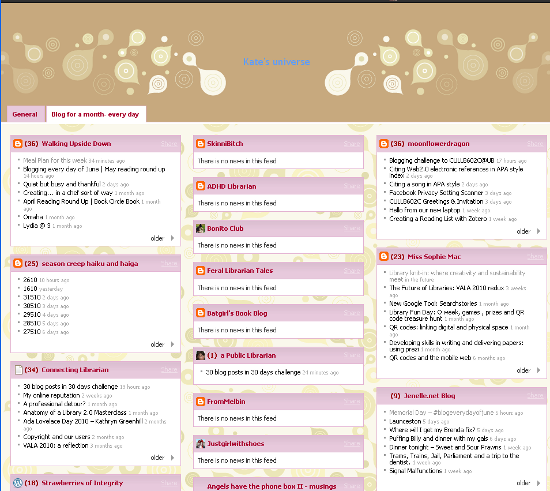
There I was, trying to create a single file of RSS feeds for all the blogs in the 30 in 30 challenge using Yahoo pipes, so people could add them to their feed reader… when Kate Bunker did something a whole lot smarter….
It took me about two seconds to decide on 1 January last year to take part in the Twitter 365 Flickr Challenge. I took a photo of myself each day for 267 days during which time I travelled overseas for seven weeks, lost 10kg, cut my hair to 1cm all over and changed jobs. I was also really confronted with the act of staring at my own camera and trying to find an image I was happy to share each day. I discovered that even though I found it really, really hard to smile for the camera, and felt like I was lying and being insincere when I did so, I looked much less like a dweeb when I smiled. I overcame my hesitancy about seeing myself in photographs and learned how to place a camera for an interesting self-portrait.
It took me slightly longer to decide to try saying “yes” to everything back in mid-June 2006 after I read Danny Wallace’s book, Yes Man….but I don’t think it was much longer, maybe five seconds. After about a year of saying yes, I found that I had previously been saying “yes” to things to do with the family and kids and “no” to things that involved me taking on personally interesting projects. At the end of the year, I described my attitude as having changed, from “I can’t do that because…” to “I can do this – do I want to?” .
1)I am going to do “30 comments in 30 days” and make sure that I comment on at least one blog on the list at LINT per day.
2) I want to write “think posts” rather than “link posts”, so it is out to just put up a link to a really cool or cute story or only embed something like this clip of the STAR WARS I-PAD BRIEFING:
If I didn’t like Plants vs Zombies so much, and if I hadn’t just realized that Margaret Atwood’s last novel was a continuation of the dystopic world of Oryx and Crake, then I may have more to report about my new iPad. Instead of putting it through its paces, I’ve been playing games and using it as an ebook reader. It is an excellent interface for both.
In a couple of days I will post about the different aps I have tried on the iPad and whether I think the device really is “magical and revolutionary” as claimed in the Apple marketing. Tonight though, a bit about the iPad as an ebook reader.
In Australia there is still only one book sitting forlornly in the iBook store, the free copy of Alice in Wonderland. The reading interface for the iBook ap is made to look like a paper book, complete with spine, pages and page turning action. It’s rather pretty as an object, but a bit too try-hard.
The iPad is the best ebook reading device I have tried. Although I read that it was too heavy to hold comfortably (Looking at the iPad from two angles) , I am fine with it resting in my lap with the print size adjusted accordingly. Other devices I’ve tried are the Kindle, my desktop PC, my large laptop, my netbook, my iPhone, and even the XO laptop that has a special screen made for reading in bright light. I understand that the matt, low-light screen on eInk readers works well for others, especially those who get headaches reading on a backlit screen. For me, the black flash between pages and slow refresh rate of the Kindle are mildly annoying. I don’t seem to read in light levels where the eInk is superior to the screen of the iPad. There is an extremely wide viewing angle for the iPad screen and it adjusts adequately to different light levels. I prefer the energy-saving potential of eInk, where a single charge lasts up to two weeks. The iPad screen is a perfect size for reading. Compared to my netbook, it is more comfortable to carry from room to room and to drop into my backpack. The netbook’s neoprene case is excellent as a cover for the iPad.
I was the type of kid who read whatever was at hand – cereal boxes, old Readers’ Digests, fold-out operating instructions for transistor radios – rather than have nothing to read at all, so the device (and sometimes even the content) is often secondary to satisfying my desire to have *something* to read. Unlike many librarians and readers, much of my pleasure is in the act of reading for itself, not from the physical act of holding a book, feeling the weight in my hand, stroking the cover or smelling the pages as they turn. I enjoy books as aesthetic objects, but I don’t think I have ever equated reading only with books.
My preferred ebook application on the iPad is the Kindle ap from Amazon. Ethically I disagree with locking up content in the .azw format and making it legally impossible and technically nigh-impossible to read one’s own ebooks in a way other than using Amazon’s application. Practically, I love the one-click delivery of my ebook straight to my device without having to plug into a PC and fiddle about transferring it. Although it is possible to read other content types using the Kindle application, I think the average user will not be bothered and will pay for the convenience of instant and easy delivery. I love the synchronisation between all my devices, so that if I am in line at the supermarket I can whip out my iPhone and carry on reading my novel from where I left off on my iPad in bed the night before. I have tried using the Stanza and Kobo applications as ebook readers, and I don’t see a lot of difference between the three of them for me and the way I read (which is indiscriminately anywhere, anytime).
I downloaded the WIRED magazine application for the iPad, which costs $5 for content of the current print/online issue.The publisher worked with Adobe to create the right platform, with the idea that they “write once, publish everywhere”. One holds the iPad in portrait mode and uses a finger to scroll horizontally from article (or advert) to the next one. To read an article or section in depth, one swipes upward so that the rest of the article appears from below. Some articles have images that you can touch to see the text below change to describe the item in the image. There is a little video engine that allows one to swipe left to right and see, for example, Mars rotate so you can read little flags on the surface of the planet describing recent Mars missions…or watch a Lego car being built and disassembled. Some advertisements have links out to external sites on the web – which seemed like a good idea at the time I am sure, but really, I’m not going to click out of the application, into the browser and then need to find my place again. It was cute to click on the front cover and see a filmclip previewing Toy Story Three, but all-in-all it felt a bit like it wasn’t there yet. I think there is such a tension between trying to look familiar enough to the reader that they accept this is a magazine, while still pushing the limits of what this new display can do. If they had dropped linearity altogether to really take advantage of the way a reader can swim and flip through the text, if they had not anchored all their film clips and images firmly to a corresponding text story, then I think people would not have felt like they were reading a magazine.
Critics of the iPad application for The Australian complained of too many advertisements and many articles not appearing on the iPad when they were in the printed newspaper. I can’t comment, as I don’t get the print edition. This time, I was set back $5 for a month worth of content delivered daily. Tonight there is an article about rough seas in Wollongong today, a Sunday, so new content is being added on the day they do not publish their print edition. It looks like I can’t view archives of previous days’ newsitems. There is no Weekend Magazine content at all. There has been no attempt to exploit multimedia with this application, just a few shortcuts in the menu structure so you can go more quickly to the section you want.
I won’t be using my iPad in the bathtub or at the beach, but I think it will be my preferred way of reading fiction from now on. In Australia, as I have said before, the major impediment to ebooks being widely and well used is neither the device nor application used. It is content. I had high hopes that Borders’ Kobo store that launched a couple of weeks ago would contain more Australian content and at cheaper prices than Amazon’s Kindle store. The cautious support from Australian publishers, like Melbourne University Press’s Louise Adler, during interviews on the day the Kobo store was launched left me hoping for more than was delivered. Searching the ebook store reveals no Tim Winton, no Patrick White, no Helen Garner, no Peter Carey and just two ebooks by Kate Grenville .
I am very glad that on 9 April the Minister for Innovation announced a Book Industry Strategy Group to ” develop strategies to ensure that the Australian book industry continues to thrive in a global digital environment.”, Charting a High Tech Future for the Book Industry . I am very, very pleased that Barry Jones, recipient of the Australian Library and Information Association’s Redmond Barry Award, will be chairing the group. As an Australian who wants to read Australian content on my iPad today, I am puzzled about why it will take a year for the group to report back.
Oh well, back to snuggle under the doona with my iPad and After the Flood by one of my favourite Canadian authors.
I first heard him speak in October 2007 at the State Library of Western Australia, where he spoke about how new online tools could transform libraries. I took a pack of coloured pencils and drew my notes. They are below, Paul Reynolds at the State Library of Western Australia. Two ideas stuck with me from the day. The first is the question
“What is it, when we walk into a library that makes us go: “Aaaah, I’m in a library”? “
– in other words, with all the changes to our buildings and services, what is so essential about what we do that it must be kept and nurtured and instantly recognisable in any library space we create? The other was the quote at the start of this post:
Our tools are in front of our ideas and our bravery
This was said in the last half of 2007, where new services -and indeed new classes of online tools- seemed to be springing up a the rate of three a week. Many of us were playing and fumbling and trying to make sense of how they worked, how we could use them in our libraries, and what would be the consequences of not jumping on that train before it left the station… Although the goldrush of new services seems to have settled down a bit, it is still worth asking I think – “what is possible, and are we being held back due to common sense or timidity?”…
I saw Paul at several conferences after that. He was a frequent end-of-session question asker. His questions always reflected the bigger picture -not just “how does this fit in a political or organisational context”, but “how does this fit in with a society that claims to be civilised?”. He will be missed in Australia as well as New Zealand.