My year in first lines.

Uncategorized

I liked this meme over at Ruminations, The year in sentences. The first line of the first post for each month of the last year.

December We know that the nature of the web is changing from read only to read/write.

November If you have a couple of minutes, please swing by this blog and leave a comment.

October Still on holidays and back from a few days at the seashore where I saw baby seagulls nesting and baby penguins and sealions lazing on the sand and dolphins playing by the boat.

September So, call me a twopointopian for loving my workday today.

August We’re a nosy bunch in the biblioblabbersphere.

July Here’s my answer to anyone who asks “so – what do you do at an unconference or barcamp ?”….

June Random thing 2 from the list I made on Thursday: 2. Five blogs that make me think are:

May Yesterday I outlined Ten very good reasons why your librarians should be in Second Life.

April Google paper – helping the environment get incrementally healthier.

March Circuses? They’re all about performing animals and clowns that do slapstick and must have a ringmaster with a big black moustache, right?

February Back in 1993, after Peter Steiner’s “on the internet no-one knows you’re a dog” cartoon was published in The New Yorker (pg 61 of July 5, 1993), everyone seemed to have it up on their wall.

January ‘Tis the season for blog migrations.

Drawing the veil …

Uncategorized

When should you blog about work and how much?

Meredith Farkas suggests that we need to know about each others’ failures and difficulties as well as successes, Sharing the bad stuff as well as the failures. All isn’t “Happy Valley” in every library, or every library blogger’s professional life. If we share these moments, then we feel less alone or stupid when they happen to us – and learn from each others’ wisdom or forbearance.

I agree in principle. In practice, I’m a lot more cautious. It’s a personal line that is different for everyone, but I thought I’d share mine.

Considering that this is a blog mainly about being a librarian and I do mention my job in it, my personal hierarchy of respect/ obligation / duty goes :

  • my family
  • my real life friends and relations
  • my workmates
  • online friends and contacts
  • my profession
  • audience of my blog

Sorry folks, but I won’t be telling you about what happens in my job if it’s likely to offend or even make my workmates uncomfortable – even though I’ve had some corkers that I’d LOVE to share with you.

My yardstick is not about individuals, but about the group to which they belong. When I want to mention what someone else said or did, I think:

“If I write about workmate x, will my other workmates think I am looking at them as blog fodder too?. If I mention the cute action by one of my kids’ friends, even with the parents’ permission, what does that do to the trust relationship with other parents ?”

Here’s some instances of where I’ve drawn the line.

1. I wrote a post about a fantastic library-based initiative that is unique and involves a lot of clever hard slog by my sons’ school librarians. I ended up not posting it because I didn’t want to identify my sons’ school.

2. One of my sons has a disability which can be hard for our family to handle from day to day. I mention it on twitter sometimes, and I’ve blogged about it here a couple of times. But the specific details of his day to day behaviour is his stuff, not mine to share. It’s not about hiding or denying his disability (which is basically EDIT: I removed this 4 yr later (2011) when as a teen I was concerned that he would have problems with this information being here and findable by his schoolfriends. ) . I’m not comfortable about sharing my frustrations with his behaviour here with a group of people he doesn’t know. When he’s older, I’ll happily share that with him, but until then I don’t want to write stuff that his friends, teachers and others could read.

3. Several months ago, when I asked for feedback at work about where we should go with our Emerging Technologies Group, a colleague sent me a wonderful, straightforward email about why she found it difficult to find time to learn new stuff. It was so well expressed, and it made so many things clear to me that I asked her whether she’d mind me publishing it on my blog. I emailed a copy of my draft post to my work colleague and to my supervisor, and they were both just fine with it.

Just before I pushed “publish”, I thought about the implications. If my work colleagues read it, how would they feel next time I asked for feedback? Even if it was clear that I had permission, would they think I was scrutinising everything they did to find blog fodder? I changed it enough to make it more general – substantially weakening the impact of the post.

I’m not always consistent with my own guidelines and don’t always get it right. Sometimes I think I do err on the side of blandness as a result. Sometimes it can be a convenient excuse for not facing my own shortcomings or not speaking out when I should. Still, I’d rather live with those mistakes on my blog and shortchange my subscribers than diminish my Real Life relationships. I love writing my blog and get a lot of my professional and personal lift and engagement from the blogging community – and I do want this space to be one of honesty, courage and sharing.

Twittory – The Darkness Inside

Uncategorized

Cameron Riley from The Podcast Network thought it would be fun to try to write a short fiction story using twitter. So did 140 of us who signed up to create the first twittory – The Darkness Inside.

The rules are simple – 140 people take turns to add up to 140 characters to a continuing fiction story. When we hit 140 entries the story is over.  As lines are being written they are added to the wiki page.

So far we are up to person number 30, and the story has already has overlords, avatars, a poisoning and mysterious tunes from the past.  You can hear more about it in G’DAY WORLD #305 – Twittories and Twitter with jjprojects.

An interesting experiment, and if you want to be part of the second twittory, you can sign up for twittory number 2 .

Twitter is like …

Uncategorized

Peter Bromberg started it by asking a mob of techno-geek librarians on twitter what twitter was like. Check out his extended list.

Michael Sauers continues it by juxtaposing some of the answers with some fantastic images to produce this laugh-out-loud slideset, Twitter is like ….

Three blog posts is a little excessive for a Thursday morning … back to twitter and drunk sex with a kaliedoscopic whippet ….

Australian Library search boxes in Facebook

Uncategorized

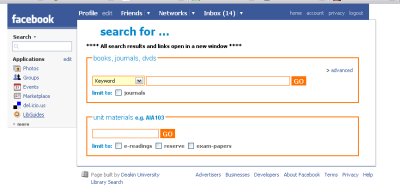
Is Deakin University Library the first Australian University Library to offer a library search box for users to install on their Facebook profile? Looks nice.

deakingfacebook.jpg


Yarra Plenty Regional Libraries have had a Facebook Page for a month or so, and released their search box ap. on December 6th . I had trouble installing it when I tried, but it may have been a temporary bug.

Does anyone know of any other Australian libraries who have Facebook Pages or have written a search box application?


Mechanics, Dynamics, Aesthetics and Iteration

Uncategorized

Come back – it’s not as techie as it sounds…

… just some great ideas I picked up on Sunday night from Robin Hunicke ‘s talk She Got Game at the Byte Me Festival.

Robin Hunicke was lead designer on the MySims game written for the wii console. She spoke about what game designers actually do, a bit about the process of game design, and about her experience with tailoring a game for a platform that hadn’t yet been released.

Lots that she said can be related to libraries.

Mechanics > Dynamics > Aesthetics model

Mechanics are the rules and structure of a game – set by the game designers (eg. in chess there are rules about how to move pieces. In The Sims there are rules about how to keep your Sims happy and productive)

Dynamics are the way people behave due to these rules – determined by the players (eg. in chess players think several moves ahead and sometimes make sacrificial moves. In The Sims, people realised they could make the Sims sick and unhappy and did so).

Aesthetics is the way it feels to play the game (eg. chess becomes a solemn and serious battle of wits. In The Sims the experience becomes to savour and create)

How does it relate to libraries? Well, we set up rules, the mechanics for using our data. (eg. to get to an authenticated journal title, you have to do a title search in the catalogue) . How our users relate to our systems is the dynamics (eg. confusion, attempts to enter an article title not journal title, google it instead ) . The user experience is the aesthetics (eg. success or frustration, incomprehension, defeat ) .

What if we started with the aesthetics – the user experience – then worked backwards to produce the mechanics that gave this? What if we acknowledged the layer of dynamics in the system – ie that users may not follow our rules and that this may produce a different aesthetics ? I think this model can apply to our offline activities as well as our online ones.

Waterfall vs Iterative vs Agile product design/testing

Robin contrasted the traditional “waterfall” model of product design with her preferred iterative product design. Waterfall has linear stages like Imagine > See > Handle >Use . Iterative testing builds in constant revisiting of the stages as the product is created.

It made me think about the decisions we make about any system in our libraries. At what point are we building in retesting, review, checking and re-evaluation? How often do we check the external circumstances and see whether the systems are still relevant? Are we building this into our cycle of product use and procedures?

( When researching this post, I found another more recent model, agile testing )

User created content – balancing the work in the fun.

Game users are changing. They are now more interested in the mechanics of games and in “putting them through their paces” (eg. creating downloadable objects for Sims to use). They are not so tied into a compulsive narrative. They want to co-create.

There is a point, however, when co-creation becomes less like fun and more like work. Robin’s example is the real lilfe co-ordination needed to get together a guild for a World of Warcraft raid at a specific time. Or the constant playing needed to go up a level in a game.

The challenge for game designers is to determine and stop short of that point where the creativity, independence and control of co-creation becomes more of a chore than a pleasure.

As we consider allowing our users to co-create our libraries, we need to consider the work / fun balance too. Will the ability to rate items in the catalogue, for example, seem like too much work for little reward?

Let the students be your voice

During question time, I asked Robin (who also works in academia) the best way to get university staff to take gaming seriously – and to understand that that gaming techniques can be a new form of information delivery and human/PC interface . I liked her answer, that it is best to “let the students be your voice”.

What if I was my own blog ?

Uncategorized

Lovely Dave Pattern wanted to cheer me up for not winning the Edublog award, so very sweetly combined

ImageMagick, 30 minutes of furious Perl coding, a little bit of random font rotation, a suitable JPEG source image, and the RSS feed from Kathryn’s blog

And redrew my twitter profile photo with words from this blog. You can read the words in the large version of the image. Yes, that’s the same Dave who drew me and a bunch of other librarians as book covers in February.

kg_001 Uploaded on December 11, 2007 by Dave & Bry

Thanks Dave. I’m smiling. Widely.

Edublog Awards 2007 winners

Uncategorized

Here’s a list of the winners of the 2007 Edublog Awards. This blog didn’t win in its category, but thanks again to the people who voted.

Interspersed with the award announcements were Dave Cormier‘s list of the Top 10 Educational Stories of 2007 . This was an international list – but number one was an Australian. A sixteen year old Australian, Tom Wood, who cracked the Federal Government’s internet filter within 30 minutes of it being released.

If you want to subscribe to all the winners with just one click, Andy Powell from Eduserv has created an OPML file of 2007 Edublog winners’ feeds .

Best educational use of a virtual world
Suffern middle school in Second Life (Second Life)

Best educational use of a social networking service
Classroom 2.0, Steve Hargadon (Ning)

Best educational wiki
Welker’s Wikinomics, Jason Welker (Wetpaint)

Best educational use of video / visual
RBG Street Scholars Think Tank Multi-Media E-Zine, Marc Imhotep Cray (Blogger)

Best educational use of audio
SMARTBoard Lessons Podcast (WordPress)

Best elearning / corporate education blog
eLearning Technology, Tony Karrer (Blogger)

Best educational tech support blog
El tinglado, Josa Cuerva Moreno

Best librarian / library blog
A Library By Any Other Name, Vaughn Branom (Blogger)

Best teacher blog
The tempered radical, Bill Ferriter (Typepad)

Most influential blog post
Is It Okay To Be A Technologically Illiterate Teacher? – The Fischbowl, Karl Fisch (Blogger)

Best resource sharing blog
TipLine – Gates’ Computer Tips, Jim Gates (Blogger)

Best new blog
dy/dan, Dan Myer (WordPress)

Best group blog
Techlearning blog

Best individual blog
ScienceRoll, Berci Meskó, Hungary (WordPress)

What if this blog was a Second Life avatar ?

Uncategorized

Well… it would look something like LibrariansMatter Bloch , the avatar I just created to attend the 2007 Edublog Awards in Second Life.

She’s seen here looking at the station for Librarians Matter at the pavillion created by Jo Kay, who is hosting the awards on Jokaydia. She’s created 85 stations in a building that is a fantastic example of Second Life architecture – created for ease of access and maximum immersion.

LibrarainsMatter Bloch on Jokaydia

And to think that in February I freaked out about the absurd concept of someone creating a Second Life avatar called something like LibrariansMatter DingDong .

I’ll let you know how the Eddies went (if I don’t sleep in and miss them). If you voted for Librarians Matter, thanks for your support.

Welcome to Draconia, where our laws are impossible to implement.

Uncategorized

Worried about the new Rudd government’s election pledge to ensure all libraries have mandatory internet filtering? Me too.

Let’s hope Kev’s too busy trying to negotiate bringing our combat troops out of Iraq to notice legislation that has been passed in the US House of Representatives. It is not yet L-A-W as it still needs to be passed by the Senate and then the President. It would affect libraries that provide wi-fi for the public.


Loli, loli, lolicon! Uploaded o Flickr on November 10, 2007 by adrimaster

According to House vote on illegal images sweeps in Wi-Fi, Web sites,

This is what the SAFE Act requires: Anyone providing an “electronic communication service” or “remote computing service” to the public who learns about the transmission or storage of information about certain illegal activities or an illegal image must (a) register their name, mailing address, phone number, and fax number with the National Center for Missing and Exploited Children’s “CyberTipline” and (b) “make a report” to the CyberTipline that (c) must include any information about the person or Internet address behind the suspect activity and (d) the illegal images themselves. (By the way, “electronic communications service” and “remote computing service” providers already have some reporting requirements under existing law too.)

The definition of which images qualify as illegal is expansive. It includes obvious child pornography, meaning photographs and videos of children being molested. But it also includes photographs of fully clothed minors in overly “lascivious” poses, and certain obscene visual depictions including a “drawing, cartoon, sculpture, or painting.” (Yes, that covers the subset of anime called hentai).